Giant Bubble Fails to Cool a Hot Heart express
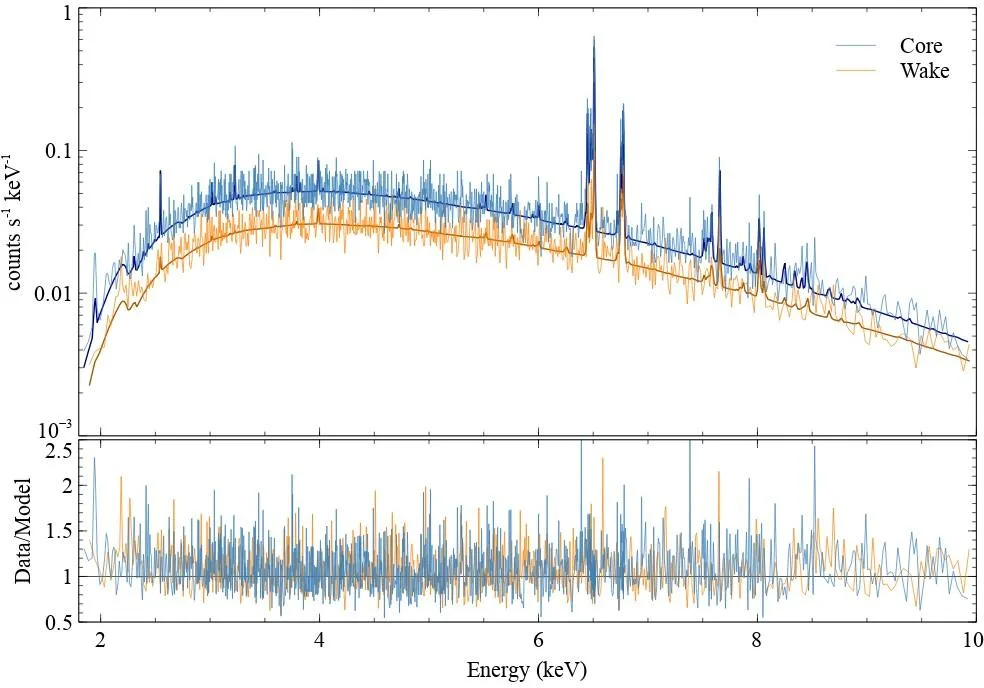
At the heart of the Ophiuchus galaxy cluster floats a bubble of hot plasma the size of several galaxies. It rises like a giant hot-air balloon in the atmosphere, leaving a wake behind it — a region where gas is set in motion. Scientists aimed the Japanese X-ray telescope XRISM at this wake to measure exactly how the gas moves.
It turns out that at the very center of the wake, the gas moves at about 80 kilometers per second relative to the entire cluster. That's not much — roughly the speed of an airplane. Meanwhile, in the wake, the gas has become more turbulent: its velocity dispersion grew from 135 to 210 km/s. But even such turbulence releases too little heat — three times less than needed to compensate for the cooling of the gas in the core.
This discovery changes our understanding of how black holes influence their galaxies. Previously, it was thought that such bubbles, as they rise, stir the gas and prevent it from cooling quickly, like a spoon stirring cooling soup. But in Ophiuchus, the spoon turned out to be too small and too slow: the soup still cools, and the gas in the cluster's center continues to contract, possibly giving birth to new stars.
The black hole at the cluster's center releases energy, but it's not enough to 'heat up' the entire core. The turbulence generated by the bubble dissipates too quickly and doesn't have time to spread throughout the volume. Perhaps in other clusters things are different: there, the bubbles are smaller but numerous, and they act together. Here, a single giant turned out to be an inefficient 'heater'.
Original abstract
as written by the authors arXiv:2604.14292
We present a 100 ks XRISM Resolve observation of the Ophiuchus cluster that measures turbulence and bulk motion in the wake of the largest radio bubble on the sky. We detect a significant velocity shift of $$-80\pm20$$ km/s from the cluster centre to the bubble's wake and a clear increase in velocity dispersion from $$135\pm10$$ km/s to $$210\pm20$$ km/s. The measured bulk velocity in the wake is low and suggests that the bubble's trajectory is inclined with respect to the line of sight. If we subdivide the bubble's wake, fitting spectra simultaneously with cross-region responses, we find that the velocity shift and dispersion increase are primarily detected in the very centre of the wake. This is consistent with the expected updraft, or `splash', found beneath buoyantly rising radio bubbles. In the cluster's cool core, the turbulent kinetic energy is only 1% of the thermal energy radiated over a cooling timescale of 7 Gyr, and even falls short, by a factor of 5, of the thermal energy radiated over the bubble's rise time. Whilst turbulent energy generated in the large wake region may provide additional heating, this propagates too slowly to prevent rapid cooling across the core. The turbulent-dissipation heating rate is a factor of ~3 below the cooling luminosity. Despite the vast power of the giant radio bubble in the Ophiuchus cluster, the gas motions in the wake are remarkably modest and turbulent-dissipation appears unable to prevent rapid cooling.
The gas speed in the bubble's wake is about 80 km/s. That's 200 times faster than the fastest maglev train, but 4000 times slower than the speed of light.
In Stanislaw Lem's novel 'Solaris', the planet's ocean spawns giant structures that seem alive. Plasma bubbles in galaxy clusters also look like giant 'bubbles' rising through gas, and their behavior still surprises astronomers.