Layers Change the Material's Character express
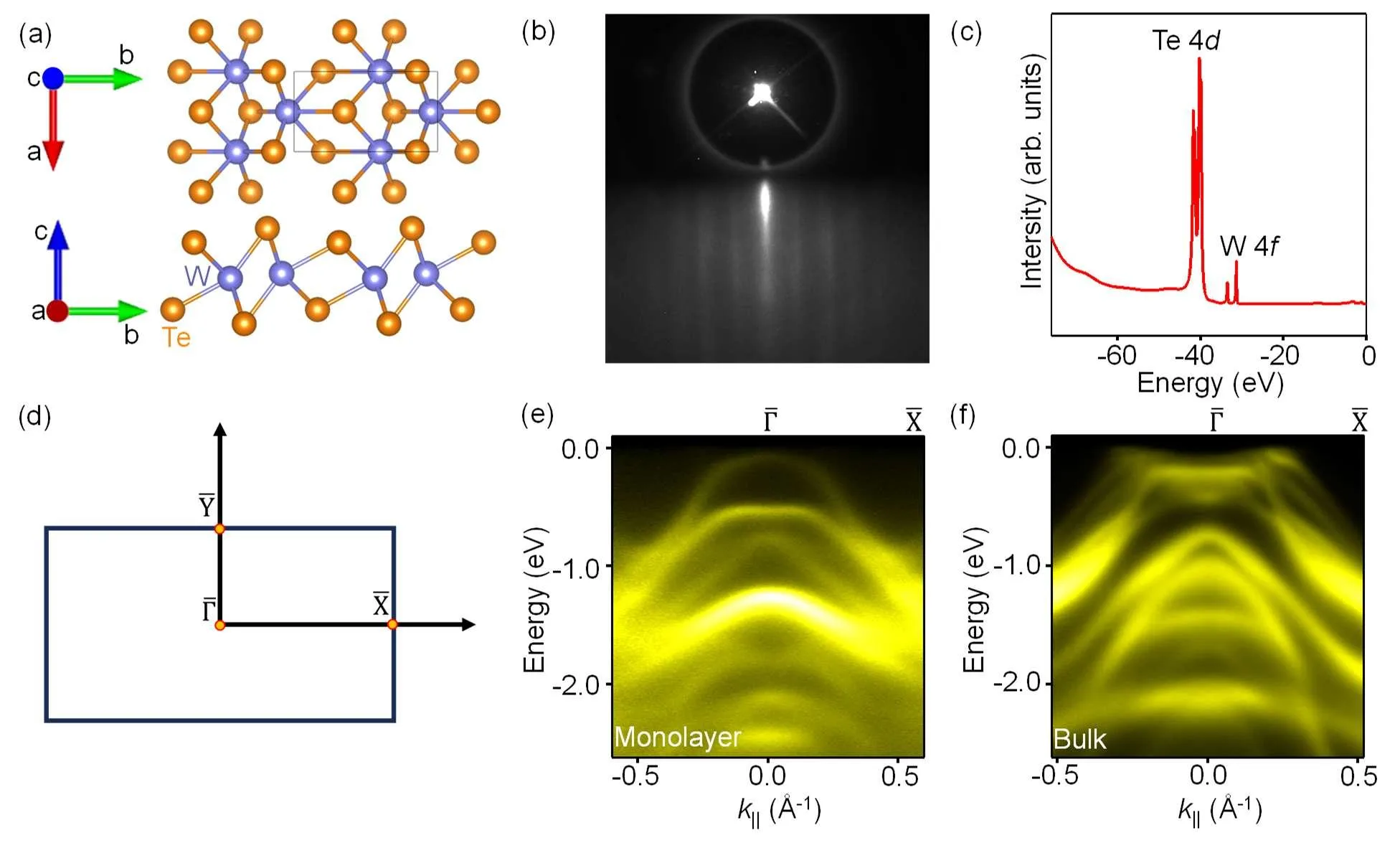
A single-atom-thick sheet of tungsten telluride is like thin foil: electrons can't pass through because there's a band gap between their possible states, like a moat you can't jump across. Add two more layers, and the moat disappears; the material becomes a metal, and current flows. Add more layers, and the properties change again, as if someone is flipping modes with a single button.
The researchers mapped the electronic structure using photoemission: light knocked electrons out of the sample, and their velocities revealed which states were occupied. It turned out that going from one layer to three collapses the band gap, and as thickness grows further, the electronic bands converge and diverge like breathing. Calculations showed that the topological index, a number indicating whether the material has special conducting channels at its edges, jumps between 0 and 1 with each new layer.
When the conduction and valence bands touch at a single point, the material becomes a Weyl semimetal: electrons move as if they were massless and split into left- and right-handed pairs, like gloves. This behavior is described by the Chern number, which shows how many "vortices" are in the electronic structure. The thicker the crystal, the more complex the pattern of these vortices.
It's like tuning a musical instrument: each new string-layer changes not just the volume but the very timbre. Engineers building electronics from layered materials get not just an on/off switch but a whole range of states — from insulator to semimetal with massless electrons.
Original abstract
as written by the authors arXiv:2604.16860
Topological materials ranging from topological insulators to semimetals host many novel quantum phenomena including quantum spin Hall effect and topological Fermi arcs. Transitions between these topological phases have attracted much research interest. We performed angle-resolved photoemission spectroscopy (ARPES) on WTe2 ranging from a monolayer to the bulk and reveal the evolution of the electronic structure and the band gap. Notably, the gap observed in the monolayer system is suppressed in the three layers, where the film becomes metallic. Variations in the topological properties with thickness are demonstrated by the first-principles calculations. Topological Z2 invariant is shown to oscillate between 1 and 0 with the addition of layers, originating from the interlayer coupling-induced change in band crossing. The system evolves into a Weyl semimetal when the conduction and valence bands touch near the Fermi level and the topological nature is described by the Chern number. Our findings demonstrate the non-monotonic dependence of topological states on dimensionality and how layer-driven electronic band reconfiguration leads to phase transitions in solids.
Tungsten telluride as a single layer is an insulator, but as three layers it's a metal. Add two atomic layers, and current flows.