Moiré patterns arise when two periodic structures are superimposed with a slight twist or mismatch, creating a new, larger-scale pattern. In physics, these patterns can dramatically alter the electronic, optical, and acoustic properties of materials. For example, twisting two layers of graphene at a 'magic angle' can turn it into a superconductor, and similar effects can trap sound waves or create topological defects like skyrmions.
History
Moiré patterns have been known in optics for centuries, but their application to condensed matter physics exploded after 2018, when Pablo Jarillo-Herrero's group at MIT demonstrated superconductivity in twisted bilayer graphene. The concept of topological defects like skyrmions in moiré systems is even more recent, emerging in the 2020s.
How it works
When two lattices are twisted, the local atomic alignment varies periodically, creating regions of different electronic or mechanical properties. This periodic variation acts as a superlattice potential, which can flatten electronic bands and enhance electron-electron interactions, leading to correlated states like superconductivity. For sound or light, the moiré pattern can create band gaps or waveguides, trapping waves in specific regions.
In practice
Moiré engineering is used to design novel quantum materials with tunable properties, potentially leading to new types of transistors, superconducting devices, and quantum computers.
Fun fact
The 'magic angle' for twisted bilayer graphene is approximately 1.1 degrees, and even a tiny deviation of 0.1 degrees destroys the superconducting state.
Two transparent sheets with circles drawn on them. If you stack them exactly, the circles align. But give one sheet a slight twist, and a new pattern emerges: in some places the circles bunch together, in others they spread apart. That's roughly how moiré works — an unexpected pattern born from rotating two periodic structures.
Graphene, a two-dimensional carbon crystal, has long tantalized physicists with the hope of high-temperature superconductivity. Its electrons obey the relativistic equation of Paul Dirac, racing at tremendous speed, barely noticing each other.
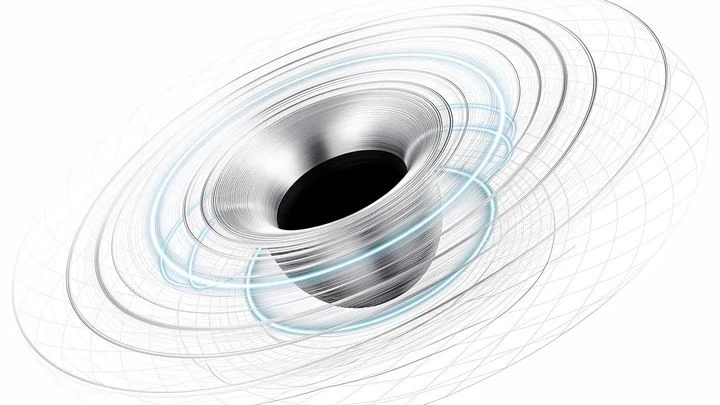
Imagine a river at a rapid: the current accelerates until no wave can go against the flow. So it is with gas near a black hole: reaching the speed of sound, it locks itself in — an acoustic black hole is born, a twin of the gravitational abyss. Here the event horizon is woven from a flow faster than its own sound.
A switch that knows which way to let current flow. That's how a Josephson diode works — a superconducting bridge where current goes willingly in one direction but meets resistance in the other. In the new study, such a bridge was made from graphene — a sheet of carbon just one atom thick.
A single-atom-thick sheet of tungsten telluride is like thin foil: electrons can't pass through because there's a band gap between their possible states, like a moat you can't jump across. Add two more layers, and the moat disappears; the material becomes a metal, and current flows. Add more layers, and the properties change again, as if someone is flipping modes with a single button.
A sheet of graphene one atom thick is like a perfectly smooth tablecloth on which electron marbles roll. Place an electric barrier in their path, and usually they'll bounce back. But in graphene, it's different: under certain conditions, electrons pass through the barrier without even noticing it, as if the wall were made of mist.
Two layers of a magnetic material, rotated relative to each other by fractions of a degree, like two slightly offset screens on a window. In their normal state, they don't produce anything special, but at a certain twist angle, an unexpected effect emerges.
According to theories beyond the Standard Model, our best description of elementary particles and their interactions, pairs of magnetic monopoles were born in the first instants after the Big Bang. These hypothetical particles carry only one magnetic pole—'north' or 'south'—unlike familiar magnets where poles are inseparable.
An ordinary superconductor loses resistance when cooled, and current flows through it without loss. But in ultrathin films, things are different: the material fluctuates between normal and superconducting states, and in this transition zone, strange resistance waves emerge. Resistance rises and falls as if someone were turning a volume knob.
A spider web is not just a sticky net but a delicate instrument that responds to the weather. When the air becomes humid, spider silk threads shorten and twist, like a wet towel being wrung from both ends. Previously, it was thought that the thread twists because the proteins inside are arranged in a spiral. But no direct evidence for such an arrangement was found.
Quantum particles in a strongly disordered environment behave like dancers executing steps in sync: each knows its own move and never collides with others. This kind of coordinated, frictionless flow, superfluidity, unexpectedly emerged in an experiment on a superconducting quantum chip.
Run a current through a contact between a superconductor and a ferromagnet, and you will hear the whisper of the quantum world. In the lab at 0.3 K, that whisper turned into a roar: the shot noise—electrical noise due to the discreteness of charge—was a hundred times louder than theory allows for ordinary contacts.