Body Heat as a Clue: A Quantum Look at Breast Cancer express
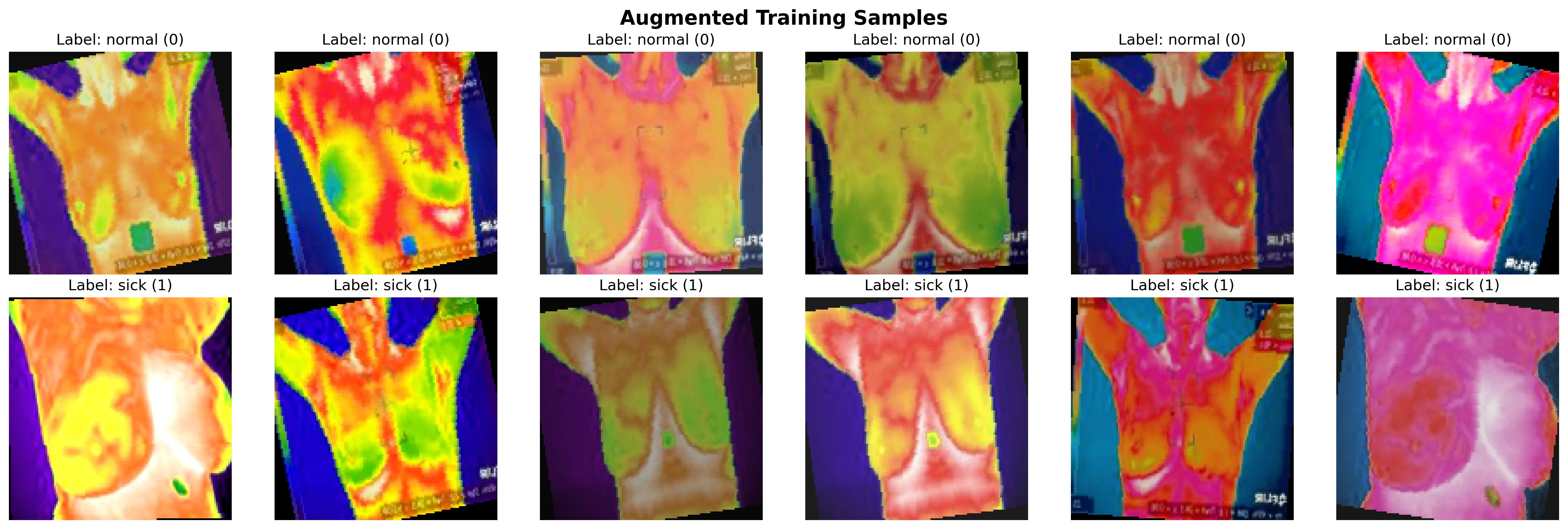
The hot air above asphalt shimmers, betraying the heated surface. Medical thermography works in a similar way: the skin over a tumor is often slightly warmer than healthy skin — by just fractions of a degree. Computer programs try to catch this difference and determine whether it's dangerous. But regular neural networks don't always manage, because the thermal patterns are too subtle and intricate.
The new approach adds a quantum block to the familiar neural network — something like an extra layer of perception. This block is built on four quantum bits (qubits) that can exist in mixed states, like a coin that is both heads and tails at once. This "fuzziness" helps extract hidden connections in the thermal pattern. An attention mechanism connects the quantum and classical parts: it decides which details of the image deserve a closer look and which can be skipped.
On breast images, the hybrid system learned faster and found warning signs more accurately than the best classical counterparts. The secret lies in the special organization of the quantum layers: they are strongly entangled, so a change in one qubit instantly echoes in the others. This is like an orchestra where musicians don't play separately but listen to each other — then even a quiet flute note changes the whole harmony.
The main takeaway is not just another algorithm, but a working recipe for combining quantum and classical computing for medicine. When full-fledged quantum processors become available, such hybrids could run right in the hospital and help a doctor assess an image in seconds. The heat we don't even feel could become a reliable signal — if we read it correctly.
Original abstract
as written by the authors arXiv:2604.16953
Breast cancer diagnosis through thermographic image analysis remains a critical challenge in medical AI, with classical deep learning approaches facing limitations in complex thermal pattern classification tasks. This paper presents a novel Hybrid Quantum Neural Network (HQNN) architecture that integrates quantum computing principles with classical convolutional neural networks for enhanced breast cancer classification. Our approach employs parameterized quantum circuits with multi-head attention mechanisms for quantum-aware feature encoding, coupled with classical convolutional layers for comprehensive pattern recognition. The quantum component utilizes a 4qubit variational circuit with strongly entangling layers, while the classical component incorporates advanced attention mechanisms for feature fusion. Experimental validation on breast cancer thermographic data demonstrates substantial performance improvements over state-of-the-art classical architectures, with the quantum-enhanced approach exhibiting superior convergence dynamics and enhanced feature representation capabilities. Our findings provide evidence for quantum advantage in medical image classification through classical simulation, establishing a framework for quantum-classical hybrid systems in healthcare applications. The methodology addresses key challenges in quantum machine learning deployment while maintaining computational feasibility on near-term quantum devices.
The temperature difference between healthy tissue and a tumor can be as small as 0.1 °C — less than the fluctuations caused by a draft in a room.