A Stellar Cocoon for the Little Red Dots express
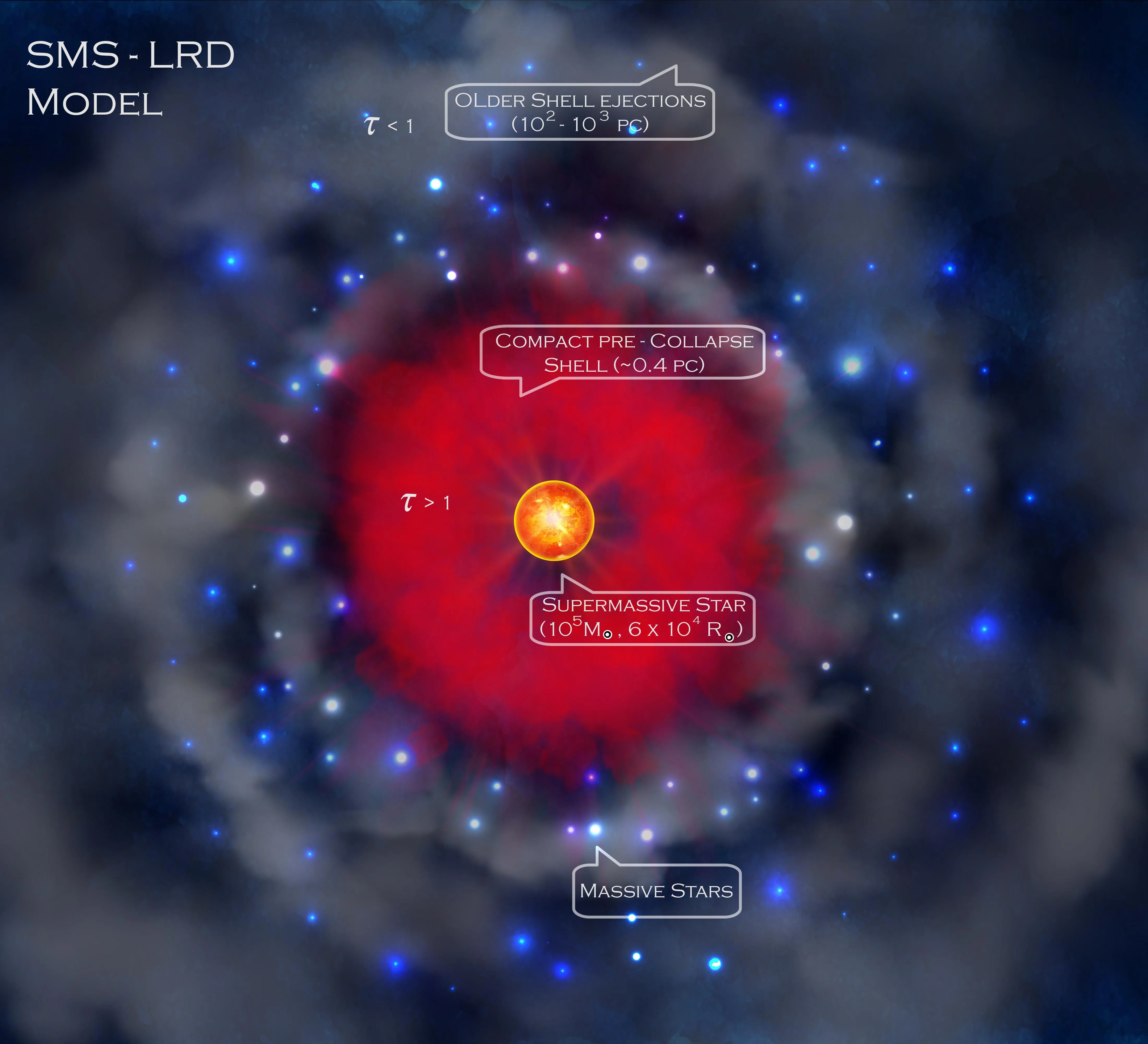
A star weighing a hundred thousand Suns lives bright and brief. Its finale is a rapid collapse into a black hole. But just before the end, it manages to wrap itself in a dense gas cocoon. It is precisely such cocoons that the James Webb Space Telescope discerns around enigmatic objects — the "little red dots."
Astronomers took five models of supermassive stars with different compositions and traced their lives step by step. It turned out that a star loses mass not in a steady stream but in sharp bursts, like a steam boiler that periodically releases jets of vapor. In one model, the closest to early Universe conditions, there were four such episodes. Each lasted from forty to three hundred years and ejected from ten to three hundred fifty solar masses of gas.
This gas cocoon is composed mostly of hydrogen and helium, but with a chemical quirk: it has unusually high nitrogen compared to oxygen. This signature will help distinguish this mechanism from others. After shedding the shell, the star itself lives for about another million years, then collapses into a black hole within hours — a ready-made "seed" for future giants at the centers of galaxies.
Original abstract
as written by the authors arXiv:2604.19988
Little Red Dots (LRDs) have emerged as one of the central puzzles of the JWST era. Their spectra increasingly require dense gas close to the source, yet the physical origin of that cocoon-like structure remains unclear. We examine whether late pulsational mass loss from supermassive stars (SMS)leads to dense gas cocoons. We analyze five accreting GENEC models at different metallicities with characteristic masses of order $$10^5\,M_\odot$$, following them through post-accretion evolution with radial pulsation calculations and general relativistic (GR) stability diagnostics. Mass loss during the final stages of evolution occurs not as a steady wind, but through discrete strange-mode ejection episodes. In the $$Z=10^{-2}\,Z_\odot$$ model, which provides the clearest LRD analogue, four late episodes last $$41$$--$$282$$ yr and eject $$10$$--$$348\,M_\odot$$ each, for a total loss of $$(4.8-10)\times10^2\,M_\odot$$; the final episode alone contributes $$\simeq 73\%$$ of that budget. Since the last episode dominates the mass-loss, it is the only event sufficiently massive enough to leave behind a compact, optically thick shell extending out to 0.4 pc that reproduces the LRD dense gas cocoon. The final ejecta are H/He dominated but chemically distinctive, with a robust nitrogen-rich composition, $$\log(\mathrm{N/O})\simeq0.13$$ and $$\log(\mathrm{C/O})\simeq-0.23$$. The SMS reaches GR instability at an age of $$\sim 1$$ Myr and collapses in $$\sim10^4$$ s, retaining $$\sim 99\%$$ all of its mass. Across the full metallicity range from Pop III to $$10^{-2}\,Z_\odot$$, this shell-ejection channel persists. Pulsational mass-loss from SMSs therefore provides a physically motivated origin for the compact cocoon-like structure implied by LRDs, while remaining the natural progenitors of the massive black hole seeds invoked in direct collapse scenario.
The final gas ejection from a supermassive star lasts less than three hundred years — by cosmic standards, that's shorter than a blink of an eye.
In Arthur C. Clarke's novel Rendezvous with Rama, humanity encounters a giant alien spacecraft resembling a dense cocoon — what is that if not a little red dot that has passed through the crucible of stellar evolution?