How to Purge the Magnetic Trail of Gravitational Waves express
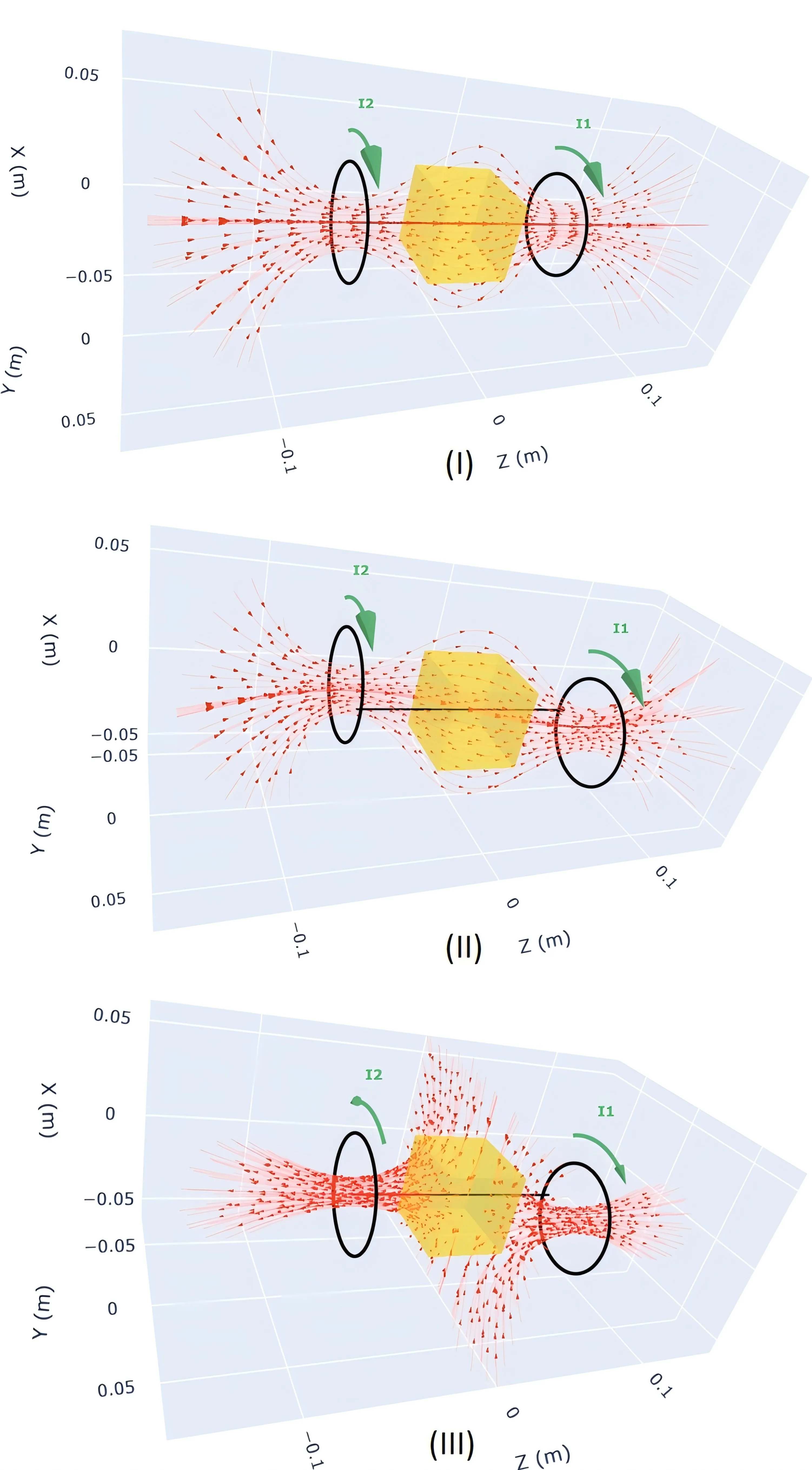
Three satellites will drift apart in the heliocentric void, forming a triangle with sides of three million kilometers. This is the future Taiji observatory, aimed at millihertz gravitational waves — ripples in spacetime from mergers of supermassive black holes and other colossal events. Inside each spacecraft floats a test mass — a tiny cube of gold-platinum alloy that should move only under gravity, like a dust mote in a beam of light. But any breath of magnetic field can nudge that cube, mimicking a false signal.
The magnetic "memory" of the test mass — its residual magnetic moment and volume susceptibility — must be known before launch with unprecedented precision. On Earth, these parameters are measured with torsion balances: a cube suspended by a fine fiber twists under weak magnetic fields, and its jitter reveals magnetic properties. However, the real noise of the lab setup at the Changchun Institute of Optics and Fine Mechanics behaves like a capricious ocean — its waves shift in color and height, confounding classical methods like least squares or Kalman filtering. An ordinary estimator here is like a sailor navigating by the stars on a cloudy night: it systematically errs, mistaking noise for signal.
To sidestep this trap, the authors devised a hybrid method, AI-WLS. A neural network with dilated one-dimensional convolutions acts as a smart observer, learning to tell murky noise spikes from the clean magnetic response. It doesn't just discard "dirty" data segments but weights each fragment by its reliability, like a seasoned taster separating the barrel's tang from the wine's true bouquet. In parallel, an accurate physical model works — it knows exactly how magnetic parameters should translate into torque, and this link stays crystal clear at every stage of the calculation.
This symbiosis of artificial intelligence and physical insight brings us back to that cosmic triangle. Now that the magnetic cleanliness of the test masses is confirmed with earthly meticulousness, Taiji's future flight can listen to the gravitational whisper of the universe without fear of being drowned out by a magnetic draft.
The residual magnetic moment of Taiji's test mass is roughly a million times weaker than that of a typical fridge magnet, yet even such a minuscule amount can shift the cube by fractions of a picometer — enough to mask a gravitational wave.