The Conductor with a False Note: Why Quintessence Couldn't Save Inflation ✛ ✎ ✦
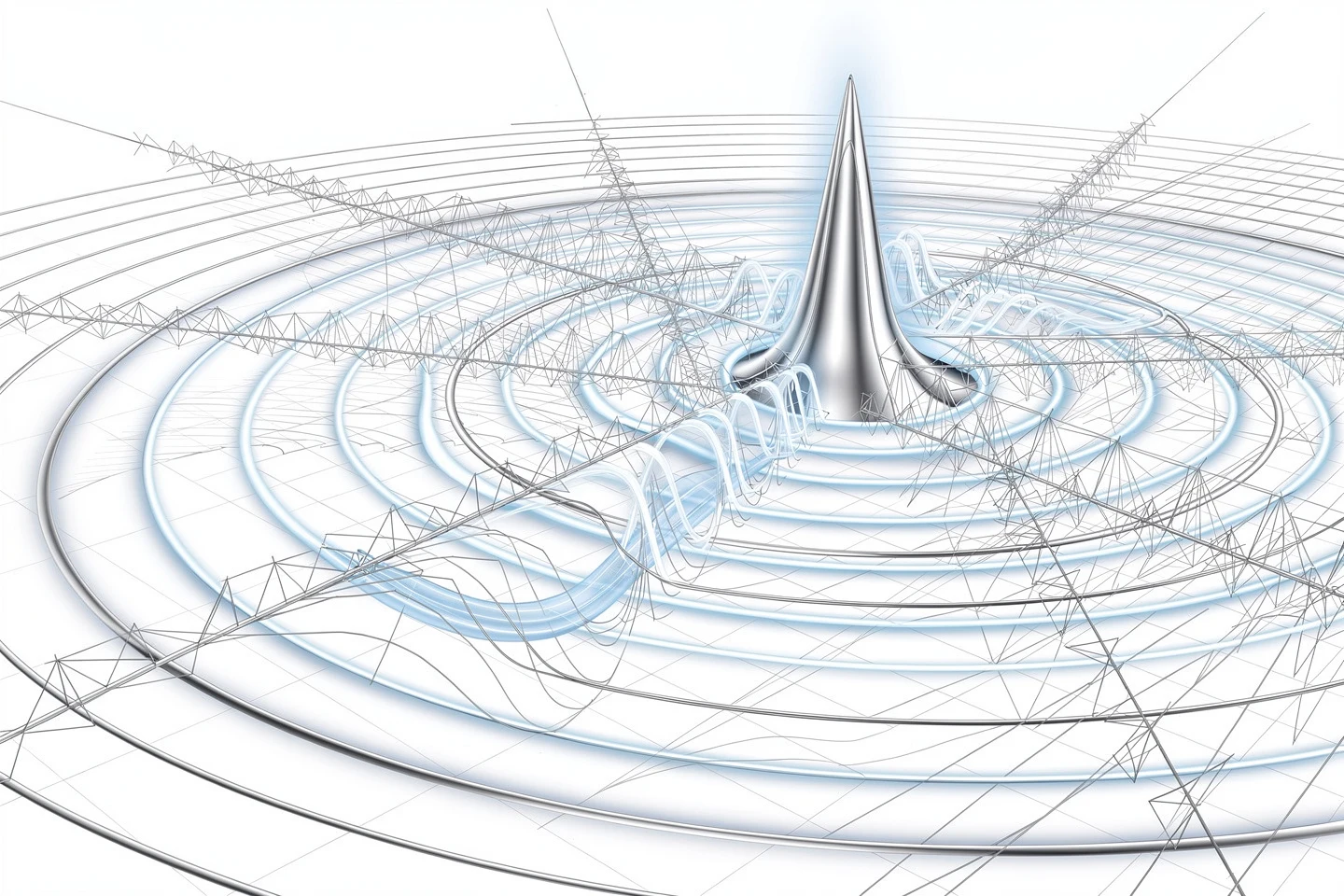
The Universe performs a symphony in two contrasting tempos. The first explosive accelerando (inflation, conceived by Alan Guth) sent spacetime soaring in the first trillionth of a second. The second acceleration, slow but relentless, began five billion years ago. Its score is dark energy, discovered through supernovae by teams that included the brilliant Adam Riess. A tantalizing idea is to assign both themes to one musician, a scalar field conductor whose potential smoothly shifts from turbulent youth to fading maturity. Such a unified explanation of the universe's expansion seemed the height of elegance. But the latest analysis, incorporating data from DESI, Planck, ACT and Pantheon+, has heard a false note in the score, so loud it drowns out the main melody.
The quintessential inflation model based on α-attractors forces the conductor field to strike a furious crescendo right after inflation. This phase, called kination, is a moment when the field's kinetic energy dominates and the potential temporarily falls silent. The abrupt braking of inflationary stretching births high-frequency gravitational waves, like a piercing blow on the strings of spacetime. Unlike the soft hum of the low-frequency cosmic microwave background, here the spectrum soars to a peak at frequencies around 10¹⁰ Hz, where wavelengths are comparable to an atomic nucleus. Astrophysicists compute the contribution of these waves through the parameter ∆$N_{eff}$: it recasts their energy into extra neutrino species, which affect primordial nucleosynthesis and the CMB pattern. A shift of just a few hundredths in this parameter would alter the helium fraction, and we would live in a chemically different universe.
And then the performance falls apart. The ACT and Planck detectors have precisely measured the spectral index of primordial perturbations — the very "timbre" of the sound. In the simple α-model, it is tied to the duration of inflation: $n_s$ ≈ 1 — 2/N_*. To avoid overheating the early universe with gravitational waves, inflation must be short, which gives $n_s$ ≈ 0.966—noticeably lower than the measured 0.975. Tension mounts. Numerical calculations, varying all parameters and tracking the field from inflation to the present, deliver the verdict: the logarithm of the Bayes factor, ln B = –12.47, favors the standard ΛCDM. The attempt to play two themes with one hand has failed — at least for this minimalist scenario. But in its place, a superb atlas of the gravitational wave spectrum has been born, predicted with such detail that future experiments can settle the matter.
What next? Quintessential inflation does not exit the stage without a trace. Its predictive spectrum, from a flat plateau to a steep ridge, provides a clear target for telescopes hunting for B-mode polarization, like LiteBIRD, and for future space-based interferometers such as Ultimate DECIGO, whose ideological forerunner can be seen in the pioneering work of Joseph Weber. If no signal is detected at frequencies of 10⁹–10¹¹ Hz, we will have to complicate the score: introduce additional fields, non-gravitational coupling, or even abandon the solo conductor altogether. In any case, the union of cosmology and gravitational-wave astronomy turns the Universe into a giant instrument whose tuning we are only beginning to check. And today's false note is not a failure, but the discovery of a new sound that leads to truth.
Gravitational waves from the kination epoch are an 'echo' of inflation's sudden braking. Their frequency is so high that the peak wavelength rivals an atomic nucleus, and the peak energy is like bringing the entire primordial ocean to a boil.
It recalls the plot of Isaac Asimov's novel "The Gods Themselves," where matter exchange between universes with different physics determines the fate of both worlds. Here there is no exchange, but the chameleon field still conducts the symphony of expansion — albeit with a false note.