Quantum Bounce: A Black Hole Turns into a White One ✛ ✎ ✦
Original: "Relational quantum dynamics of the black hole interior: singularity resolution and quantum bounce"
Inside a black hole, space doesn't collapse into a point; it compresses like a spring and bounces back, giving birth to a white hole.
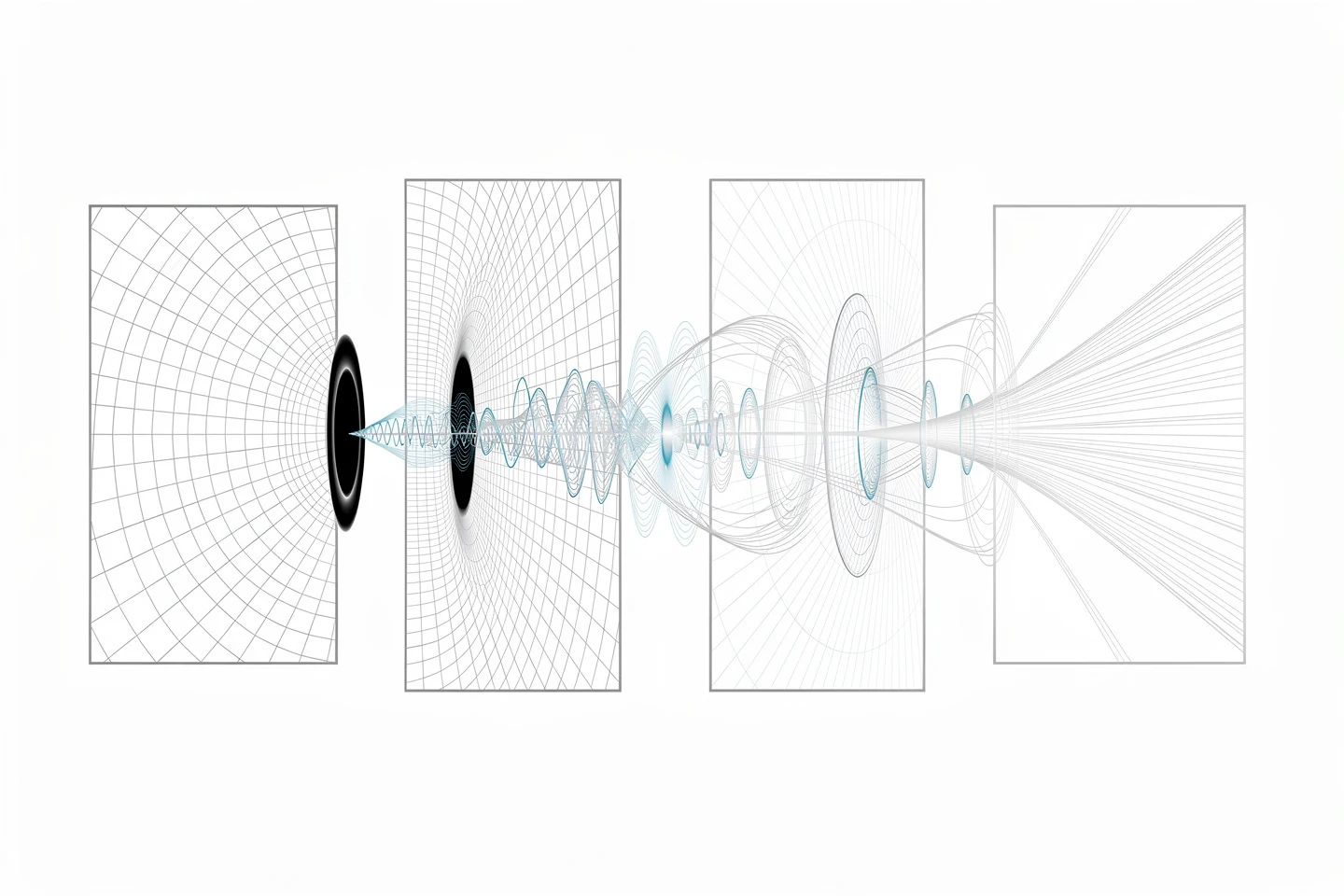
A black hole is a cosmic trap: its gravity won't let even light escape. Classical theorems by Penrose say that at the center a singularity forms — a point of infinite density where physics breaks down.
But quantum mechanics abhors infinities. Using the idea of relative time by Dirac and uncertainty by Heisenberg, physicists have shown: inside the hole, a spatial coordinate takes on the role of a clock. Under the influence of quantum entanglement, it cannot shrink to zero — space behaves like a compressed spring: it bounces and starts expanding.
Measurements confirm: the area inside drops to a minimum, then grows. Curvature doesn't shoot to infinity. Thus, a black hole turns into a white one — a region from which everything is ejected. Quantum information isn't destroyed; it resurfaces in another universe.
In the quantum model, one of the spatial axes inside the hole becomes a clock: it doesn't collapse to a point but springs back, like a released coil.
It’s reminiscent of 'Interstellar': a black hole as a portal, but without a wormhole — just a quantum bounce.
A_{\min} = 4\pi (\Delta a)^2
A min — minimum area, Δa — quantum uncertainty in size. The greater the fuzziness, the larger the minimum volume.
Scientists
Stephen HawkingJacob BekensteinRoger PenroseJohn Archibald WheelerJohn Stewart BellFritz Zwickyschwarzschild metric
schwarzschild black hole
Hilbert space
kerr black hole
hamiltonian
kerr metric
horizon area
wald entropy
quantum bounce
logarithmic correction
Wheeler-DeWitt equation
time evolution
Hawking area theorem
Schrödinger equation
classical gravity
inner horizon
quantum corrections
flat space
charge to mass ratio
relativity