Quantum Bounce Inside a Black Hole: How Relational Dynamics Removes the Singularity ✛ ✎ ✦
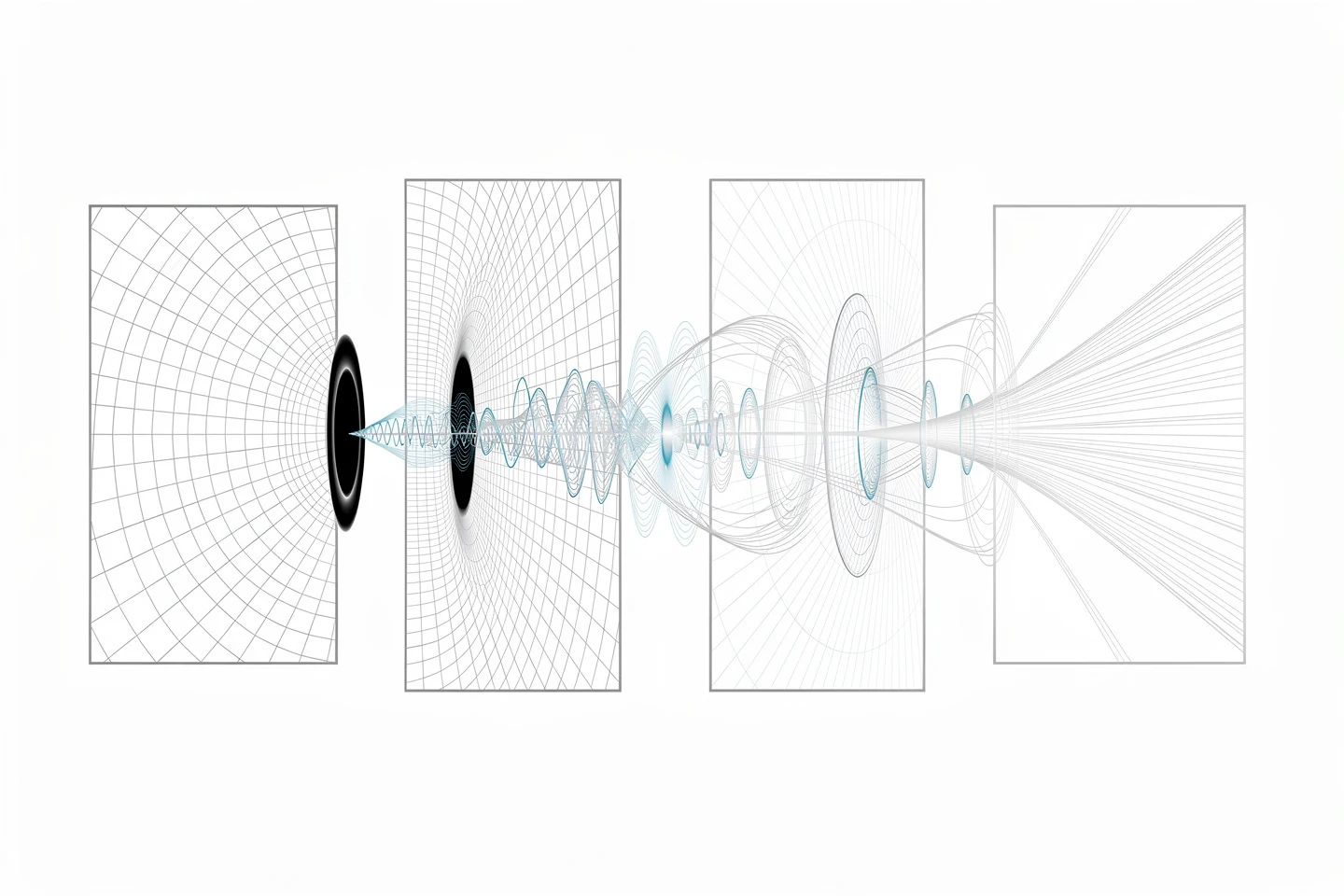
Context
The problem of singularities in black holes remains one of the major unsolved challenges in gravity. Classical general relativity predicts that the collapse of massive stars leads to points of infinite spacetime curvature, where Einstein’s equations break down. The theorems of Penrose and Hawking prove the inevitability of such singularities under very general conditions. However, a quantum theory of gravity is expected to smooth out these infinities. The difficulty is that time in quantum gravity is not given externally—it must emerge from correlations between subsystems, as in the relational approach of Dirac. Instead of an external time parameter, an internal relational time is used, defined by the evolution of one of the degrees of freedom. This work applies, for the first time, a fully relational quantization method to the interior of a Schwarzschild black hole, where one variable serves as a 'clock' for the others.
Methods
To describe the interior region, the Kantowski–Sachs model is used—a homogeneous cosmological metric with two dynamical variables: a (the radius of 2-spheres) and b (the transverse coordinate). After redefining the lapse, the Hamiltonian constraint takes the form H = $p_b$ + const/$p_a$, which allows the system to be split into a 'clock' (variable b with Hamiltonian $H_C$ = $p_b$) and a 'system' (variable a). Quantum clocks are built using covariant positive operator-valued measures (POVMs), which generalize ordinary projective measurements, thus circumventing the limitations of Pauli’s theorem. Formally, the evolution is described through conditional quantum states, obtained by projecting the global vector onto the clock readings. The physical Hilbert space is constructed via the refined algebraic quantization (RAQ) method, using 'group averaging' to build gauge-invariant observables (the area of 2-spheres, the Kretschmann scalar, the expansion scalar of null geodesics). The system states are rapidly decaying as $p_a$ → 0, ensuring the monotonicity of the clock and excluding 'frozen' configurations.
Results
The expectation value of the sphere area A(τ) as a function of the relational time τ has a parabolic form A(τ) = $A_{min}$ + βτ², where $A_{min}$ = 4π (Δa)² > 0 is proportional to the square of the quantum uncertainty of the radius a, established by Werner Heisenberg. The area never goes to zero—the classical singularity (A=0) is unattainable. The Kretschmann scalar is bounded everywhere by a finite parabola in τ, and the expansion scalar of null geodesics remains finite for any τ. At the point τ=0 (the classical location of the singularity), the expansion scalar is exactly zero and changes sign from negative to positive, corresponding to a transition from the trapped region of a black hole to the anti-trapped region of a white hole. Asymptotically, as τ → ±∞, the expansion scalar tends to zero. These results are confirmed numerically for Gaussian states and analytically for arbitrary real states.
Implications
Quantum effects—relationality, entanglement between the clock and the system, and the uncertainty principle—self-consistently remove the singularity without exotic matter or modifications of dynamics at Planck scales. The structure of the physical Hilbert space automatically cuts off singular configurations: allowed states must rapidly vanish at zero clock momentum. This points to a deep connection between quantum mechanics and the large-scale structure of spacetime.
Future development
Further steps include adding matter fields, studying Hawking evaporation in the relational picture, and generalizing to rotating black holes (Kerr) and cosmological singularities. It is important to check the stability of the bounce taking into account the backreaction of radiation and in realistic collapse scenarios.
Impact
The results will impact research in quantum gravity, the astrophysics of black holes, and the foundations of quantum mechanics. The proposed method of constructing gauge-invariant observables will find applications in other fully constrained systems.
Next steps
The immediate task is to apply the formalism to the collapse of dust clouds with matter, in order to uncover possible observational signatures in gravitational waves or cosmic rays.
Key open problems
The study is directly linked to the problem of time in quantum gravity and the resolution of singularities. The use of POVM clocks and relational observables offers a concrete path to background-independent dynamics. This also sheds light on the black hole information paradox, as the bounce could provide a way for information to escape.
The knowledge machine's view
This section is addressed to the author of the paper and their colleagues. Neighbouring works were found by meaning-based search across our archive, not by word overlap. We do not review: we show the field around the work.
What the work does
This work constructs a quantum model of the interior of a Schwarzschild black hole within the framework of relational dynamics, using one of the variables as a clock. By applying POVM quantization and the RAQ method, the authors show that the expected value of the area of the 2-sphere never vanishes, and both the Kretschmann scalar and the expansion scalar remain finite. Moreover, at the classical singularity, the expansion changes sign from negative to positive, indicating a bounce.
Where its strength is
The strong point is the fully relational scheme, where time is not introduced from the outside but emerges from correlations, allowing one to bypass the frozen-time problem and obtain explicit bounce dynamics with finite geometric invariants.
Where it could go next
- It might be interesting to compare the obtained bounce with models of regular black holes without singularities, as considered in a neighboring paper.based on: Black Holes Without Singularities: A New Approach arXiv:2607.07790
- Nearby is a study on the stability of horizonless objects such as gravastars; perhaps your approach could test whether the bounce survives perturbations similar to those that destroy gravastars.based on: A Black Hole with No Bottom: Why Gravastars Can't Hold Up arXiv:2607.18764
- Another direction is to study how the proposed relational dynamics affects gravitational wave emission near the horizon, in the spirit of the analysis carried out in another arXiv paper.based on: Gravitational Waves at the Horizon: Silence Instead of an Explosion arXiv:2607.21066
Worth trying
- Try applying the POVM clock method to other homogeneous models, such as dust collapse, to test the universality of the bounce.
- Estimate how quantum corrections to the sphere area affect the quasinormal mode spectrum of a black hole, using the technique from the paper on 'ringing' after a perturbation.
- Consider linking the minimal area to quantum uncertainty parameters and compare with observational constraints, as in the work on bottomless black holes.
Why this may matter
If the relational approach indeed eliminates the singularity, it could provide a new tool for constructing a consistent quantum theory of gravity, where time and geometry emerge from quantum correlations, and pave the way for testable predictions about the fate of collapsing objects.
Nearby works in our archive
- Black Holes Without Singularities: A New Approachsimilarity 0.69
- A Black Hole with No Bottom: Why Gravastars Can't Hold Upsimilarity 0.68
- Black Holes Don't Like Being Squeezedsimilarity 0.67
- Gravitational Waves at the Horizon: Silence Instead of an Explosionsimilarity 0.67
- A Quantum Twist at the Heart of a Black Holesimilarity 0.67
- How Black Holes Ring After a Strikesimilarity 0.66
The closest work in the archive sits at 0.69 by meaning — the usual level for our corpus.
The role of quantum clocks in the model is played by one of the spatial coordinates inside the black hole: time 'flows' from the horizon to the center, and the variable b, which resembles the radius of a cylinder, takes on the role of time. Classically, this coordinate shrinks into a singularity, but in the quantum version, it undergoes a bounce.
The idea of a black hole transitioning into a white hole is reminiscent of the concept of a 'tunnel' between universes from Stanisław Lem’s novel 'Fiasco' and the film 'Interstellar,' but here there is no wormhole: there is a quantum bounce of the entire spacetime.
Key numbers
- Planck area: ≈2.6×10⁻⁷⁰ m²
- Minimum area (at σ ~ p_P): ≈ 4πℓ_P²
- Expansion scalar at the bounce: ϑ(τ=0) = 0
- Quantum radius spread: Δa ~ ℏ/σ