Improvisation beneath the horizon: quantum bounce turns a black hole into a white hole ✛ ✎ ✦
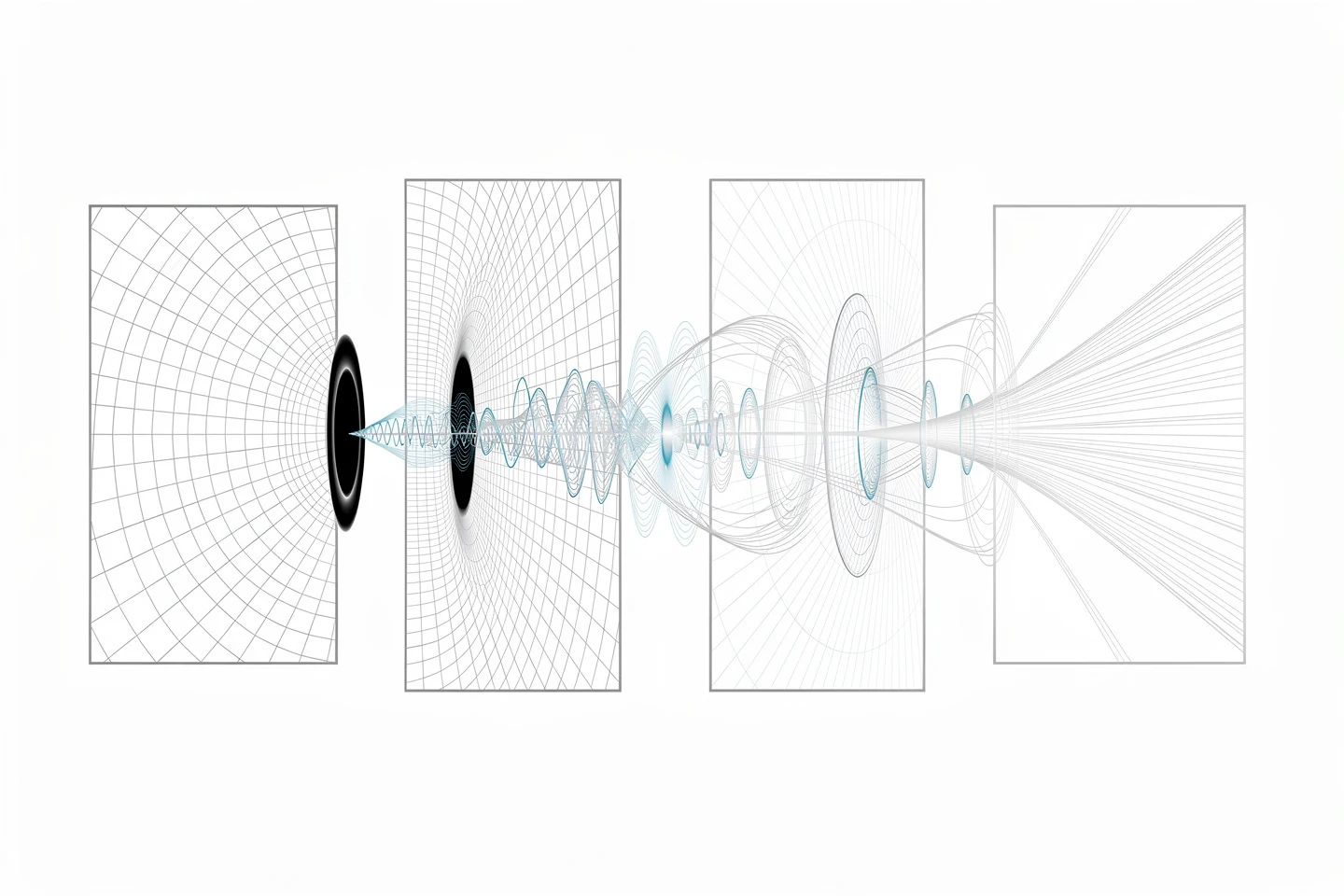
Classical general relativity predicts: a singularity hides inside every black hole. In this region, spacetime curvature skyrockets to infinity, and Einstein's equations lose meaning. The theorem of Roger Penrose asserts the inevitability of such an outcome during the collapse of a massive star. This is not just a mathematical curiosity; it is a sign that geometrodynamics itself, in its classical form, is incomplete.
But time in quantum gravity is not a tyrant with a stopwatch. As early as Paul Dirac realized: at a deep level, time must emerge from the relationships between subsystems, rather than being imposed from outside. In the new work, this philosophy takes shape: physicists construct a quantum clock directly from the fabric of spacetime inside a black hole. The Kantowski–Sachs model — a simplified but exact isometry of the Schwarzschild interior — contains two dynamical variables. One becomes the 'clock': its evolution sets the relational time for the other. Measurements are constructed through covariant POVM operators, circumventing Pauli's theorem on the impossibility of ideal clocks. As a result, a conditional quantum state emerges, which evolves smoothly without an external parameter — as if breathing in time with quantum correlations.
The result is staggering: the area of two-dimensional spheres inside the hole never goes to zero. Its expectation value A(τ) follows a parabola A(τ) = $A_{min}$ + βτ², where $A_{min}$ = 4π (Δa)². Here Δa is the quantum uncertainty of the radius, the very one that Werner Heisenberg formulated nearly a century ago. The more 'blurred' the radius, the larger the minimal area — a quantum effect prevents collapse to a point. At τ=0 (where classically a singularity awaited) the expansion scalar vanishes and changes sign: the trapped region becomes anti-trapped — before us is a white hole. All scalar curvature invariants, including the Kretschmann scalar, remain finite.
The interior of a black hole is likened to a jazz fugue without a conductor. The geometric variables are musicians, weaving a melody through entanglement. One takes the rhythm section, setting the tempo, while the others improvise the shape of space. Classical collapse is a dissonance that cuts off the score; the quantum bounce is the resolution of a chord, a transition to a new key. This work does not merely close the old problem of singularities. It opens a path to testable predictions: bounces could leave imprints in gravitational-wave echoes, alter the Hawking evaporation spectrum, possibly even resolve the information paradox without data loss. Next steps: including matter, rotation, realistic collapse scenarios. The improvisation beneath the horizon continues — but now we have the score.
The clock inside a black hole is one of the spatial coordinates. Usually, time flows from the horizon to the center, but in relational quantum mechanics, the role of time is taken by the variable b, describing the 'radius' of invisible cylinders. Classically, it squeezes to a point, but quantumly, it bounces, as if hitting an elastic quantum cushion.
The idea of a black hole turning into a white hole echoes the 'tunnels' from Stanisław Lem's 'Fiasco' and the timeless dimension of 'Interstellar', but here there are no wormholes — only a fundamental quantum bounce of the very fabric of reality.