How to Hear a Crack in the Fabric of the Universe express
The symphony plays, but a barely perceptible wrong note has crept into the score. This is roughly how physicists search for deviations from general relativity in the 'sounds' of the universe — gravitational waves from merging black holes. These waves, like ripples from a stone thrown into water, spread across the fabric of spacetime and reach detectors on Earth.
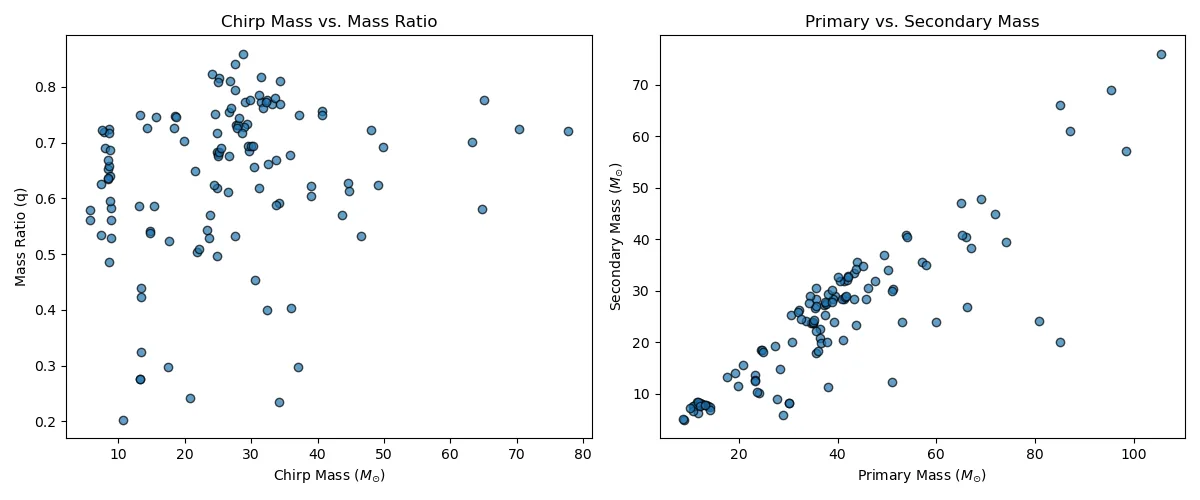
The authors of the new study built a 'wrong-note trainer': they took 173 real events from the gravitational-wave catalog and created exact copies of them using Einstein's equations. Then they carefully introduced distortions into these copies — tiny phase shifts that could arise if gravity is slightly more complex than we think. The result was a set of 'clean' and 'corrupted' signals for training the neural network.
This approach increased classification sensitivity by a factor of 33 compared to standard analysis of cleaned signals. The neural network learned from these difference portraits and found subtle patterns — collective signatures of deviations that are invisible to the eye and not captured by simple statistical methods. In the end, the algorithm could reliably detect effects of massive gravity — a theory where the force-carrying particles of gravity have a tiny mass on the order of 10⁻²³ electronvolts. For comparison, that is a trillion trillion times lighter than a neutrino.
The method does not just find a needle in a haystack: it learns to recognize the very shape of the needle among straws, even if it is slightly bent. And someday, this tuning of the ear might help physicists hear that very wrong note in the symphony of the universe.
The sensitivity of aLIGO detectors is such that they can notice a change in the length of a four-kilometer arm by a thousandth of a proton's diameter: that's like measuring the distance to the nearest star with the precision of a human hair's thickness.
The idea of 'wrong' gravity is explored in Peter Watts's novel 'Echopraxia': there, gravitational waves carry information from parallel universes, and their distortions are the key to contact.