The Invisible at the Galaxy's Heart: Black Hole or Ghost Star? ✛ ✎ ✦
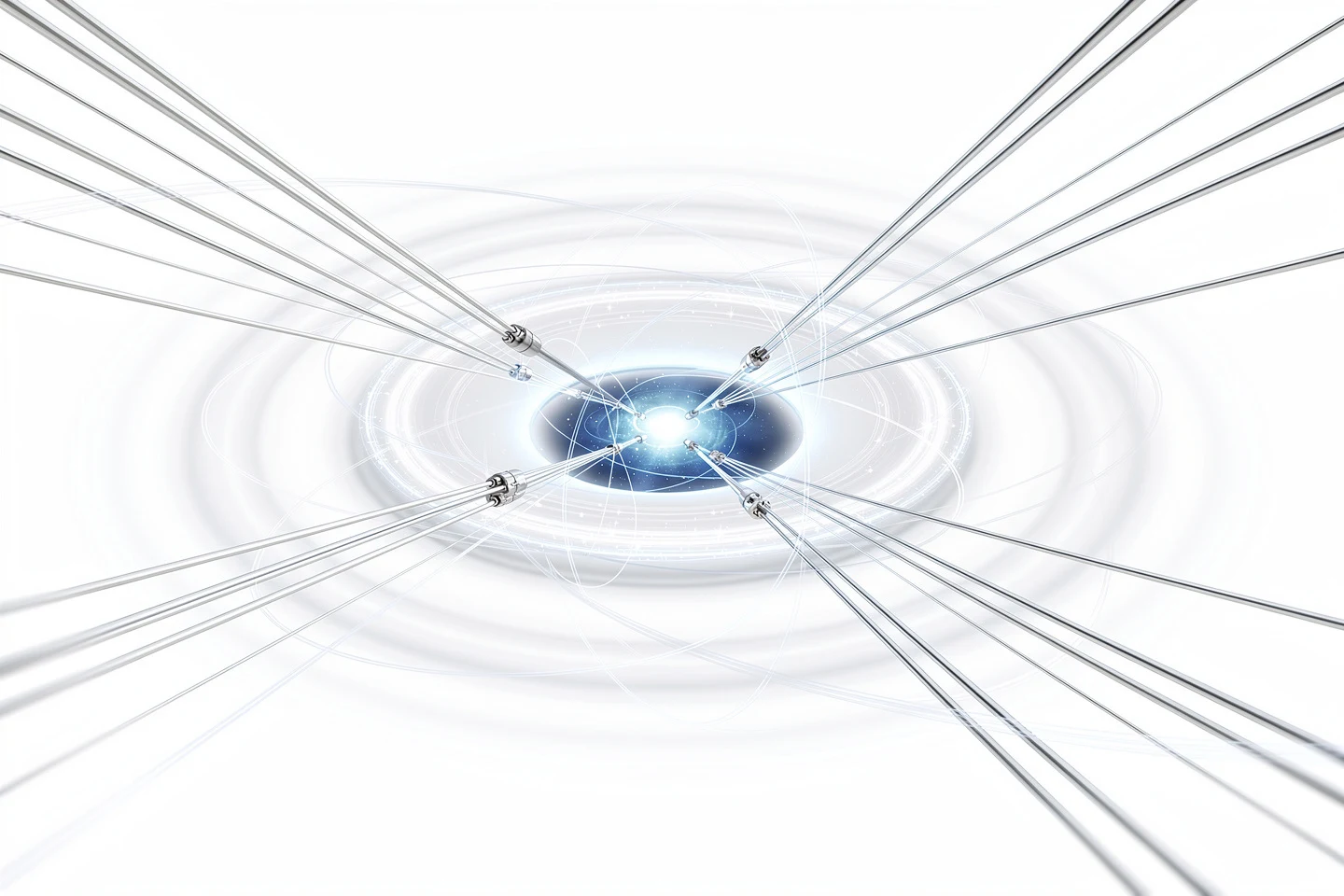
In the center of our galaxy, as in many others, lies an active nucleus — a massive object holding stars in their orbits. It's conventionally thought to be a black hole, a bottomless pit from which not even light escapes. However, the data allows for another option: it could be an invisible, ultra-dense ball.
Two heavy balls of equal mass, one solid and one hollow, are indistinguishable to a light ribbon circling around them. Similarly, the orbits of hot spots of light do not reveal the nature of the central body. Computer simulations showed: the image of a spot around a black hole and around a boson star — a superdense clump of particles moving as one — match the telescope data in brightness and polarization. These star-balls, akin to neutron stars (stellar remnants compressed to city size), may consist of axions — particles that likely make up dark matter, the invisible scaffolding of the universe.
Future detectors of gravitational waves, ripples in spacetime, may solve the mystery. For now, we can only guess: perhaps at the heart of the Milky Way hides not an abyss, but a ball that, with a mass of millions of suns, would fit inside Mercury's orbit — almost like a black hole, but made of substance.
A boson star with a mass of millions of suns would be so compact that its radius would exceed the critical size of a black hole by only three times — essentially, it would fit inside Mercury's orbit.