Light Trembles to the Beat of a Black Hole's Gravitational Ring ✛ ✦
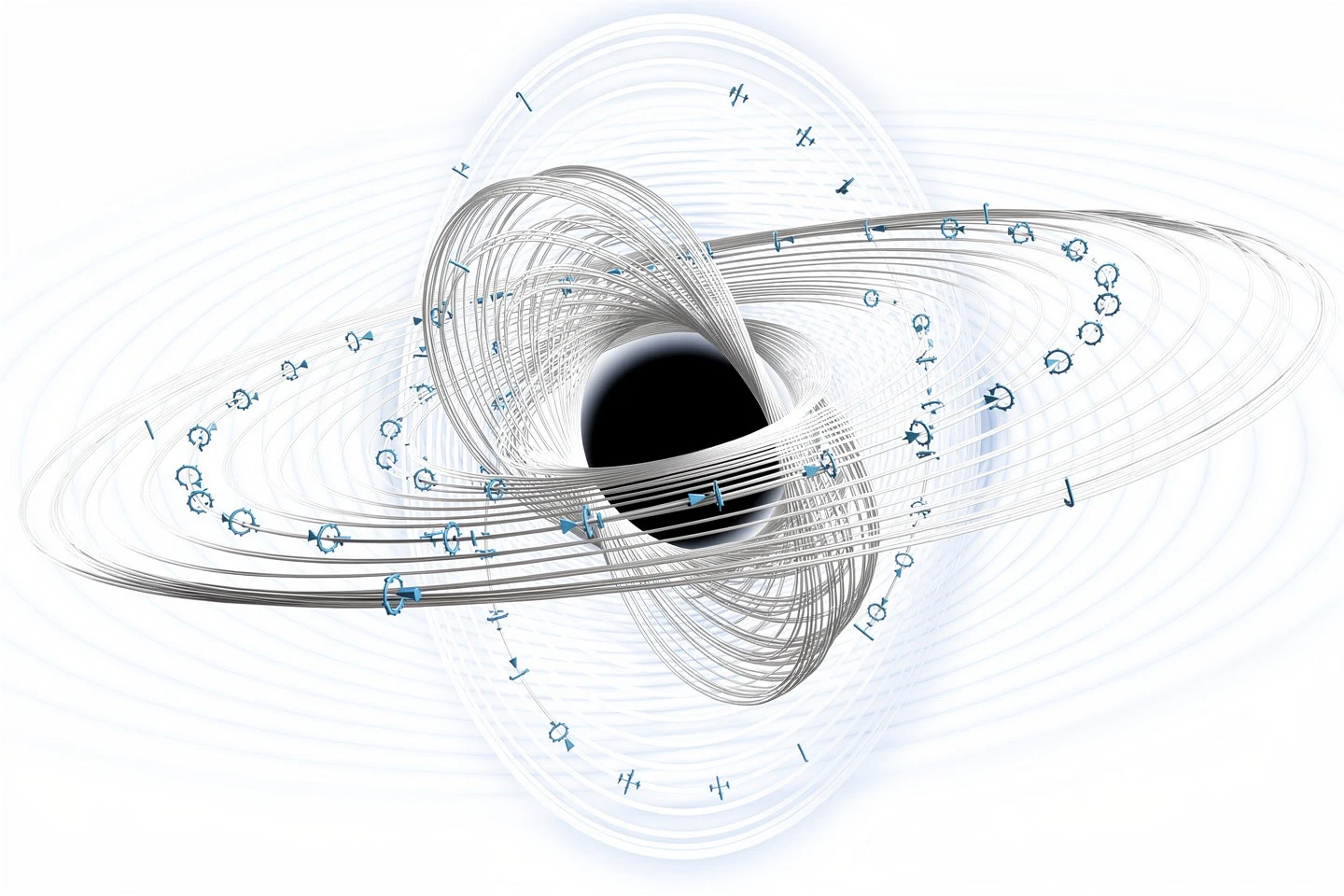
When two black holes merge, the resulting giant begins to hum like a bell. This ringing, gravitational waves, stirs ripples in spacetime itself. Passing light catches the tremor: the orientation of its wave oscillations, or polarization, shifts in time with the fading rhythm. Much like a bell's tone fades but keeps its pitch, the polarization oscillates at a constant frequency and slowly decays. The effect was predicted by Wheeler and refined by Thorne; now numerical simulations provide precise numbers.
Such polarized light is emitted by superheated gas disks around black holes or jets from the cores of active galaxies. The rotation angle can reach nearly 10 degrees — a noticeable tilt, comparable to the movement of a clock's hand over half an hour. Remarkably, light, without ever touching the black hole, carries its rhythm outward, letting astronomers measure the mass, spin, and even test general relativity in the strongest gravity.
Predicted in the 1950s, the 'gravitational Faraday effect' makes polarization rotate identically for all colors — unlike the plasma effect, which acts more strongly on longer wavelengths.