Polarization Echo: Light Catches the Gravitational Ringdown of a Black Hole ✛ ✦
Context
The merger of black holes produces powerful gravitational waves, whose final stage — the ringdown — carries key information about the mass, spin, and charge of the resulting black hole, in accordance with the 'no-hair' theorems. Existing detectors like LIGO/Virgo pick up this ringdown, but their sensitivity is insufficient for detailed spectroscopy. An alternative approach is to use polarimetry of electromagnetic radiation from the black hole’s vicinity: accretion disks, jets from active galactic nuclei, or lensed background blazars. As early as the works of John Wheeler, it was emphasized that spacetime geometry can alter light’s polarization, but direct observation of this effect from gravitational waves has only now become possible.
Methods
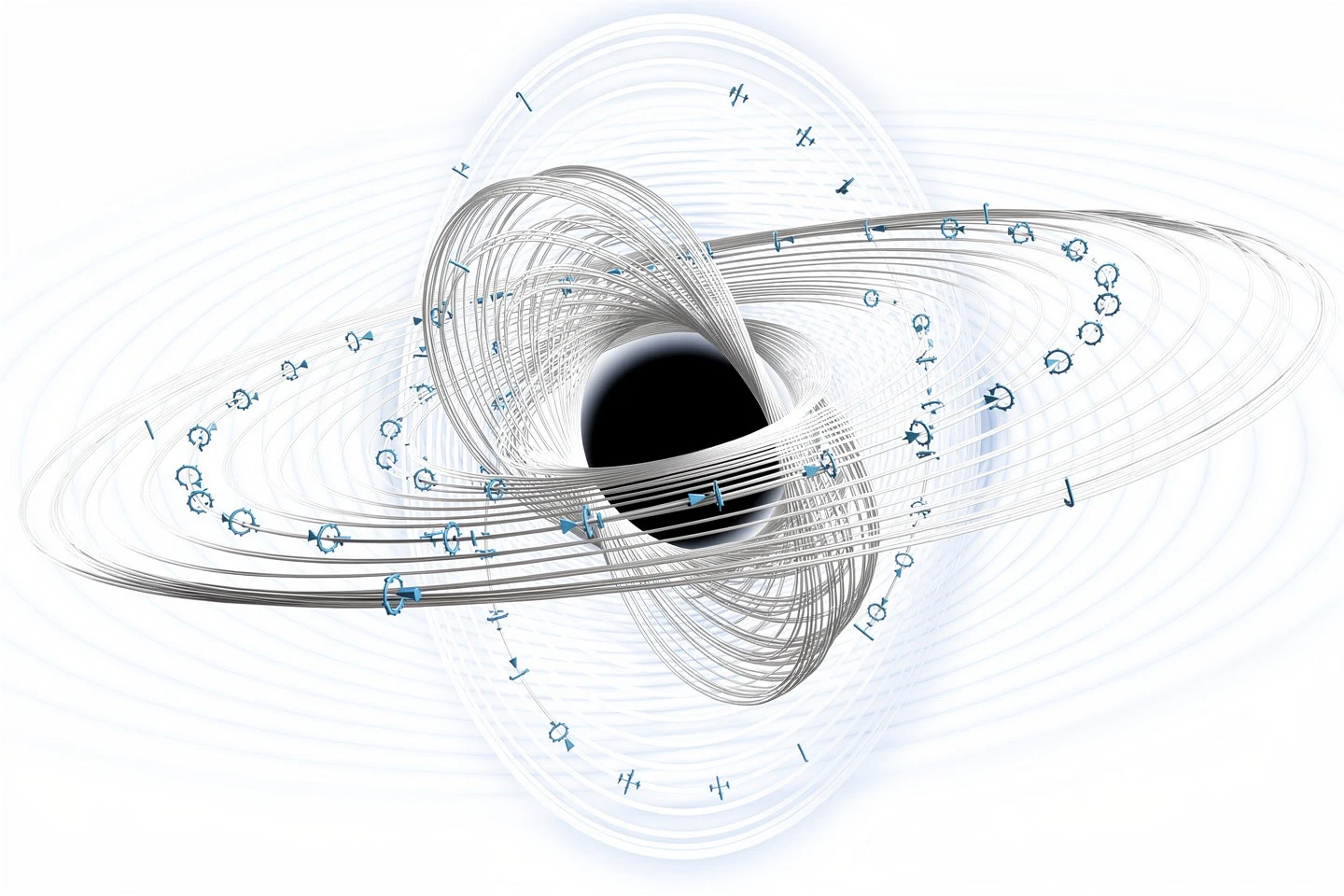
The authors constructed a covariant first-order perturbation theory for polarized light propagation in dynamic spacetime. In the geometric optics limit, polarization is parallel-transported along null geodesics, and the gravitational influence reduces to a local angular velocity of polarization rotation, generalizing the plane-wave result. For specific calculations, the Kerr metric with a linearized gravitational-wave perturbation was used, described by the Teukolsky equations and the CCK formalism. Numerical simulations via backward ray tracing allowed the evolution of the polarization angle to be tracked for a broad class of trajectories — from sources in the equatorial plane (modeling an accretion disk) and from infinity (modeling background objects).
Results
It was found that for photons emitted from an accretion disk or a jet (as observed in blazars), the time dependence of the polarization angle rotation ϑ(t) follows a damped harmonic: ϑ ∝ $e^{-ω_I t}$ cos($ω_R$ t - Φ), where $ω_R$ and $ω_I$ are the real and imaginary parts of the quasinormal mode frequency. For the fundamental mode (l=m=2) of a rotating black hole with a=0.7M, the rotation amplitude reaches ~10° when the photon passes close to the horizon (b≈4M). The phase Φ is directly linked to the azimuthal number m: Φ = m φ + const, as demonstrated in images with different φ. For photons from distant sources at late times, the signal transitions to a power-law tail ∝ $t^{-3}$, arising from the alignment of the photon’s wave vector with the direction of the gravitational wave. Correlation analysis of the two-point autocorrelation function confirms the signal’s robustness to noise and allows extraction of the frequency and damping rate even at a signal-to-noise ratio ~0.
Implications
This work opens a new polarimetric window into gravitational-wave astronomy. The polarization ringdown is achromatic, which helps separate it from plasma Faraday rotation, and has a predictable temporal structure. It can serve as an independent test of general relativity in strong fields, complementing measurements of gravitational waves by ground-based and space interferometers.
Future development
In the future, the method could be extended to superpositions of higher overtones, enabling extraction of more parameters from the ringdown. Joint numerical simulations that include magnetohydrodynamics of accretion flows and realistic plasma will help assess the contribution of astrophysical noise. Observations with next-generation telescopes (EHT, ngVLA, space-based polarimeters) coordinated with gravitational-wave detectors (LISA, Einstein Telescope) will test predictions on actual merger events of supermassive black holes at the centers of active galaxies.
Impact
The results will impact black hole astrophysics, gravitational-wave astronomy, high-resolution polarimetry, and tests of modified theories of gravity, where the quasinormal mode spectrum may differ.
Next steps
Next steps include detailed modeling of polarization responses from accretion flows with magnetic fields and turbulence, and developing algorithms to extract the ringdown signal from the source’s intrinsic variability.
Key open problems
This work directly addresses the problem of testing the no-hair theorems for black holes and understanding strong-field dynamics, where classical GR tests are limited to weak-field observations.
The knowledge machine's view
This section is addressed to the author of the paper and their colleagues. Neighbouring works were found by meaning-based search across our archive, not by word overlap. We do not review: we show the field around the work.
What the work does
The authors developed a first-order covariant perturbation theory for the propagation of polarized light in a dynamic spacetime and numerically simulated the rotation of the polarization angle for photons passing near a merging black hole. They showed that the time dependence of the rotation takes the form of a damped harmonic oscillation with the frequency of a quasinormal mode, and the amplitude can reach ~10° for close encounters. They also found a power-law tail for distant sources and demonstrated the signal's robustness against noise.
Where its strength is
This work opens a new polarimetric window into gravitational-wave astronomy: the achromatic nature of the effect and its direct link to black hole parameters allow it to be distinguished from plasma effects and potentially used for quasinormal mode spectroscopy.
Where it could go next
- It might be interesting to compare the obtained polarization signal with predictions for black hole echoes in alternative theories of gravity, where the quasinormal spectrum is modified—this would allow assessing the method's sensitivity to deviations from general relativity.based on: Echoes of Black Holes: How Gravitational Sirens Reveal the Curvature of the Universe arXiv:2606.04216v1
- A related approach links polarization to black hole spin parameters; perhaps it can be adapted to extract spin from the observed polarization angle rotation in your setup.based on: Black Hole Spin Paints a Polarization Pattern arXiv:2606.12518
Worth trying
- Investigate how the polarization ringdown changes in the presence of an accretion disk with a realistic radiation model, to assess the possible plasma contribution.
- Consider a scenario where the source of polarized light is a blazar jet, and evaluate whether the signal can be extracted against the jet's own variability.
Why this may matter
If the polarization ringdown can be detected, it would provide a way to test no-hair theorems and study strong gravity independently of gravitational-wave detectors, and could also serve as a foundation for multi-messenger gravitational-wave astronomy.
Nearby works in our archive
- A Black Hole in Polarized Glassessimilarity 0.72
- Black Hole Spin Paints a Polarization Patternsimilarity 0.70
- Gravitational Waves Reveal Black Hole Pairssimilarity 0.67
- A Gravitational Call a Minute Before the Mergersimilarity 0.67
- The Invisible Spring Around a Black Holesimilarity 0.67
- How Black Holes Play Strings of Invisible Particlessimilarity 0.67
- Echoes of Black Holes: How Gravitational Sirens Reveal the Curvature of the Universesimilarity 0.67
The archive is crowded around this work: 9 reviews nearby, closest at 0.72. This ground is well walked — and there is plenty to compare against.
Original abstract
as written by the authors arXiv:2605.11499v1
Light propagating through a perturbed spacetime could imprint the underlying gravitational waveform directly onto electromagnetic observables. In this Letter, we develop a covariant perturbative framework for polarized photon propagation in generic curved spacetimes, and derive a compact expression for the observable polarization-angle (PA) swing during Kerr ringdown, explicitly demonstrating its time-domain locking to the quasi-normal modes. We confirm this behavior using dynamical ray-tracing calculations for a broad class of photon trajectories. Photons grazing the strong-field region exhibit an achromatic, damped PA oscillation that tracks the ringdown, with a phase set by the mode's angular structure. The swing amplitude can reach $$\sim 10^{\circ}$$ and leaves distinctive signatures in spatially resolved autocorrelations. These results open a new polarimetric window onto black hole mergers and ringdown.
Unlike Faraday rotation in plasma, which strongly depends on wavelength, the gravitationally induced polarization rotation is the same for all frequencies — an achromatic 'gravitational Faraday effect' predicted back in the 1950s, but only now quantitatively evaluated for realistic scenarios.
Key numbers
- polarization rotation amplitude near the horizon: ~10°
- oscillation period for the mode (l=m=2) at a=0.7M: ~11.8 M (in units G=c=1)
- logarithmic damping decrement per cycle: ~0.95
- fraction of gravitational-wave energy in the ringdown (conservative estimate): 0.6% of the black hole mass