Popular

How to Hear a Planet Near a Dead Star ⚡ экспресс

Original: "Planets in Pulsar Winds"
arXiv:2605.14077 · 2026-05-13 · CC BY 4.0 · ⏱ 1 min · High Energy Exoplanets Stellar
Planets around [tag:neutron_star]neutron stars[/tag] give themselves away with radio signals born in the hurricane-like stellar wind.
Abstract

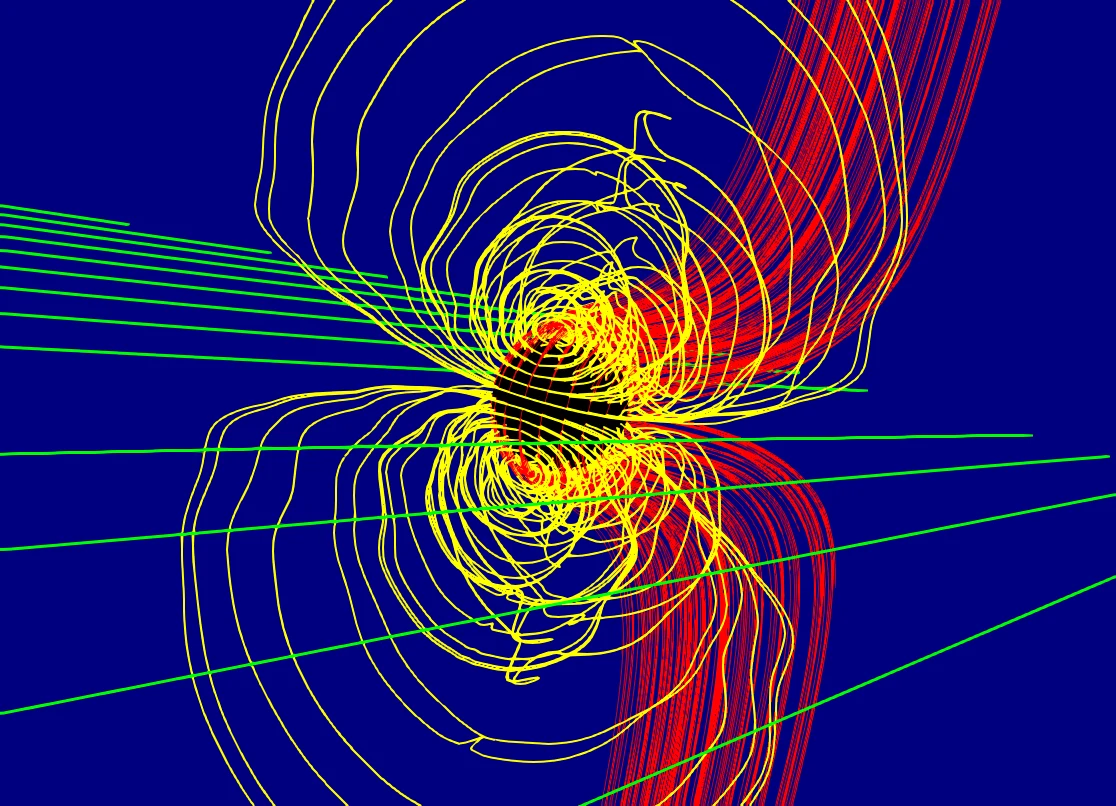
Pulsars are spinning neutron stars with extreme magnetic fields; their timing led to the first exoplanet discoveries. Now, a new detection method is proposed: the radio waves from the crash of the pulsar's ultra-relativistic wind against a planet. Simulations show this interaction creates a glowing magnetic tail on the planet’s nightside, like a comet’s tail. The known pulsar planet PSR J0636+5129 b should be bright enough to be heard by radio telescopes, meaning we might soon find more planets in these stellar graveyards.

Links in the knowledge graph 1

📄 Showing the "Simple" version — "Popular" is not ready yet. Add it to favorites to help prioritize it.

The first exoplanet was discovered around an unusual cosmic lighthouse — a neutron star known as a pulsar. These ultra-dense remnants of dead stars spin at tremendous speeds and emit precise radio pulses. In 1967, Jocelyn Bell Burnell detected such signals, and at first they were mistaken for an alien message.

Now scientists have found a new way to "hear" planets around pulsars. Besides the pulses, the star emits a continuous wind — a stream of charged particles racing at nearly the speed of light. A planet in this hurricane becomes an obstacle: as the wind flows around it, it stirs up radio waves — like a stone thrown into a stream creates ripples in the water.

The wind is so powerful that it can strip material from the planet: every second, it tears off a mountain's worth of matter. It's this blown-off dust, interacting with the magnetic field, that makes the planet "glow" in radio waves.

Computer simulations confirmed that such radio glow can be detected from the known pulsar PSR J0636+5129 b. This opens the door to finding other exoplanets in the harshest corners of the Universe, even where deadly radiation reigns.

🎯 Planets around pulsars are one of the most extreme places in the Universe: magnetic fields there are trillions of times stronger than Earth's, and the particle wind is accelerated to near light-speed.

Scientists
Christian DopplerD. B. McLaughlinDidier QuelozMichel MayorR. A. RossiterAlbert Einstein
Tags
exoplanet neutron star speed of light
Laws
Doppler effectprinciple of constancy of the speed of lightKepler's third lawmass–energy equivalenceMaxwell's equationsLorentz transformations
Original: arXiv:2605.14077 · CC BY 4.0 · bridge42worlds