Simple

Wormholes Turn Out Brighter Than Black Holes

Original: "Image of a wormhole with an arbitrary throat profile"
arXiv:2605.16413v2 · 2026-05-13 · CC BY 4.0 · ⏱ 1 min · General Relativity
The disk around a wormhole is almost twice as bright as that of a black hole of the same size.
Abstract

How to tell a black hole from a wormhole? Turns out, by the shadow — no way: some wormholes have a shadow exactly like a black hole's. But as soon as matter starts falling in, the wormhole shines brighter — imagine a tunnel that's always lit.

Links in the knowledge graph 1

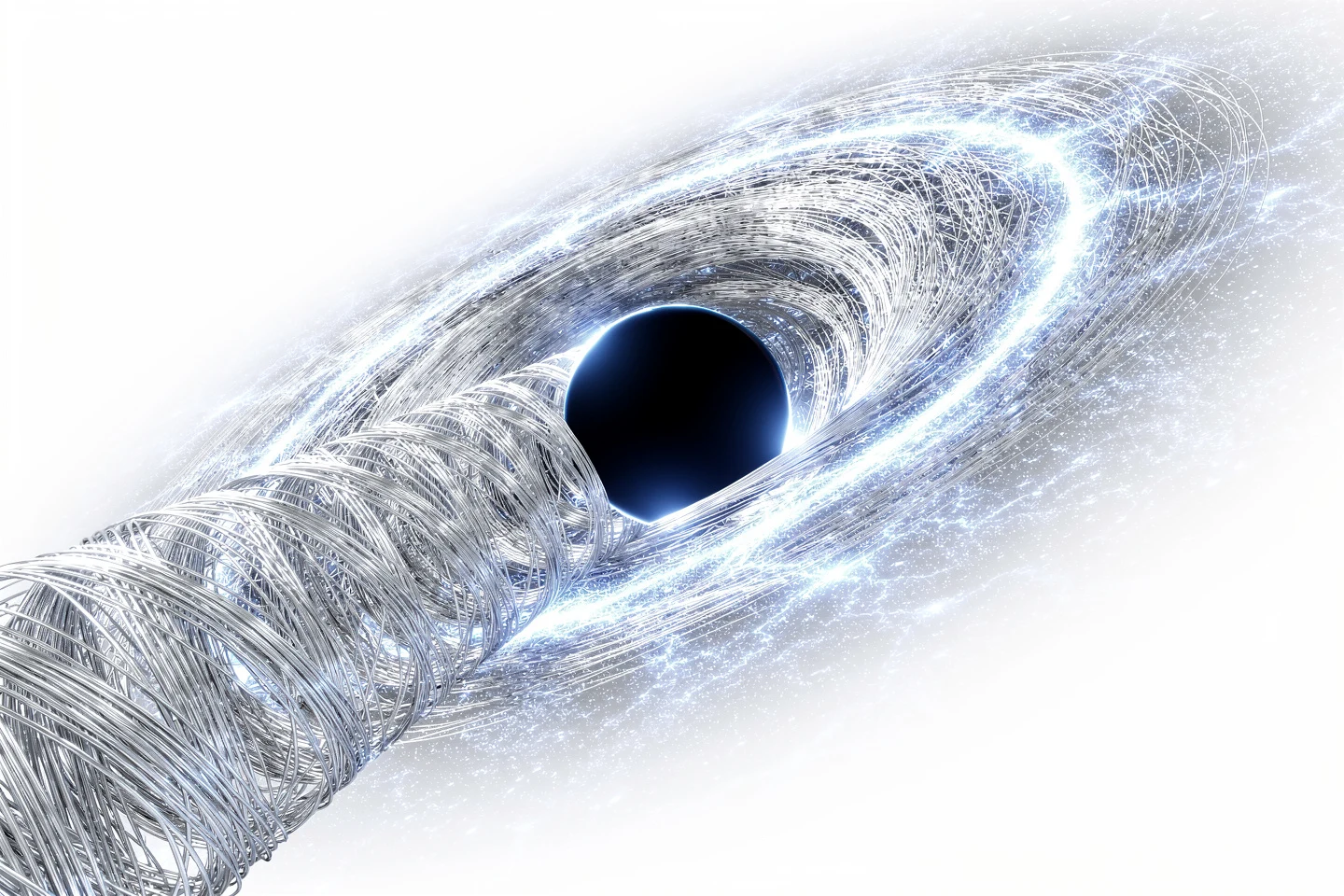
In space, we see dark spots in glowing rings. These could be black holes — regions where gravity traps even light. But Einstein's equations also allow wormholes — tunnels through curved space. The difference is easy to grasp with an analogy: a mountain tunnel versus a dark cave. Around the entrance, superheated gas swirls. If the tunnel goes through, light enters from both sides, making the ring noticeably brighter. In a cave, the rear lights are hidden, and the glow is dimmer. Computer simulations confirm: a glowing disk around a wormhole is brighter than one of the same size around a black hole. The reason: light freely passes through the throat, and weak reddening hardly dims it. In contrast, a black hole's gravity severely stretches the light rays. This gives a simple sign: if the disk is too bright — perhaps we are looking at a wormhole. Future telescopes, using polarization of light, the pattern of its waves, could clarify its nature.

John Wheeler coined the name 'wormhole', comparing it to a worm's passage through an apple. Kip Thorne dreamed of traveling through them. But the most amazing thing: peering inside, you might see a distorted reflection of stars from the other side — like in a funhouse mirror.

🎯 With the same shadow size, a wormhole's disk can be one and a half times brighter than a black hole's — a reliable way to tell them apart.

🎬 The movie Interstellar depicts a wormhole as a bridge to another galaxy — a fantasy inspired by the real theory of tunnels through space.

\alpha_{\text{sh}} = \left| \frac{r(u_{\text{ph}})}{N(u_{\text{ph}})} \right|
The angular shadow radius α_sh is given by the ratio of the radial coordinate r to the lapse function N at the photon sphere—the very place where light is caught in a gravitational carousel.
\int_0^{\infty} \frac{du}{r^2(u) \sqrt{N^{-2}(u) - \alpha_{\text{sil}}^2 / r^2(u)}} = \frac{\pi}{\alpha_{\text{sil}}}
This equation links the angular size of the throat silhouette α_sil to the full geometry of spacetime—it 'feels out' the entire wormhole.
Scientists
Stephen HawkingJacob BekensteinAlbert EinsteinFritz ZwickyVera RubinBernhard Riemann
Tags
Wormhole black hole Accretion disk spacetime curvature gravity redshift numerical simulation polarimetry
Laws
Hawking radiationgravitational lensingBekenstein-Hawking entropyEinstein field equationsequivalence principlevirial theorem
Original: arXiv:2605.16413v2 · CC BY 4.0 · bridge42worlds