Long-Throat Wormholes: How to Distinguish Them from Black Holes by Their Images ✛ ✦
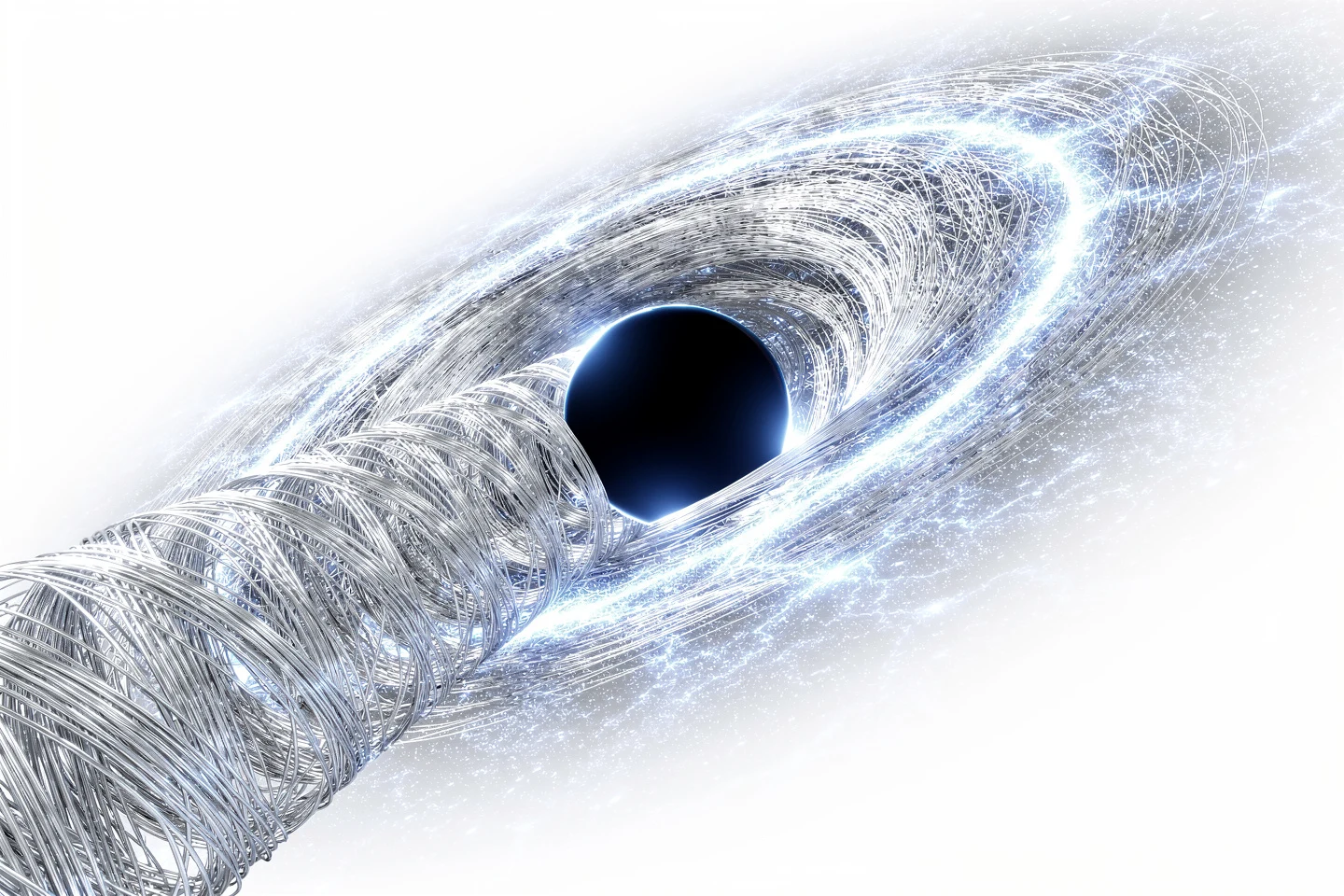
Context
The search for astrophysical wormholes has intensified thanks to advances in observations of supermassive compact objects. The Event Horizon Telescope collaboration captured the first images of black hole candidates, ushering in an era of testing strong gravity. While these observations are consistent with theory, they do not rule out alternatives like wormholes, whose gravitational lenses and shadows can mimic black holes.
Methods
Based on a general parameterization of a static spherically symmetric metric with an arbitrary throat profile, analytical expressions were derived for the shadow radius, throat silhouette, and photon energy shift. For a specific model with parameters a, λ, and u0, geodesic equations were solved numerically, and embedding diagrams and accretion disk images were constructed. Comparison was made with the Schwarzschild black hole—the classic solution obtained by Karl Schwarzschild.
Results
It was found that there exist parameter sets a, λ, and u0 for which the shadow and throat silhouette radii of a wormhole exactly match those of a Schwarzschild black hole of equal mass. However, the accretion disk images differ dramatically: in a wormhole, the Doppler effect dominates over gravitational redshift. As a result, the wormhole disk appears much brighter—the maximum energy shift reaches 1.45 versus 0.74 for a black hole.
Implications
Joint analysis of the dark spot size and energy shift distribution provides a reliable observational tool to distinguish wormholes from black holes, paving the way for empirical testing of alternative gravity theories.
Future development
Future work includes extending the model to rotating wormholes, incorporating more realistic accretion models, and accounting for polarization of radiation for direct comparison with Event Horizon Telescope data.
Impact
The results will directly impact observational astrophysics of compact objects, gravitational lensing methods, and tests of general relativity.
Next steps
The next step involves simulating images for specific candidates like M87* and Sgr A*, incorporating the latest polarization data from the EHT collaboration.
Key open problems
This work is directly connected to the fundamental problem of identifying the true nature of supermassive compact objects and the search for exotic solutions of Einstein's equations alternative to black holes.
The knowledge machine's view
This section is addressed to the author of the paper and their colleagues. Neighbouring works were found by meaning-based search across our archive, not by word overlap. We do not review: we show the field around the work.
What the work does
The paper examines observational signatures of static spherically symmetric wormholes with an arbitrary throat profile: analytical expressions are derived for the shadow radius, throat silhouette, and photon energy shift, which are then applied to a specific three-parameter metric. Numerically constructed images of a thin accretion disk are compared with those of a Schwarzschild black hole.
Where its strength is
The strong point is obtaining analytical formulas in the general case and demonstrating that, despite the shadow and throat silhouette coinciding with those of a black hole, the accretion disk images differ due to the Doppler shift dominating over the gravitational redshift.
Where it could go next
- It might be interesting to compare the obtained images with calculations for other exotic compact objects, such as white holes, to identify commonalities and differences in observational signatures.based on: A White Hole in the Lens: What the Telescope Will See arXiv:2607.20945
- A related approach uses gravitational waves to identify black hole 'look-alikes'; combining electromagnetic and gravitational-wave signatures could enhance the discrimination between wormholes and black holes.based on: Black Mirrors: How Gravitational Waves Will Reveal Black Hole Twins arXiv:2508.13272
- Our archive contains studies investigating radiation polarization near black holes; a similar analysis for wormholes could provide an additional observational channel for testing.based on: How a Black Hole Splits Light by Polarization arXiv:2511.22276
Worth trying
- Apply the imaging method to other wormhole models, e.g., rotating ones, and test the robustness of the conclusion about Doppler shift dominance.
- Compute polarization maps for the considered configurations and compare them with those expected for a Schwarzschild black hole.
- Use the derived formulas to analyze EHT data to constrain wormhole parameters.
Why this may matter
Developing reliable observational criteria to distinguish black holes from wormholes is important for interpreting Event Horizon Telescope data and testing fundamental assumptions of gravitational theory.
Nearby works in our archive
- A Black Hole's Shadow as a Mirror of Unknown Gravitysimilarity 0.64
- The Shadow of a Black Hole: How Bent Light Paints a Portrait of the Invisiblesimilarity 0.63
- Spindle Black Hole: The Shadow Changes Shapesimilarity 0.62
- A White Hole in the Lens: What the Telescope Will Seesimilarity 0.62
- Black Mirrors: How Gravitational Waves Will Reveal Black Hole Twinssimilarity 0.61
- The Quiet Phantom Before a Black Hole Ringssimilarity 0.61
- How a Black Hole Splits Light by Polarizationsimilarity 0.60
The closest work in the archive sits at 0.64 by meaning — the usual level for our corpus.
Original abstract
as written by the authors arXiv:2605.16413v2
We investigate the observable signatures -- the shadow, the throat silhouette, and the image of a thin accretion disk -- for a family of static, spherically symmetric wormholes with an arbitrary throat profile. First, we derive expressions for the shadow radius, the throat silhouette radius, and the photon energy shift for a general static, spherically symmetric metric. Then we apply these results to a specific wormhole metric containing three free parameters: the throat radius~$$a$$, the throat length~$$\lambda$$, and the parameter~$$u_0$$ that controls the depth of the gravitational well. We numerically obtain the shadow and silhouette radii as functions of $$\lambda$$, $$u_0$$, and $$a$$, construct accretion disk images for three representative parameter sets, and compare the results with those for a Schwarzschild black hole. We find that there exist sets of parameters $$a$$, $$\lambda$$, $$u_0$$ such that the wormhole shadow and throat silhouette radii coincide with the shadow and event horizon silhouette of a Schwarzschild black hole of the same mass. Nevertheless, the accretion disk images of these objects differ substantially. In wormhole images, the Doppler effect plays a major role, not the gravitational redshift. As a result, the accreting wormhole images appear brighter.
The term 'wormhole' was coined by John Wheeler in 1957, and the idea of using them for interstellar travel was popularized by Kip Thorne and Michael Morris in 1988.
In the movie 'Interstellar', a traversable wormhole serves as a portal to another galaxy, artistically echoing the theoretical possibility of travel through such objects.
Key numbers
- Schwarzschild black hole shadow: 5.196m
- Black hole horizon silhouette: 4.457m
- Max energy shift for wormhole (λ=1, u0=1): 1.45
- Max energy shift for black hole: 0.74
- Throat radius in wormhole model: 2m