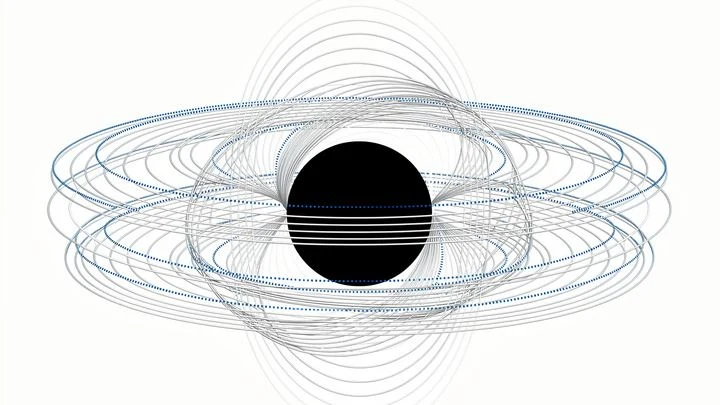
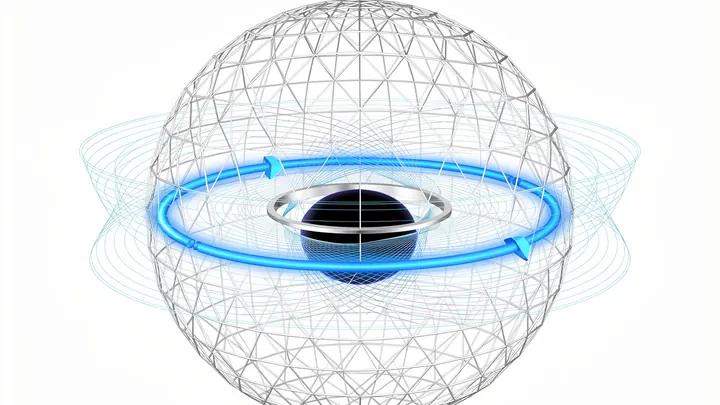
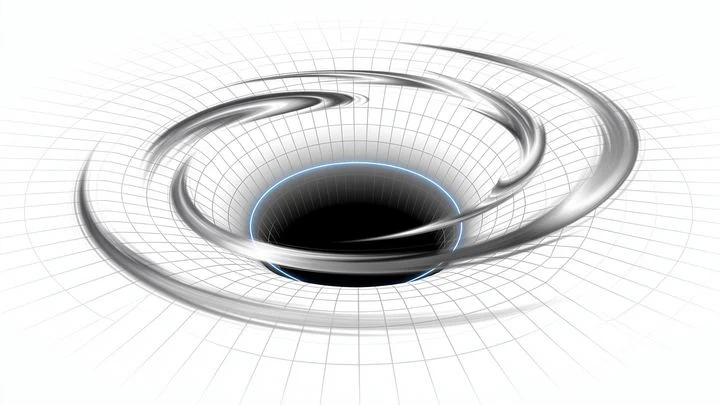
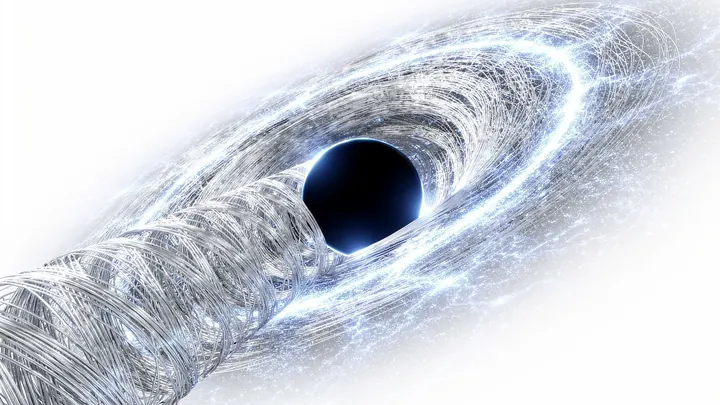
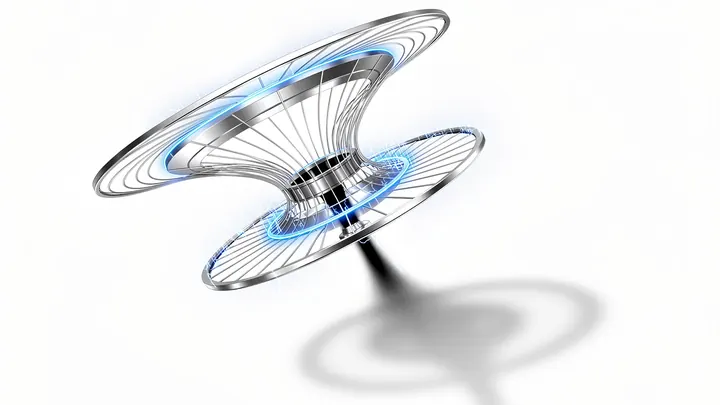
Surface gravity is the gravitational acceleration measured at a horizon, such as the event horizon of a black hole. In the context of black hole thermodynamics, it plays a crucial role: the surface gravity κ is directly proportional to the Hawking temperature, T = κ / (2π), meaning that a black hole with higher surface gravity radiates more intensely. This quantity bridges geometry and thermodynamics, showing that black holes are not just gravitational objects but also thermal systems with entropy and temperature.
History
The concept of surface gravity in black hole physics was formalized in the 1970s by Stephen Hawking and Jacob Bekenstein, who established the analogy between black hole mechanics and thermodynamics, with κ playing the role of temperature.
How it works
For a Schwarzschild black hole, surface gravity is κ = c⁴ / (4 G M), inversely proportional to mass. It represents the acceleration a stationary observer at the horizon would need to resist the pull of the black hole. In more general spacetimes, surface gravity is defined via the Killing horizon, and it determines the rate at which quantum vacuum fluctuations near the horizon become real particles, leading to Hawking radiation.
In practice
Surface gravity is used in theoretical astrophysics to predict black hole evaporation rates and in numerical relativity to simulate black hole mergers and their gravitational wave signatures.
Fun fact
For a black hole of one solar mass, the surface gravity is about 10¹² m/s², yet the Hawking temperature is only 60 nanokelvin, far colder than the cosmic microwave background.
Units by system: SI: ms2 · CGS: cms2 · Planck: 1s · natural: 1s
At the center of nearly every large galaxy sits a supermassive black hole. It doesn't just devour infalling gas; it also blasts some of it back out in powerful jets. These jets act like giant pistons, shoving the surrounding gas and heating it. Astronomers have long suspected that this is how black holes keep galaxies from cooling into cold star factories.
A black hole is a maze with no way out. But what happens to the information inside? To test this, physicists didn't fly to the nearest hole; instead, they built a tiny replica on a quantum processor. The maze was played by a chain of 32 superconducting qubits, where each step leads only forward, like a one-way corridor.
Stare long enough into the night sky, and sooner or later your gaze hits a blackness beyond which nothing is visible. This is not just a distant fence: it is the edge of the universe accessible to us, the cosmic horizon. Light from more distant stars simply hasn't had time to reach us.
A boiling kettle on the stove eventually boils dry — and so, according to the classical picture, a black hole should gradually vanish in a hiss of radiation. But what if you add a special ingredient to the kettle?
A black hole is not just an abyss. It is a seething cauldron whose temperature rises as it evaporates. The authors of the study found that when the heat reaches a critical threshold, the hole seems to boil. It emits superheavy particles — the very ones that exist on a scale where any theory of gravity collapses.
A black hole is not an absolutely black bag. In 1974, Stephen Hawking showed that it glows — faintly, but continuously. This radiation is born not inside, but outside, right at the boundary from which even light cannot escape.
A new study sharpens the picture.
Two balls dropped from different heights fall to the ground with different accelerations. In space, things are more complicated: even emptiness makes bodies move differently.
The event horizon's edge is never calm. Quantum vacuum boils there, and particles sometimes burst out of this foam: that is how Stephen Hawking in 1974 discovered black hole radiation, forever linking gravity with quantum field theory.
A black hole is not just an abyss where everything falls. Right at its horizon, in the so-called quantum atmosphere, a faint glow is born — Hawking radiation. This is not calm light but a churning stream of particles that can influence the most delicate quantum connections.
At the hearts of many galaxies, cosmic tops of incredible power spin — supermassive black holes. Their nature was first described by Schwarzschild right after Einstein gifted the world with general relativity.
The LIGO detectors caught the signal GW250114—a gravitational wave from the merger of two black holes. After the main burst, a decaying 'tail' remained — direct waves from the newborn hole's horizon. It was expected that their damping would reveal the gravitational strength at the horizon's surface. But the measured value came out smaller.
At the center of an ordinary black hole, according to classical ideas, lurks a singularity — a point of infinite density where the laws of physics break down. But some theories, inspired by the duality idea from string theory, propose replacing the point with a tiny 'smudged' region.
Gas passing through a narrow valve can heat up or cool down: this is the Joule–Thomson effect, which powers refrigerators and air liquefiers. It turns out black holes can do the same.
At the centers of many galaxies lurk supermassive black holes. One of them, Sagittarius A* at the heart of the Milky Way, has become a testing ground for a new idea. The authors of the work took Einsteinian gravity and added an unusual electromagnetic field to it.
Imagine a steam engine where instead of a steel piston there is an event horizon, and the cylinder is curved space itself. This metaphor has gained mathematical flesh: physicists have for the first time constructed a complete set of reversible heat cycles with a Schwarzschild black hole confined in a spherical cavity.
A black hole's interior is layered like an onion. In the new model, instead of an infinite point at the center, there are three regions: a dense core, a transition layer, and a crust just below the horizon. All arise from a single field that interacts with itself.
A black hole is like a perfectly dark room: from outside, you can't see what's inside, and anyone crossing the threshold seems to vanish from the outside world. But what does the falling observer feel? In classical physics, nothing special: the event horizon isn't marked by any signpost.
A black hole is not just a vacuum cleaner. It glows faintly, emitting particles — this idea was proposed by Jacob Bekenstein, who connected the hole's temperature to its degree of disorder. Detecting such radiation in space is incredibly difficult.
A black hole with a magnetic field resembles a whirlpool in a river, where water doesn't flow into the vortex but swirls in place. Usually, the hole's rotation picks up waves and amplifies them: this is called superradiance. But add a magnetic field, and everything changes.
A black hole horizon is like a soap film stretched over an abyss. From a distance it looks perfectly smooth, but up close it trembles. This ripple arises from quantum fluctuations — the continuous birth and death of particles in the vacuum.
The universe as painted in Einstein’s textbooks is a smooth four-dimensional canvas. But string theory adds a frame of extra dimensions — invisible, yet tangible to gravity. Imagine our universe as a membrane that trembles under the pressure of hidden layers.
The focus is on a black hole, but not an ordinary one. It carries a magnetic monopole and is surrounded by a dilaton — a field that blurs the familiar boundaries of space. The authors tested how stable such a system is to thermal jolts.
A magnetic monopole is a hypothetical particle with a single magnetic pole.
A black hole is like a pot that slowly boils away. Its surface emits particles, a process known as Hawking radiation. The hotter the pot, the faster it empties. But what if the pot is not ordinary, but has a double bottom — capable of turning into a passage to another place?
The merger of two black holes is the most powerful explosion in the Universe, yet we cannot see it. We only catch the shudder in spacetime — gravitational waves that carry information from the heart of the cataclysm. In December 2025, the LIGO detectors registered event GW250114.
A light ray skims along the horizon of a black hole: that invisible boundary from which nothing can escape. The closer the ray gets to the horizon, the slower its own 'time' stretches — a special measure of path called the affine parameter.
Spacetime flows like a river, and a black hole is a whirlpool. Particles in this flow are like waves with their own rhythm: alternating crests and troughs. It turns out the whirlpool shifts the wave's rhythm from a distance, without even sucking it in.
A black hole is like a perfect safe: anything that goes in seems lost forever. But at the microscopic level, it doesn't destroy information: it shuffles it with its internal degrees of freedom, much like a deck of cards after a thorough shuffle.
Around an invisible fire, glowing gas swirls. The fire itself is hidden, but its outline can be guessed from the way the flames dance. That's roughly how astronomers 'see' black holes — not the object itself, but the superheated matter that, before plunging into the abyss, accelerates to enormous speeds and shines.
In the early Universe, primordial black holes emerged — objects no larger than an atom but with the mass of a mountain. They gradually evaporate and, before disappearing, should produce gravitational waves — ripples in spacetime. If they were all identical, they would pop simultaneously, like popcorn kernels: the roar would be deafening.
Imagine a giant orchestra where every musician is a particle born in the fire of the Big Bang. When time's baton gives the downbeat, these particles begin to decay into lighter ones. Each decay is accompanied by a quiet chord — the emission of gravitons, tiny quanta of gravity.
Stephen Hawking imagined that the universe was born not from an explosion, but by smoothly emerging from a quantum 'nothing.' In worlds with concave geometry (anti-de Sitter space), such a birth acquires a rim, like the hoop of a drum.
An ordinary kettle: you heat it up — temperature rises, molecular chaos grows, and steam shoots out. But in the lab, they've created a peculiar "kettle"—an analog black hole made from superconducting circuits cooled to the extreme.
If you shrank an ordinary black hole to the size of a grain of sand, it would shine like a tiny star and quickly vanish in a flash. That's Stephen Hawking's prediction: the event horizon acts like a hot surface emitting particles.
In causal set theory, spacetime is not a smooth sheet but a web of tiny points connected by arrows of cause and effect. A point is linked to another only if the first can influence the latter. In such a web, a black hole is described differently: its horizon, the boundary from which signals cannot return, must be redefined.
The shadows of supermassive objects at the centers of galaxies, M87 and the Milky Way, have become icons of modern astrophysics. But what if these shadows are not from absorption, but passage? The equations of Einstein allow for traversable wormholes — tunnels in the fabric of spacetime.
Black holes aren't faceless devourers. Sometimes they behave like water: they can 'freeze' or 'boil', changing their internal state. Scientists described this by modeling light near a black hole as a gas.
Gravitational wave detectors pick up a low-frequency hum, like the sound of a distant waterfall. The Webb telescope finds galaxies in the early universe with black holes that seem too massive for such a young age.
A stone falls into a pond, and ripples spread across the water. Similarly, a black hole resting in the void may encounter a gravitational wave or a cloud of gas. It does not remain indifferent: its surface (the event horizon) bends slightly, like a stretched membrane under the weight of a drop.