How to Assemble a Galaxy in One Step express
An artist paints a portrait stroke by stroke, and then someone offers them a flash camera — one click, and it's done. That's roughly the shift from multi-step models to one-step models in generating images of galaxies.
Typical neural networks for image synthesis work like a watercolorist: they apply a layer, blur it, add details. In astrophysics, this is how we get realistic snapshots of distant star systems to compare with real observations. But each 'stroke' requires computation, and for hundreds of thousands of galaxies, it takes days. The authors tested whether a single 'click' would suffice, and it turns out it does. The pixel-MeanFlow model produces a finished image right away, without iterations.
Of course, as in photography, an instant snapshot sometimes falls short of a long brushwork: the finest structural details are better captured by the classic multi-step DDPM approach. But for mass 'photography'—simulations for future sky surveys — the speed gain is colossal. Instead of thousands of computational steps, just one, meaning you can quickly generate entire catalogs of training galaxies. Robotic telescopes will learn to classify distant objects from these.
Just as the camera didn't replace painting but gave us cinema and reportage, one-step models are unlikely to displace precise multi-step simulations, but they will open the way to rapid testing of hypotheses about how galaxy shapes have changed from the Big Bang to the present day.
Original abstract
as written by the authors arXiv:2605.17546
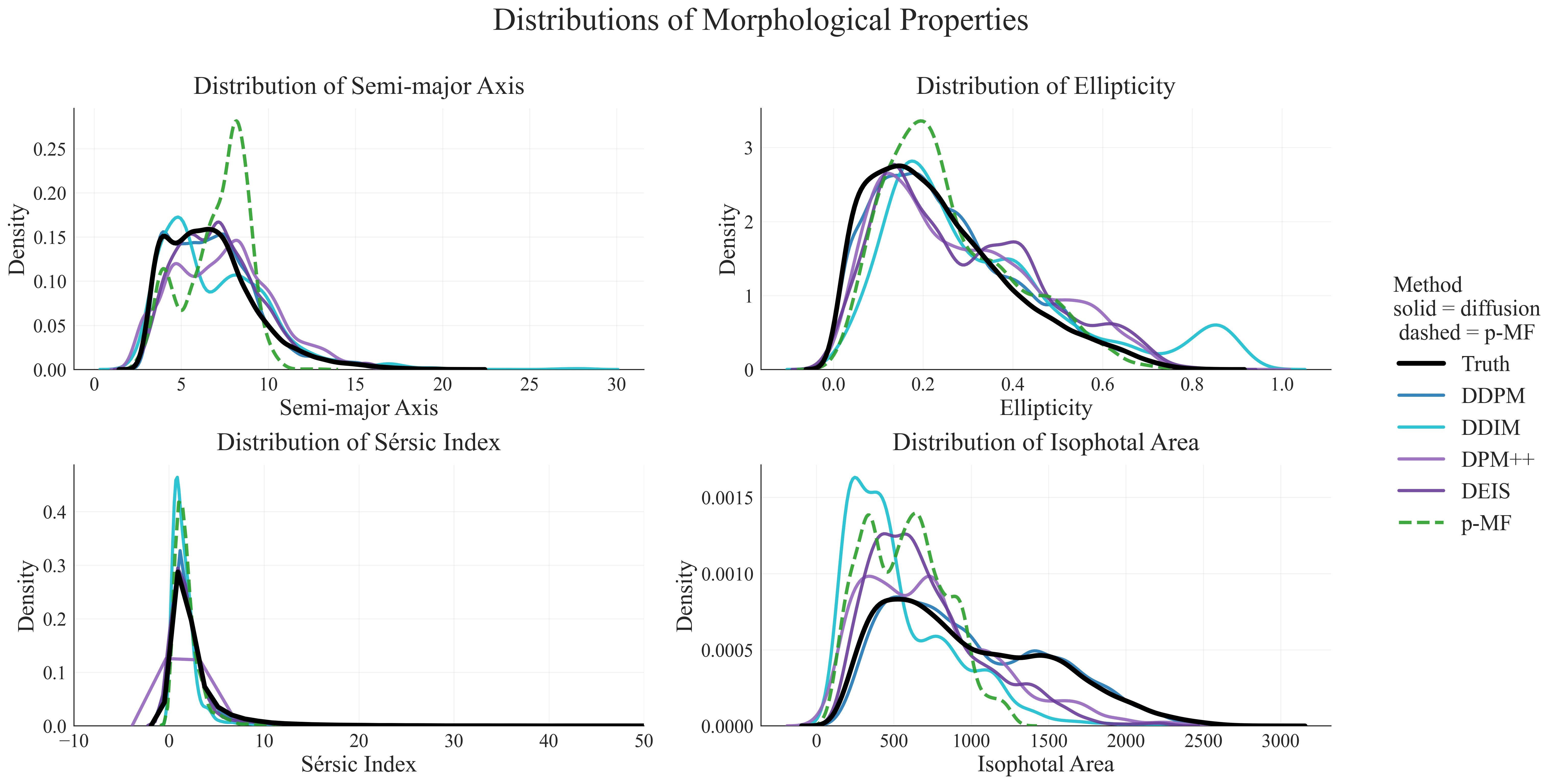
Understanding galaxy morphology evolution across cosmic time requires models that can generate realistic galaxy populations conditioned on redshift. In this work, we study efficient redshift-conditioned generative modeling for astrophysical image synthesis using diffusion models and pixel-MeanFlow. We first review the connections between score-based diffusion models, Flow Matching, one-step generative models, and modern diffusion samplers. We then evaluate DDPM, DDIM, DEIS-AB2, DPM++2M, and one-step pixel-MeanFlow on the GalaxiesML-64 dataset using morphology-based metrics, including ellipticity, semi-major axis, S\'ersic index, and isophotal area. Our results show a clear accuracy-efficiency trade-off: standard DDPM sampling achieves the best distributional fidelity but requires high computational cost, while second-order samplers substantially improve efficiency over DDIM. Pixel-MeanFlow enables single-step generation and achieves competitive performance on several morphology statistics, though it remains weaker than many-step DDPM for fine-grained structure. Our results demonstrate that one-step generative models can recover key galaxy morphology statistics at orders-of-magnitude lower computational cost, opening a path toward efficient conditional simulators for large cosmological surveys and simulation-based scientific inference.
The Sérsic index, which the authors measured, was introduced by Argentine astronomer José Luis Sérsic in 1968. He noticed that the brightness of most galaxies falls off from the center to the edge according to a simple law, and that law is described by just one number: that very index.