Wormholes Without Exotic Matter express
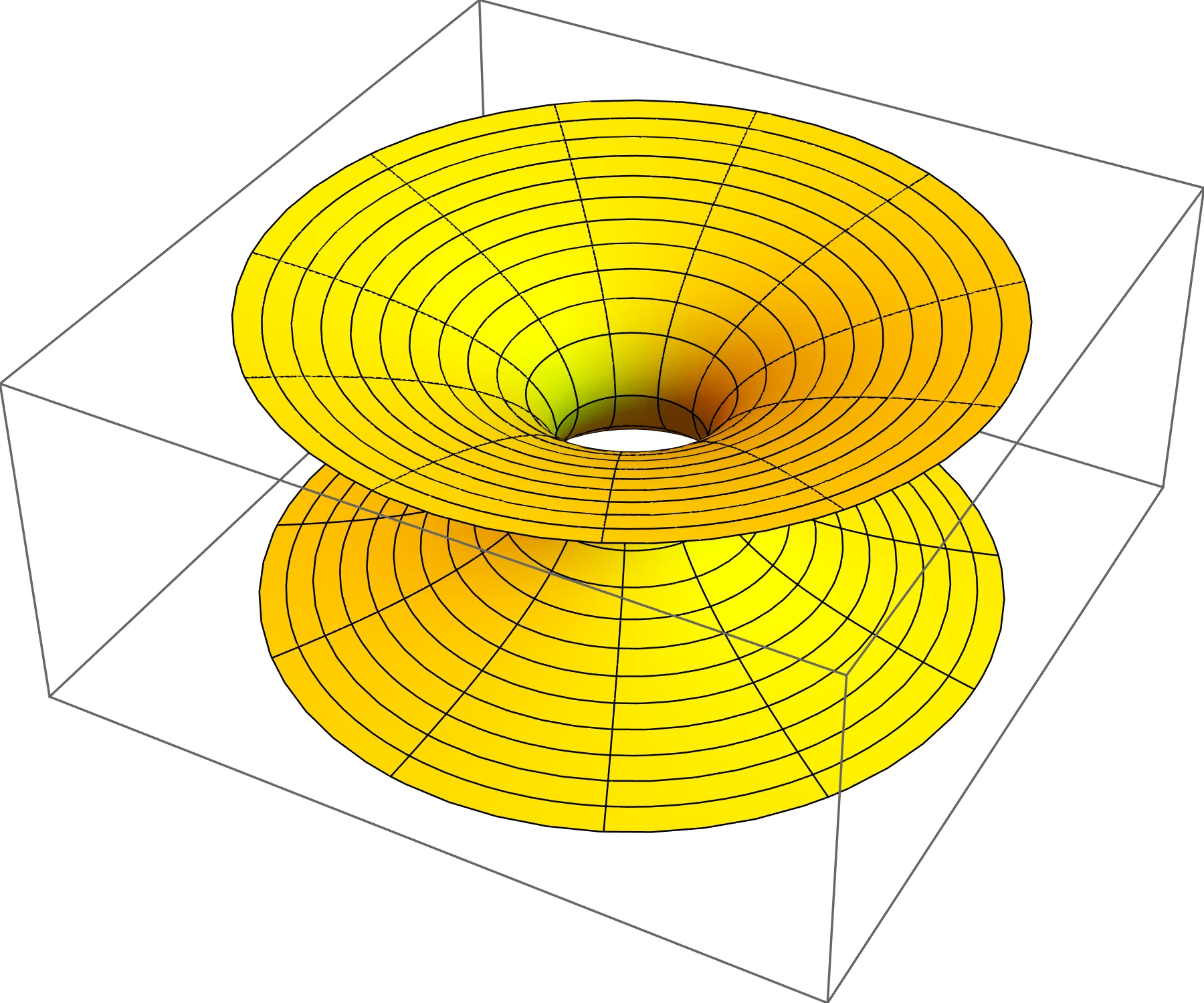
A wormhole is a tunnel through the fabric of spacetime, an idea expanded by John Wheeler and Kip Thorne. Just as a mountain passage tends to cave in, the throat of a wormhole wants to snap shut. Normally, it's propped open with exotic matter that has negative energy — a substance that pushes space apart, like dark energy. Only we don't have any.
Now, researchers have revisited gravity. Instead of hunting for nonexistent material, they tweaked the equations, adding extra spacetime curvature. Think of an arch bridge: to keep a span from falling, you could prop it with beams you lack, or you can design the arch's curve so it holds itself. Here, the geometry of space is the support. The math checks out: a traversable wormhole (a cousin of black holes) works without exotic matter, and the forces inside are no stronger than Earth's gravity. Sci-fi portals become a far-future engineering challenge.
Original abstract
as written by the authors arXiv:2605.18376
In this paper, we explore wormhole solutions in a higher-derivative theory of gravity where the action depends not only on the Ricci scalar $$R$$, but also on its d'Alembertian, $$\Box R$$. Such $$f(R,\Box R)$$ models are motivated by quantum corrections to general relativity and naturally extend the space of possible gravitational geometries. Our goal is to examine whether traversable wormholes can exist in this framework and to understand the role of higher-order curvature terms in supporting them. We derive the field equations for a static, spherically symmetric wormhole and study their solutions using both analytical arguments and numerical methods. Particular attention is given to the classical energy conditions, which are usually violated in wormhole physics. We find that the higher-derivative corrections can effectively contribute to the stress-energy tensor, reducing the amount of exotic matter required at the throat, and in some cases eliminating the need for it altogether.
Physicist John Wheeler coined the term "wormhole," comparing spacetime to an apple a worm bores through.
In the movie Interstellar, a wormhole let the heroes cross the galaxy in an instant.