Gravitational pull is the attractiveforce that any massive object exerts on other masses, as described by Newton's law of universal gravitation and refined by Einstein's general relativity. It is the reason planetsorbit stars, moons orbit planets, and why we stay grounded on Earth. The strength of the pull depends on the masses involved and the distance between them: more massive objects pull harder, and the force weakens with the square of the distance.
In Newton's formulation, every mass attracts every other mass with a force proportional to the product of their masses divided by the square of the distance between their centers. In Einstein's general relativity, gravity is not a force but a curvature of spacetime caused by mass and energy; objects move along curved paths in this geometry. Both descriptions accurately predict gravitational behavior in most situations, with general relativity being essential for extreme cases like black holes or the bending of light.
In practice
Gravitational pull is harnessed in satelliteorbits, spacecraft trajectories (gravity assists), and in measuring the masses of celestial bodies from their gravitational effects on nearby objects.
Fun fact
Gravity is the weakest of the four fundamental forces, yet it dominates the large-scale structure of the universe because it is always attractive and acts over infinite range.
A thrown stone arcs through the air, but a planet around the Sun follows a closed curve. Why an ellipse, and not a circle or a spiral? Kepler's first law provides the answer, but its usual proof requires heavy computation. This work offers a shorter path — through a single simple ratio of velocities.
Newton gave us a world where bodies move in a void and clocks tick the same for everyone. For three centuries, this picture worked flawlessly. But it relies on many invisible props: absolute position, the 'up-down' direction, and a single rhythm of time for the entire universe. We have never measured these directly — only through the relations between objects.
A lead sphere hangs above another lead sphere. According to the usual laws of gravitation, they attract each other exactly along the vertical — along the line connecting their centers.
When two neutron stars circle each other, they don't remain rigid spheres. The partner's gravity stretches each star, creating tidal bulges — much like the Moon raises ocean tides on Earth. But unlike water, here it's superdense matter that deforms: a teaspoon of this stuff weighs billions of tons.
Two tiny mirrors in a vacuum are like figure skaters in a pairs routine. Their oscillations are synchronized by an invisible gravitational thread. When cooled to millionths of a degree above zero, this thread turns them into a single quantum link — the motion of one instantly echoes in the other.
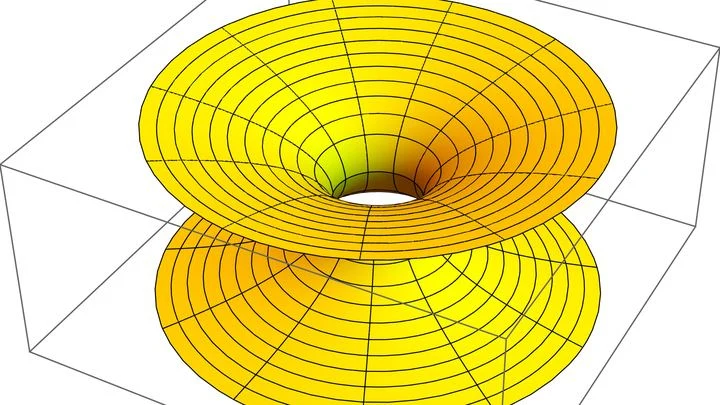
A wormhole is a tunnel through the fabric of spacetime, an idea expanded by John Wheeler and Kip Thorne. Just as a mountain passage tends to cave in, the throat of a wormhole wants to snap shut.
A handful of rice thrown into a glass of water scatters — the grains spread apart. Now imagine each grain propels itself forward with stubborn persistence and bounces off softly upon collision. Such particles are called active: they spend their own energy to move, like bacteria or microscopic robots.
A stone thrown into a pond creates ripples that spread far. But if you throw it into thick jelly, the waves die out almost immediately. That's roughly how an additional gravity field behaves under different mathematical descriptions.
The authors built a unified approach to calculate how such a field manifests itself in the Solar System.
Two galaxy clusters collided like two swarms of bees flying through each other. One of them is the famous "Bullet." After the collision, the hot gas, which makes up most of the ordinary matter, slowed down and stayed in the center, while the galaxies, like small dense pebbles, flew on.
A heavy spinning top launched near a black hole doesn't follow the curve that textbooks draw. Its own rotation and oblateness, like a pumpkin squashed at the poles, make the trajectory wobble. In a new study, this wobbling path has been calculated more precisely than ever before.
Usually, a small body in a black hole's field is treated as a point — without size or spin.
A particle wanders through a medium scattered with obstacles. Sometimes it pushes them aside like a snowplow, and it was thought that this pushing is what eventually stops the motion. But in three-dimensional space, that mechanism doesn't work.
It turns out that stopping arises from rare events: every so often, a particle randomly finds itself in a trap, and all exits close, as if doors slam shut.
The familiar picture: gravity always attracts. But if a mass is in quantum superposition (that is, in two places at once, like an object in a double-exposure photograph) everything flips. Quantum theory allows a particle to be both here and there in a literal sense: its position is described by a wave function smeared across space.
A stag beetle the size of a fingernail stands on the ground with its legs spread wider than its own height. An elephant as tall as a room, on the other hand, towers above the ground like a tower. Why is that? Both animals walk on the same ground, but they see it differently. For a beetle, each pebble is a boulder, while for an elephant, it's a grain of sand.
Astronomers, including Vera Rubin, noticed that stars on the outskirts of galaxies rotate faster than visible mass allows. To explain this, they invented dark matter — an invisible ballast. But there's another possibility: gravity isn't always the same.