Laser Detector in Two Places: How to Hear a Quantum Field express
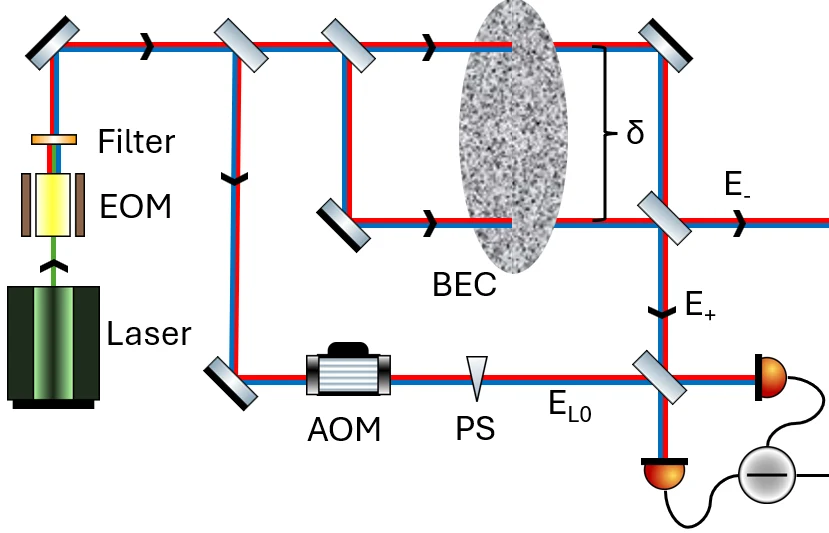
Physicists have proposed an experiment: a laser beam acts as a quantum detector and splits into two beam-ears. Each ear is directed through a tiny cloud of ultracold atoms — in this state, atoms merge into a single wave. The clouds are separated, so the detector is in superposition — it’s as if it’s listening to the field from two positions at once. Then the ears merge, and the light is directed to a photodetector and mixed with a reference beam (like tuning a radio) — analyzing the current beats reveals the response of the Unruh–DeWitt detector, a simple receiver model.
To prevent the field’s sound from drowning in noise, the physicists use squeezed light — here, noise in one quantum property is sacrificed for silence in another. It’s like muting the hum to make out a whisper. That’s exactly how gravitational waves were caught — the tremor of spacetime from black hole collisions. In the new experiment, the signal will be clearly heard: it will exceed the noise by 10 times. This will be the first direct test of how quantum fields sense curved spacetime.
Mixing the signal with a reference beam, like in a radio receiver, helps pick out weak quantum beats from the noise.
The idea of an object in two places at once inspires science fiction writers: in Hannu Rajaniemi’s novel 'The Quantum Thief,' the protagonist’s consciousness can be distributed across different points.