Black Hole Shadows Put Quantum Gravity to the Test express
The shadow of a black hole is not just a silhouette. It's the edge of the abyss, where space and time are twisted so tightly that even light is forced to swirl like a wood chip in a whirlpool. This 'cosmic whirlpool' arises from the monstrous mass warping spacetime.
Physicists tested what would happen if quantum effects (tiny corrections from loop quantum gravity theory, where space itself is made of microscopic loops) are added to this whirlpool. Calculations showed that quantum corrections barely perceptibly widen the shadow. But more importantly, even if you remove the 'drain hole,' i.e., the event horizon, the funnel remains closed, and the shadow stays a ring. The real surprise: inside such a black hole, there's no singularity point, just an entangled tangle of loops.
Original abstract
as written by the authors arXiv:2605.28871
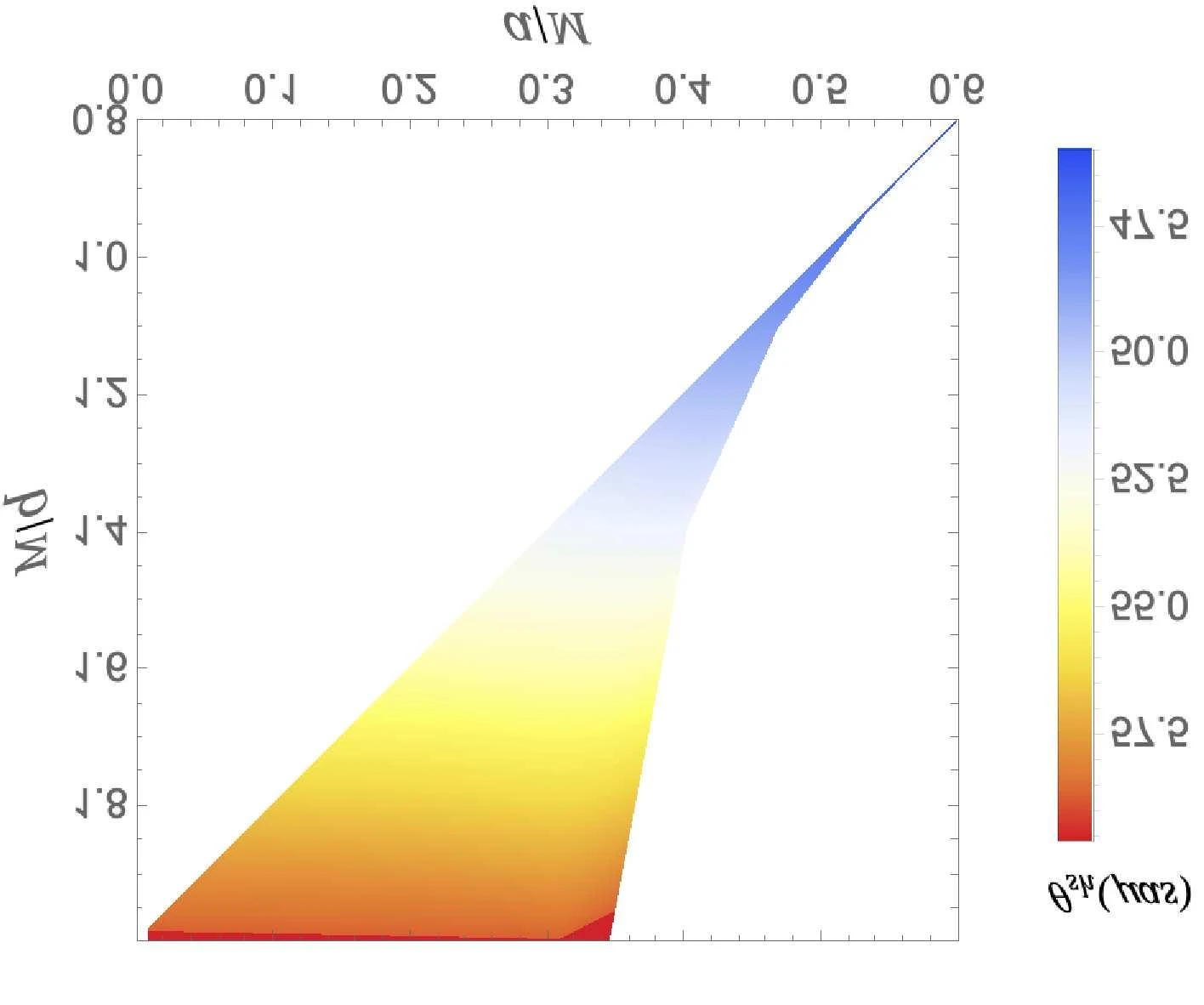
The Event Horizon Telescope (EHT) has provided a new tool for testing the strong-field regime of gravity by imaging the shadows of M87* and Sgr A*. These observations provide the first real opportunity to test whether quantum gravity--specifically loop quantum gravity--leaves observable imprints on spacetime. We use the EHT observations of M87* and Sgr A* to examine the observational signs of rotating holonomy-corrected black holes (RHCBHs). We discover that, in comparison to the typical Kerr black hole, the quantum correction parameter $$b$$ increases the size of the black hole shadow. As the deviation parameter $$b$$ increases in RHCBH, the prograde photon orbits shift outward, indicating a weaker effective gravitational field near the central region. Unlike Kerr naked singularities, which produce open arc-like shadows, the RHCBH spacetime can still produce closed shadow rings even in the absence of an event horizon. We find that photon rings continue to exist in the parameter range $$b_E \leq b \leq b_p$$, due to the presence of unstable circular photon orbits.We apply the Kumar--Ghosh method based on the shadow observables: the shadow area $$A$$ and the oblateness $$D$$ that together allow a unique determination of the spin parameter $$a$$ and the quantum correction parameter $$b$$. At $$\theta_o=17$$\textdegree~, the angular diameter bound of M87$$^{*}$$ yields $$b \leq 0.1319\,M$$ at $$a = 0\,$$ and $$b \leq 0.421\,M$$ at $$a = 0.784\,M$$, while at $$\theta_o=50$$\textdegree~, the angular diameter bound of Sgr A$$^{*}$$ yields $$b \leq 0.5764\,M$$ at $$a = 0\,$$ and $$b \leq 0.7482\,M$$ at $$a = 0.6253\,M$$ the Sgr~A$$^{*}$$. Our results show that nonzero values of the holonomy correction parameter are consistent with current EHT data, indicating that RHCBHs provide viable alternatives to the classical Kerr geometry in the strong-gravity regime and are strong astrophysical black hole candidates.
Light in a black hole's shadow can loop around, creating an infinite series of reflections, like in a hall of mirrors.
In 'Interstellar,' Gargantua's shadow was modeled using classical equations; quantum corrections would make it slightly more oval.