Popular

Black Hole Shadows Put Quantum Gravity to the Test ⚡ экспресс

Original: "Testing loop quantum gravity through EHT observations of M87* and Sgr A* using rotating holonomy-corrected black holes"
· Heena Ali, Sushant G. Ghosh
arXiv:2605.28871 · 2026-05-23 · CC BY 4.0 · ⏱ 1 min · General Relativity
Black hole shadows have helped test loop quantum gravity theory: quantum corrections are almost imperceptible, yet they still change the silhouette of the abyss.
Abstract

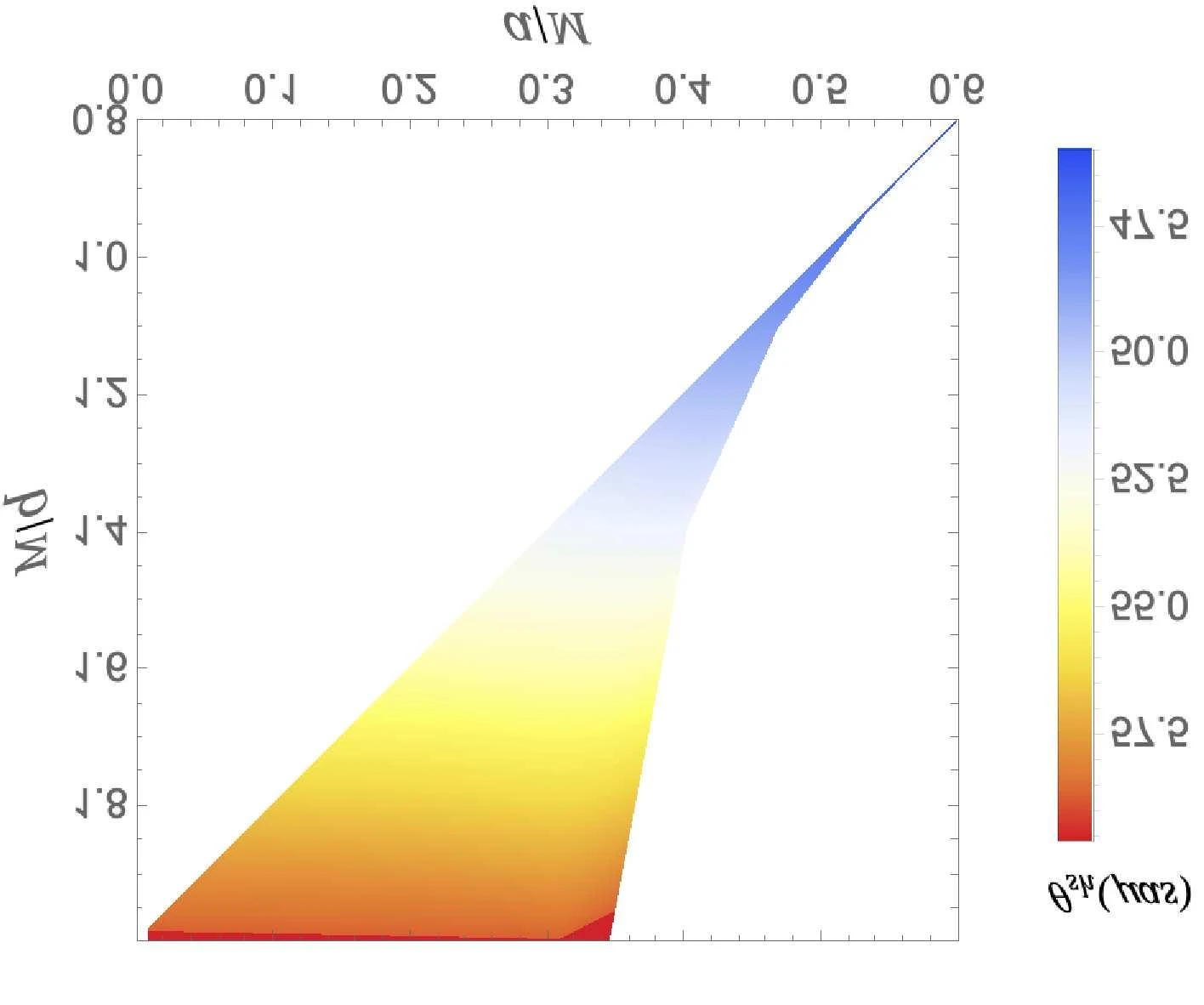
Using images from the Event Horizon Telescope, scientists studied the shadows of black holes M87* and Sagittarius A* within loop quantum gravity—a theory where spacetime is woven from quantum loops. They examined rotating black holes with a quantum correction (parameter b). It turned out that increasing b 'inflates' the shadow, and photon orbits shift outward from the center—effective gravity weakens. An intriguing fact: a closed dark ring remains even without an event horizon. According to EHT data, b for M87* can reach 0.13–0.42 solar masses, and for Sgr A*—0.58–0.75 solar masses, consistent with observations. This strengthens the case for quantum-corrected black holes as real astrophysical objects.

Links in the knowledge graph 1

📄 Showing the "Simple" version — "Popular" is not ready yet. Add it to favorites to help prioritize it.

The shadow of a black hole is not just a silhouette. It's the edge of the abyss, where space and time are twisted so tightly that even light is forced to swirl like a wood chip in a whirlpool. This 'cosmic whirlpool' arises from the monstrous mass warping spacetime.

Physicists tested what would happen if quantum effects—tiny corrections from loop quantum gravity theory, where space itself is made of microscopic loops—are added to this whirlpool. Calculations showed that quantum corrections barely perceptibly widen the shadow. But more importantly, even if you remove the 'drain hole,' i.e., the event horizon, the funnel remains closed, and the shadow stays a ring. The real surprise: inside such a black hole, there's no singularity point, just an entangled tangle of loops.

The Event Horizon Telescope (EHT)—an Earth-sized network of antennas—was able to measure the size and oblateness of the shadows of M87* and Sgr A*. The data do not yet rule out corrections: the classical model of Schwarzschild and Penrose might be just an approximation.

🎯 Light in a black hole's shadow can loop around, creating an infinite series of reflections, like in a hall of mirrors.

🎬 In 'Interstellar,' Gargantua's shadow was modeled using classical equations; quantum corrections would make it slightly more oval.

Scientists
Christian DopplerD. B. McLaughlinDidier QuelozMichel MayorR. A. RossiterStephen Hawking
Tags
black hole spacetime curvature speed of light
Laws
Doppler effectHawking radiationgravitational lensingprinciple of constancy of the speed of lightBekenstein-Hawking entropymass–energy equivalence
Original: arXiv:2605.28871 · CC BY 4.0 · bridge42worlds