Cosmic strings decay faster than we thought ✛ ✎ ✦
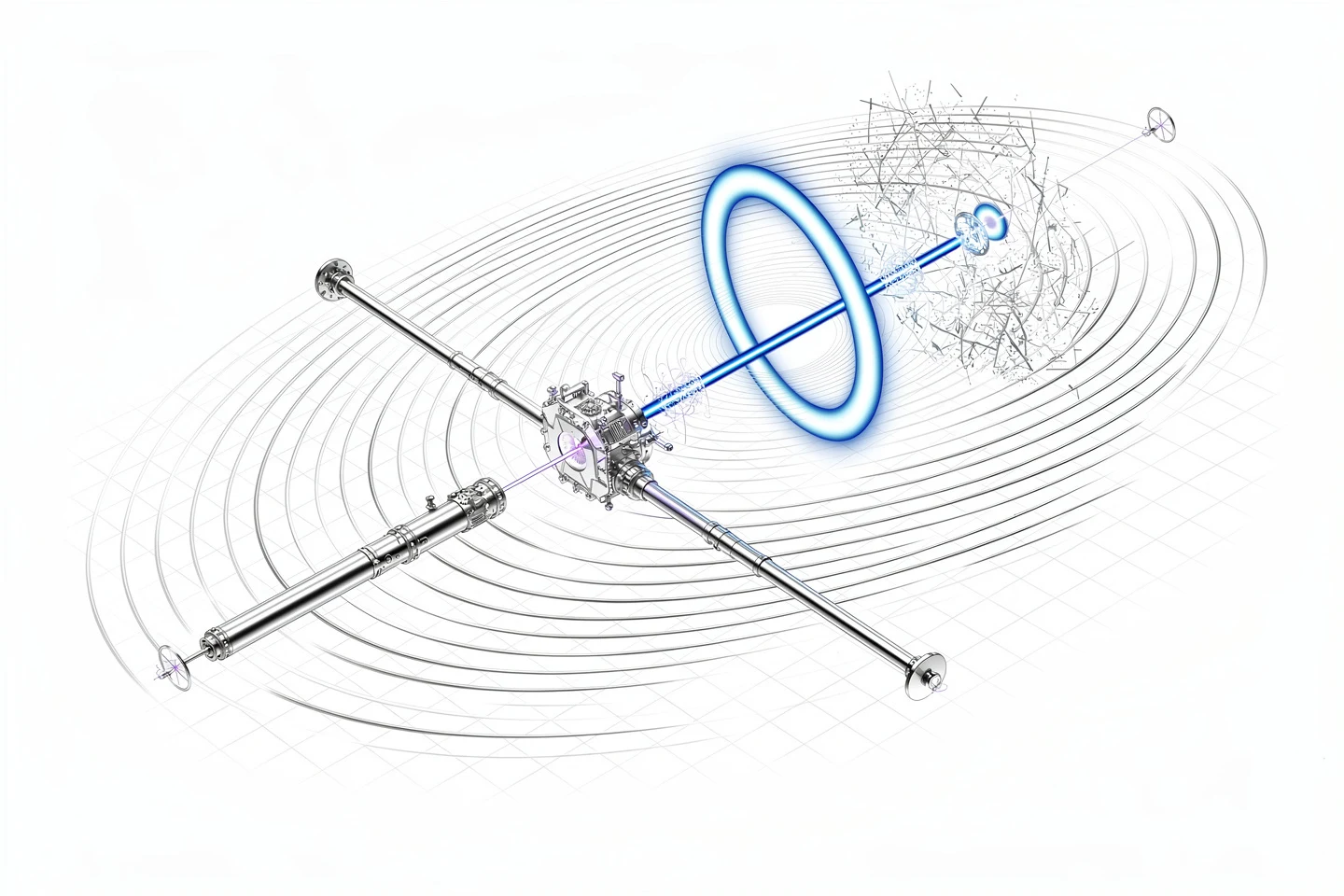
In the first moments after the Big Bang, the universe expanded and cooled. Like freezing water, cracks appeared in the fabric of spacetime — cosmic strings. These superdense filaments are thinner than a proton, yet each centimeter packs the mass of a mountain.
For a long time, strings were thought to be almost eternal. New calculations using quantum field theory have for the first time accounted for their actual thickness and shown that decay proceeds faster. The reason is quantum tunneling: particles can pass through barriers, like ghosts through walls. Because of this, strings spontaneously snap, giving birth to magnetic monopoles — elusive particles physicists have been hunting for decades.
Faster decay changes the expected signal of gravitational waves — ripples in spacetime. Detectors like LIGO (Rainer Weiss, Kip Thorne) may pick up weaker and rarer bursts. Traces of these events are also sought in the cosmic microwave background, the ancient light of the universe, as well as in observations of neutron stars.
A cosmic string, billionths of a proton thick, has such tension that it's as if each centimeter hides the mass of a skyscraper.