The Snapping Cable of Reality: How Finite String Thickness Accelerates Quantum Decay and Reshapes the Gravitational Hum ✛ ✎ ✦
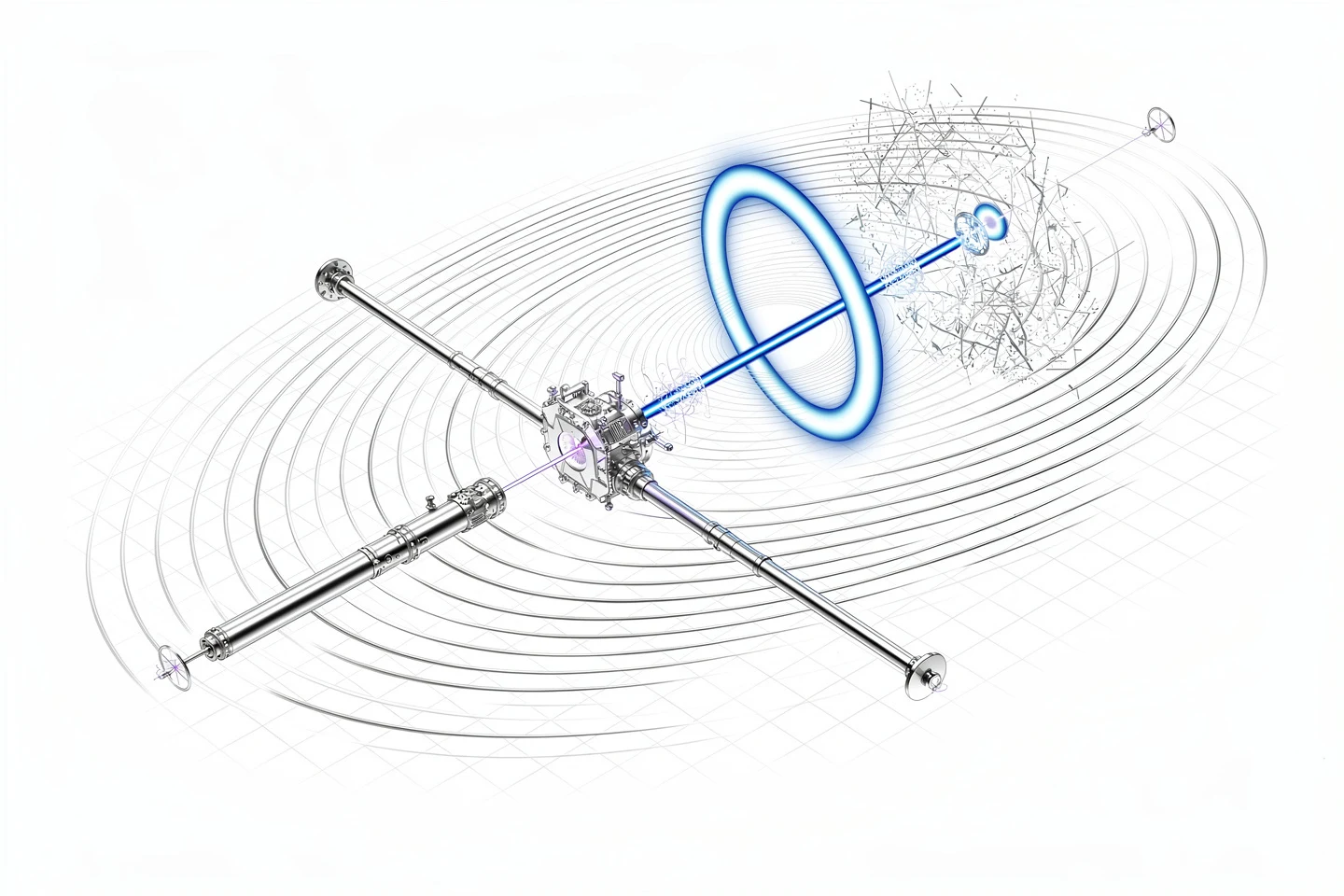
Immediately after the Big Bang, in the seething cauldron of the cooling Universe, much like in unevenly hardening glass, stresses appeared — hairline cracks in reality, cosmic strings. Picture a tightrope walker balancing on an invisible cable stretched across the abyss of warped spacetime. This cable is taut with an energy density of a million tons per centimeter. And when it snaps, it’s not a fall: it’s an instantaneous annihilation in a quantum leap, releasing ripples that can travel to us across billions of years. Those same strings might have left imprints on the cosmic microwave background — the oldest photograph of the cosmos.
For a long time, physicists were content with the infinitely thin string approximation: it’s easier to calculate. According to the Preskill–Vilenkin formula, the bounce action, the key quantity dictating the decay rate, was written as $S_B$^(PV) = π $m_M$² / μ. Here $m_M$ is the mass of the magnetic monopole born at the break, and μ is the string tension. But this formula ignores the defect’s internal structure. A team of theorists tackled the problem anew on a lattice, introducing an SU(2) gauge model with two consecutive phase transitions: first monopoles appear, then strings stretch between monopole–antimonopole pairs. A numerical gradient flow method within quantum field theory found the action minimum for a fixed break size, then tracked down the maximum — the very saddle-point scenario along which quantum tunneling proceeds.
The result is sobering: for plausible gauge boson mass ratios ($m_W$/m_γ ≈ 3), the bounce action drops by over 20% compared to the thin-string estimate. The decay rate, proportional to exp(–$S_B$), skyrockets by many orders of magnitude. A cosmic string bursts almost before it can noticeably influence the Universe’s expansion. The consequence: the characteristic cutoff frequency $f_{low}$ in the gravitational wave spectrum shifts from nanohertz to micro- or millihertz. In other words, the low-frequency hum sought by pulsar timing array collaborations, which use neutron stars as natural beacons, now requires either heavier strings or a different nature altogether to explain it.
Practically, this means the gravitational-wave landscape must be redrawn. The terrestrial LIGO detectors, built thanks to the genius of Rainer Weiss and Kip Thorne, now get an extra chance to register the echo of strings — a high-frequency “click” from individual breaks, not just a stochastic background. If such a break occurs within our Galaxy, LIGO could hear it as a distinct event — a distant gravitational thunderclap in the cosmic silence. On the other hand, the signal recently detected in pulsar timing data (PTA) is no longer a smoking gun for metastable strings: creating it demands parameters once thought forbidden. Finite string thickness, it turns out, widens the allowed region, smoothing the path for grand unification models with intermediate inflation.
If you stretched a cosmic string along Earth’s equator, its total mass would rival a small asteroid, yet its thickness would remain a billion times smaller than an atom. Step on it, and your foot would pass through like a shadow, feeling no obstacle.