The Shape of the Universe: What Black Hole Collisions Will Tell Us ✛ ✎ ✦
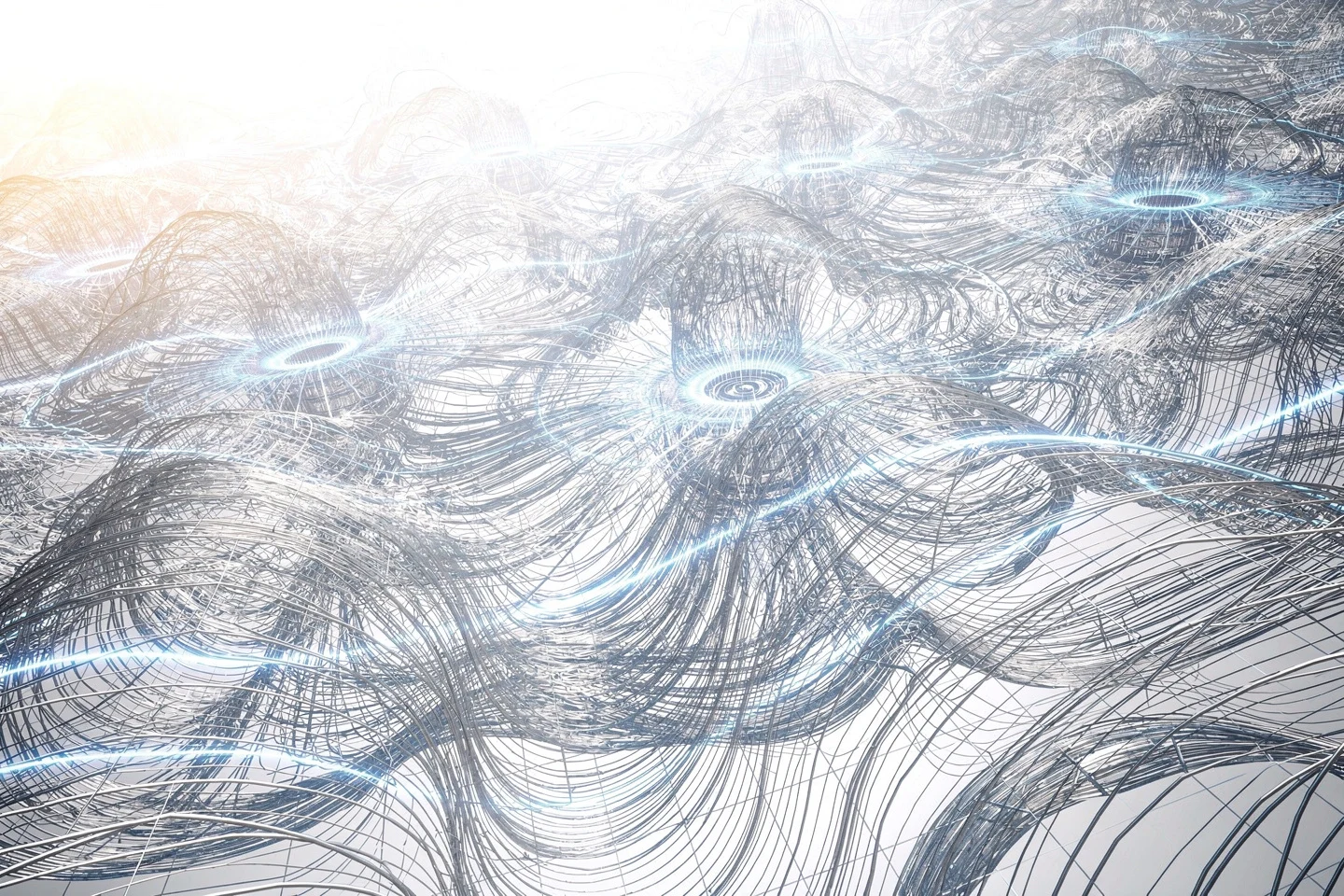
When a stone falls into a pond, the ripples on the water reveal the point of impact. The Universe is like a pond, only four-dimensional. In it, black holes collide, giving birth to gravitational waves — ripples in the fabric of space. From the amplitude of these ripples, astronomers calculate the distance to the event, and black holes provide a clearer signal than neutron stars.
If a flash of light is detected simultaneously, we can compare the distance from waves with the distance from brightness. This reveals the curvature of space, like an uneven pond bottom distorting the ripples. Future detectors will measure this curvature with an error of 0.029. Data from a few dozen intermediate-mass black hole mergers will suffice — a stunning result, achievable with the next generation of instruments.
Whether space is curved or flat as glass affects the distribution of dark matter and the properties of dark energy — the conductors of the Universe's expansion. This method complements observations of the ancient light from the Big Bang, but takes a different path. The key to synchronicity is the speed of light, the same for both waves and flashes. The very ideas of expansion were laid down by Edwin Hubble and Georges Lemaître, and black holes were predicted by Karl Schwarzschild.
Event GW231123: two black holes with a combined mass of 236 Suns proved for the first time that intermediate-mass black holes are real. They were once considered merely a hypothesis.
Sci-fi often portrays curved space as a portal to other dimensions (as in the movie 'Interstellar'). The real curvature of the Universe will tell us whether it will expand forever, stop, or collapse.