A Black Hole in a Stellar Beehive express
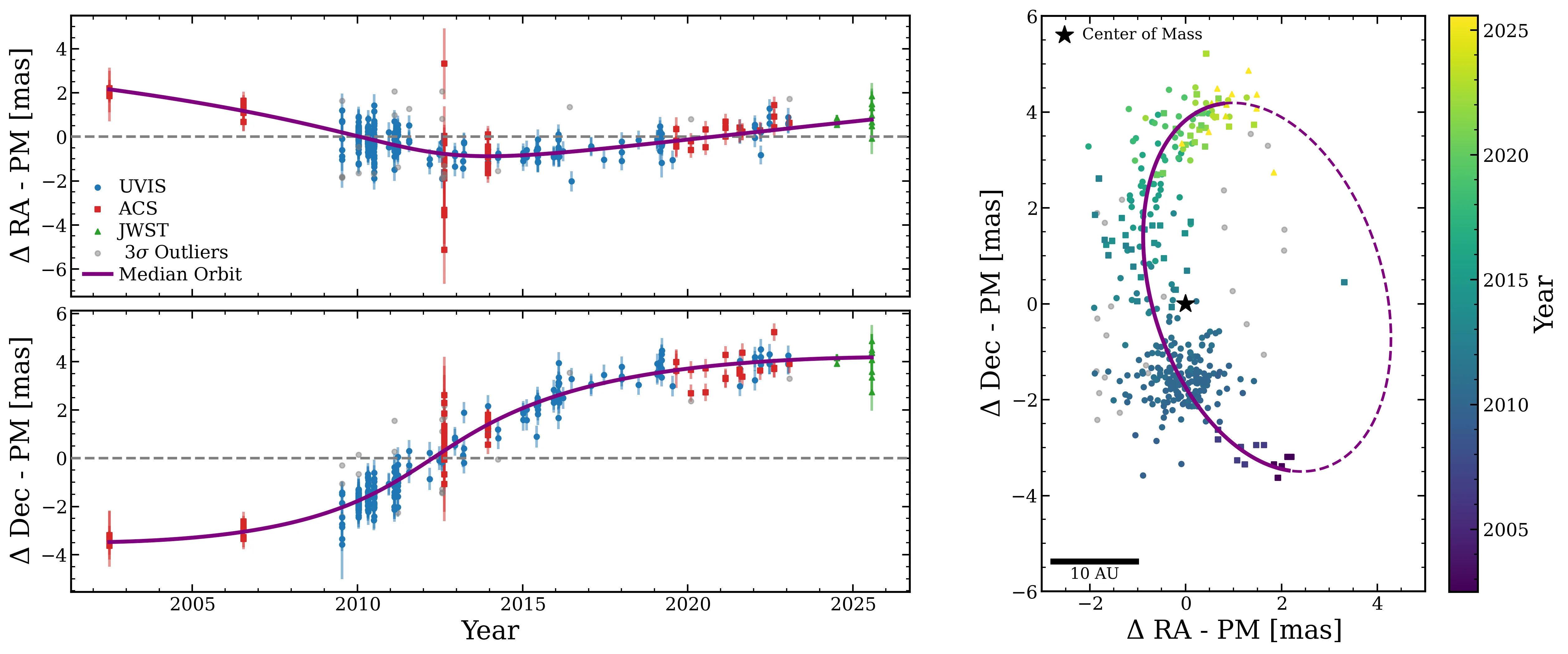
For 23 years, Hubble and James Webb have peered into the heart of Omega Centauri, a globular cluster where millions of stars crowd into a space just 150 light-years across. In this stellar beehive, the motion of the stars betrayed an invisible partner: a main-sequence star (one that has not yet left the main evolutionary branch) seemed to be tugged in a dance with an unseen weight. That is how they found black hole oMEGACat BH-2.
This dance is slow and sweeping. The pair completes one orbit in about 94 years, separated on average by 31 astronomical units — about the distance from the Sun to Neptune. But the orbit is highly elongated: at closest approach, the objects pass near each other, and it is precisely this moment that astronomers were lucky enough to catch. Thanks to that luck, the invisible object's mass is precisely determined—4.46 solar masses. For a black hole, that is modest, especially in an environment where stars were born from nearly primordial gas (with elements heavier than helium at less than one-thousandth of the solar abundance).
The discovery breaks a stereotype: it was thought that at such low metallicity, black holes should be more massive. This means nature can make lightweight black holes even from nearly pure hydrogen and helium. Moreover, the pair is likely not native — the stars did not form together but found each other in the cluster's hustle and bustle. Their union is fragile: in about 800 million years, gravitational nudges from neighbors will tear the pair apart. But for now, it dances — revealing secrets of stellar dynamics that were previously just lines in simulations.
Omega Centauri is so massive that it may be the core of a dwarf galaxy swallowed by the Milky Way billions of years ago.
In Peter Watts's novel Blindsight, black holes in globular clusters serve as a refuge for an ancient intelligence — the discovery of oMEGACat BH-2 makes such a fantasy a bit more tangible.