The Hubble Space Telescope is an orbiting observatory that captures high-resolution images of celestial objects, aiding in cosmological and exoplanetary studies.
The Hubble Space Telescope is an 11-ton reflector in orbit at an altitude of about 540 km. Its Ritchey–Chrétien optical design provides ideal image quality in ultraviolet and visible light. Thanks to the absence of atmosphere, it achieves a resolution of 0.05 arcseconds — equivalent to the ability to discern a coin from 100 kilometers away. Main instruments: WFC3 camera, COS spectrograph, ACS camera, and others.
History
The Large Space Telescope project was developed since the 1960s. The launch was repeatedly postponed, including due to the Challenger shuttle disaster in 1986. On April 24, 1990, Discovery placed the telescope into orbit, but it was discovered that the primary mirror suffered from spherical aberration — a shape error. The first repair mission (STS-61, 1993) installed the COSTAR unit with tiny corrective mirrors and replaced the camera, revitalizing the project. Subsequent missions added ever more sophisticated instruments: the ACS camera (2002), the COS spectrograph and WFC3 camera (2009). From the outset, the scientific inspiration behind the project was Lyman Spitzer, and the name of Edwin Hubble recalls his epoch-making discovery of the expansion of the Universe. It was with Hubble that Adam Riess and his colleagues discovered that this expansion is accelerating.
How it works
HST uses a Ritchey–Chrétien optical system with an effective focal length of 57.6 m (f/24). Light is collected by the primary mirror, reflected to the secondary hyperbolic mirror, and then through the central hole in the primary projected onto the focal plane, where instruments are located. Cameras use CCD sensors; spectrographs use diffraction gratings. Fine pointing is achieved by the Fine Guidance Sensors, which use 14th-magnitude stars. The onboard computer executes observation scripts; data transmission occurs via radio link through TDRS satellites.
In practice
Thanks to Hubble images, the age of the Universe has been refined to 13.8 billion years, and water and methane were directly detected for the first time in the atmospheres of distant exoplanets.
Fun fact
Hubble does not see stars twinkling — on Earth, twinkling is caused by atmospheric turbulence, but in orbit the air does not interfere, and images are crystal clear.
Imagine looking at a distant mountain range through morning fog. The peaks' outlines are blurred, and if the fog is patchy, some slopes fade more than others. That's roughly how astronomers see the ancient light of the universe, which has been traveling to us for 13.8 billion years.
This light was born when the universe was just 380,000 years old, long before the first stars.
In a distant galaxy, light from hot gas should reveal its composition. The James Webb Telescope split that light into a spectrum, and astronomers saw: oxygen lines too weak.
Every morning, a janitor sweeps leaves into a pile. The Sun, as it travels through the galaxy, does something similar: its gravity gathers diffuse interstellar gas into an invisible cone — a giant funnel.
In the heart of an old city stands a clock tower whose hands have never been adjusted since it was built. By how far it runs slow, you can calculate how much time has stretched since then. In space, the role of such towers is played by relic galaxies — dense stellar systems that formed in the first few billion years and have since neither merged with neighbors nor given birth to new stars.
A lamp is hidden behind a large aquarium filled with water. You see not one light source but several reflections and refractions — the water bends the path of the rays.
Measuring distances in the universe is no easy task. Almost all methods rely on light, which can be absorbed by dust, scattered, or distorted along the way. It's like trying to spot a distant lighthouse through fog and haze. Neutrinos are a different story. These ghostly particles pass through anything without noticing obstacles.
Edge of the spotlight. Remove the dazzling light of the central star, and a theater of shadows emerges. The James Webb coronagraph, like a dense curtain, hid the star TW Hydrae — and on a stage 120 astronomical units long (four times the distance to Neptune), its protoplanetary disk came alive.
Tabby's Star, a beacon in the cosmic sea, has baffled astronomers since 2015. Its light flickered not in the rhythm of planets, but as if scattered by a storm — deep dips, sharp spikes. But amid this chaos, a smooth, nearly perfect dip was found. The eye of the storm.
Water comes in different varieties. Not just fresh or salty, but also "heavy"—when one of its hydrogen atoms is replaced by deuterium, its heavier cousin. Such water is called HDO, and it's a true cosmic passport: the amount of deuterium in water reveals where and when that water was born.
The optical sky background is a cosmic palimpsest, where light from billions of unresolved galaxies is layered, each layer corresponding to a different epoch. Until now we could only distinguish the brightest "letters"—individual stars and nearby galaxies.
In 2024, the team led by David Charbonneau pointed the Magellan telescope with the WINERED spectrograph at LHS 1140. During transit, high-resolution spectroscopy caught the absorption line of metastable helium at 10833 Å.
The standard cosmological model ΛCDM, where dark matter and dark energy act as the chief architects of the cosmos, has predicted astronomical data with Swiss-watch precision for decades. Its foundation was laid by three geniuses.
When we peer deep into space, we see the past. Edwin Hubble’s law turns redshift into a time machine: light from galaxy UDS 12999 traveled to us for 7.6 billion years — more than half the age of the Universe.
Tiny seeds of life can cross the black void on icy wanderers like comet 3I/ATLAS. The James Webb Space Telescope found water and methane on it for the first time, and light analysis revealed an unusual gas composition.
The cosmological orchestra doesn't tune to a single tuning fork. There are two groups of instruments: one listens to the hum of the young universe — the cosmic microwave background, while the other reads notes from mature galaxies and supernovae.
A world where a year lasts just one and a half Earth days, and the star in its sky is hundreds of times larger than our Sun. This is KELT-9 b — a gas giant heated to temperatures at which iron vaporizes. Its atmosphere is not just hot; it is literally boiling away into space, like steam rising from a giant cauldron.
The universe is a vast orchestra playing the score of expansion. Galaxies race apart to the beat of inaudible music of dark energy. But here's the trouble: the conductor's baton held by Edwin Hubble, Adam Riess, and Vera Rubin sets two incompatible tempos.
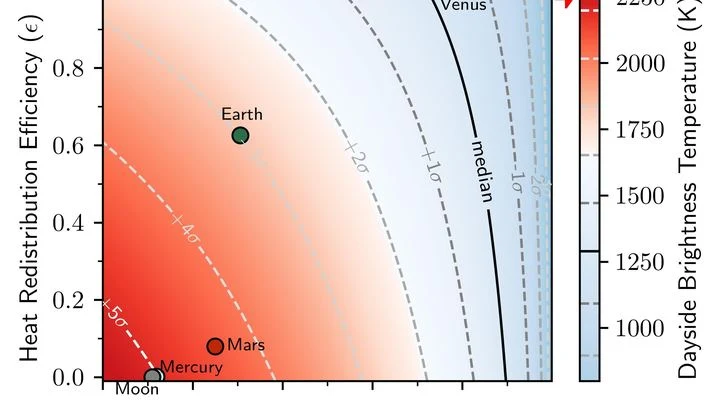
The planet WASP-121 b is a gas giant, heated to 2500°C. It always faces its star with one side, like a globe frozen under a lamp. But as it passes in front of the star's disk, its rotation reveals different facets to us — as if that globe were slowly turned, letting us peer into every corner.
A giant baby planet is still pulling in leftover building material from its surrounding cloud. That's the scene the Hubble Space Telescope captured when it aimed its cameras at an object catalogued as SR 12 c. This companion planet orbits a young star at a wide distance — farther out than Neptune is from the Sun.
The atmosphere of Titan, discovered by Christiaan Huygens, is opaque to ordinary telescopes. But spectral analysis finds 'windows' of transparency — narrow regions where the haze parts.
Astronomers using the JWST (James Webb Space Telescope) have for the first time studied in detail the atmosphere of a young exoplanet, V1298 Tau c. This super-Earth, a planet more massive than Earth but less so than gas giants, is only 23 million years old.
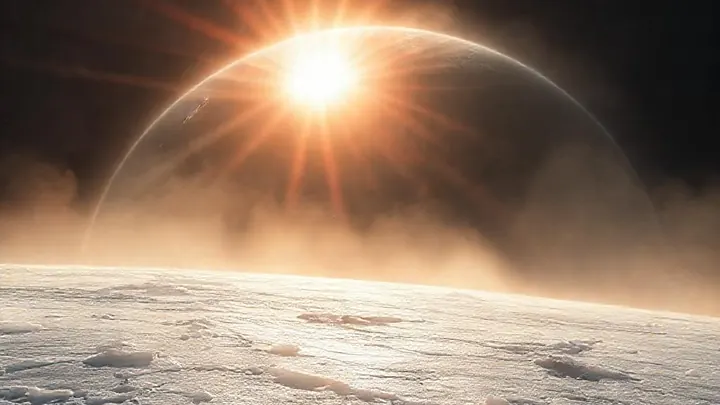
When a planet slips behind the edge of its star, the star backlights the planet's atmosphere, just as a setting sun illuminates clouds on the horizon. This brief moment, lasting only minutes, carries the imprint of the gases through which the starlight has passed.
Light takes 124 years to reach us. That's how long it takes for the star's rays to bring news of K2-18b — a planet entirely covered by an ocean but wrapped in a thick hydrogen blanket. It's about two and a half times the size of Earth. For a long time, scientists debated: a water world with a dense atmosphere, or a scaled-down Neptune without a solid surface?
Planet WASP-121 b always shows the same face to its star, like a rock in a campfire. The dayside is so hot that ordinary hydrogen, the very stuff most of the universe is made of, can't take it: its molecules tear apart into individual atoms, and the temperature flips upside down: the higher you go, the hotter it gets.
Astronomers aimed JWST at the rocky exoplanet LHS 3844 b — a world orbiting another star, where a year lasts just 11 hours. The planet is tidally locked: one side always faces the star, with a permanent scorch of 770°C, while the night side is plunged into icy darkness.
The cosmological dispute resembles two craftsmen measuring the same room with different tape measures. One, looking at distant galaxies, gets one number. The other, peering into the ancient glow (the cosmic microwave background, the cooled light of the Big Bang) gets another, smaller number.
A giant planet hangs in space in complete solitude, separated from its star by a distance 160 times greater than the path from the Sun to Pluto. The light from its parent star arrives so faintly that the surface temperature barely exceeds 200 degrees Celsius — about as warm as a well-heated sauna.
The light from two galaxies, caught by the James Webb telescope, traveled 13 billion years to us, beginning just 600 million years after the Big Bang. Breaking this light into colors (spectral analysis), astronomers saw not just distant galaxies but true lighthouses: within them blazed giant stars.
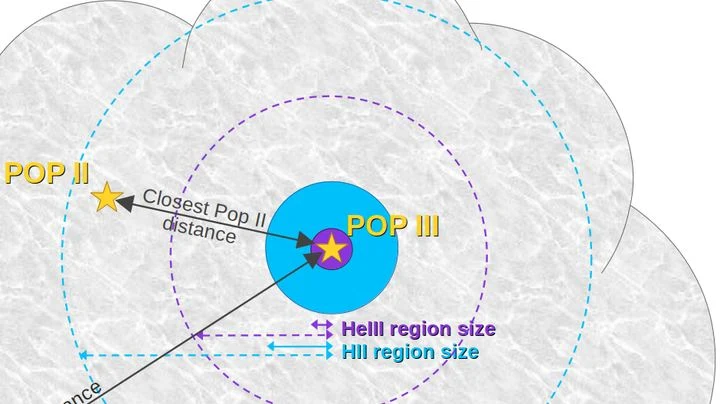
After the Big Bang, the Universe was filled with cold gas — mostly neutral hydrogen and helium. It enveloped the cosmos like a morning fog, impenetrable to light. The Dark Ages began.
When the first galaxies ignited, their radiation, like a searchlight beam, started knocking electrons out of atoms.
A hot skillet on the stove glows in the dark, but if you cover it with a lid, the heat escapes more slowly and the surface doesn't look as bright. That's roughly the situation on planet HD 3167 b: it always shows the same face to its star, and the dayside is heated to temperatures that melt rock.
The Universe is expanding, but at what speed? Astronomers have been arguing for decades about the precise value of the Hubble constant. Two classic methods give slightly different results. Now there's a third — using mysterious radio bursts.
When an exoplanet briefly eclipses its star, starlight passes through its air and absorbs its chemical taste. This technique, the transit method, is the core of how the James Webb telescope works.
Light from a distant star, passing through the atmosphere of planet K2-18b, left unusual "fingerprints" in its spectrum. Astronomers spent 420 hours collecting this light with the James Webb Space Telescope and split it into colors, like a rainbow.
Immediately after the Big Bang, an idea championed by Georges Lemaître, the cosmos was a dark broth of hydrogen and helium. Then the first stars ignited — enormous, dazzlingly bright and hot, like sparks from a cosmic bonfire.
Astronomers have tested the new Vera C. Rubin telescope in Chile, much like adjusting the focus and aperture on a brand-new camera. The first images covered a patch of sky the size of 60 full Moons, and immediately revealed millions of galaxies and stars. The imaging was done in various colors, from invisible ultraviolet to thermal infrared.
Light from a distant galaxy traveled to us for 13.4 billion years. The James Webb Space Telescope caught it and split it into colors. The spectrum shows a bright hydrogen line, like a fingerprint saying that galaxy GS-z13-1-LA is actively forming stars.
Young hot stars inside the galaxy act like floodlights.