Tiny Diamond Compass Peers Inside Batteries express
Ordinary magnetic sensors lose sensitivity as they shrink. But scientists turned a tiny diamond into a light-based compass. Unlike jewelry diamonds, what matters here isn't purity but artificially created defects — these are what turn the crystal into a compass. Under a laser beam, these defects start glowing, but a magnetic field sharply quenches the glow. That's how the diamond reveals the field's direction and strength.
The secret to its clarity lies in a fiber-optic bundle of many glass threads. One thread carries the beam to the diamond, while others collect the returning light, eliminating interference. This entire optical setup, along with the diamond, fits inside a 6-mm tip — thinner than a pencil.
The sensor is so sensitive it picks up fields millions of times weaker than Earth's, and it needs no bulky shielding. They brought it close to a working lithium-ion battery and, through spectroscopic measurements, mapped the internal currents.
This technology will be useful for checking microchips, implants, and even studying living tissues.
Original abstract
as written by the authors arXiv:2606.18871
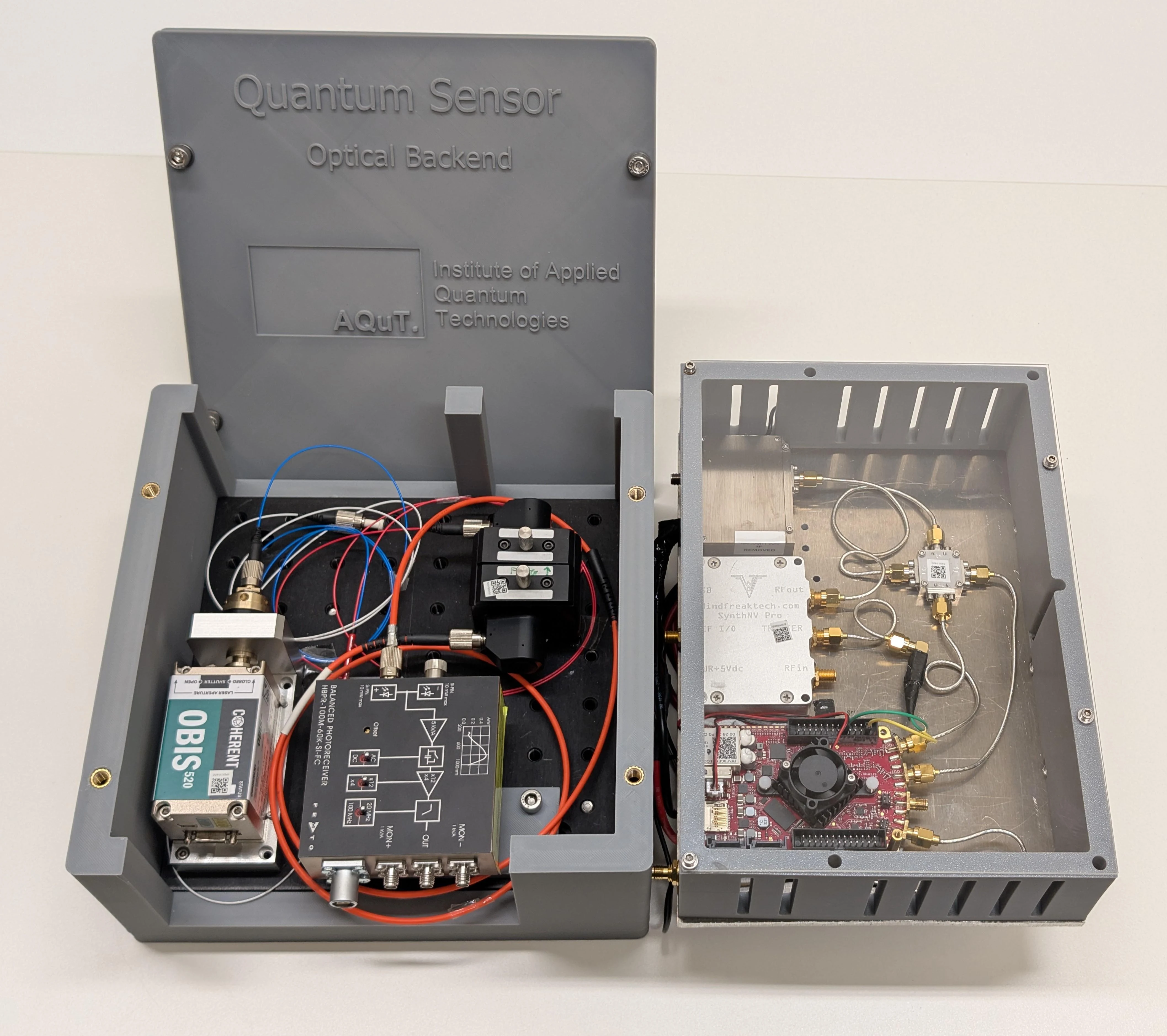
Transitioning quantum magnetometry from laboratory environments to real-world applications has been limited by a persistent trade-off between sensor miniaturization and magnetic sensitivity. While bulky systems can achieve high sensitivity, endoscopic probes commonly suffer from inefficient fluorescence collection and reduced performance. Here we resolve this trade-off and present a miniaturized diamond quantum magnetometer with a 6 mm diameter endoscopic sensor head, achieving a magnetic-field sensitivity of 91 pT/sqrt(Hz) with a 2 kHz measurement bandwidth in a magnetically unshielded environment. The fluorescence collection bottleneck is overcome by separating excitation and collection into different cores of a fused multi-core fiber bundle, coupled to the diamond through a custom high-numerical-aperture micro-objective. A compact FPGA-based backend performs microwave control, lock-in detection and real-time resonance tracking, enabling robust operation during magnetic-field imaging. To demonstrate the practical utility of the miniaturized sensor, we image the magnetic field of a commercial lithium-ion pouch cell during charge and discharge and reconstruct depth-integrated current-density maps of the current flow. These results show that endoscopic diamond magnetometers can combine high sensitivity with a probe geometry suitable for confined, unshielded measurements, opening new avenues in battery technology and beyond.
These sensors are already being tested to record nerve impulses: they sense the ultra-weak magnetic fields that neurons create.
This device is like a tricorder from Star Trek — a portable scanner that sees the internal structure of objects.