Noise in the Trap: Dust Grains vs. Quantum express
A quantum computer is like an orchestra where each ion is a musician and laser pulses are the conductor's baton. But if someone in the audience rustles, the delicate melody of quantum states goes off key. In ion traps, that rustling is the electrical noise from the electrode surface. It reduces the accuracy of operations, and the stronger the noise, the faster the quantum processor starts to "play out of tune."
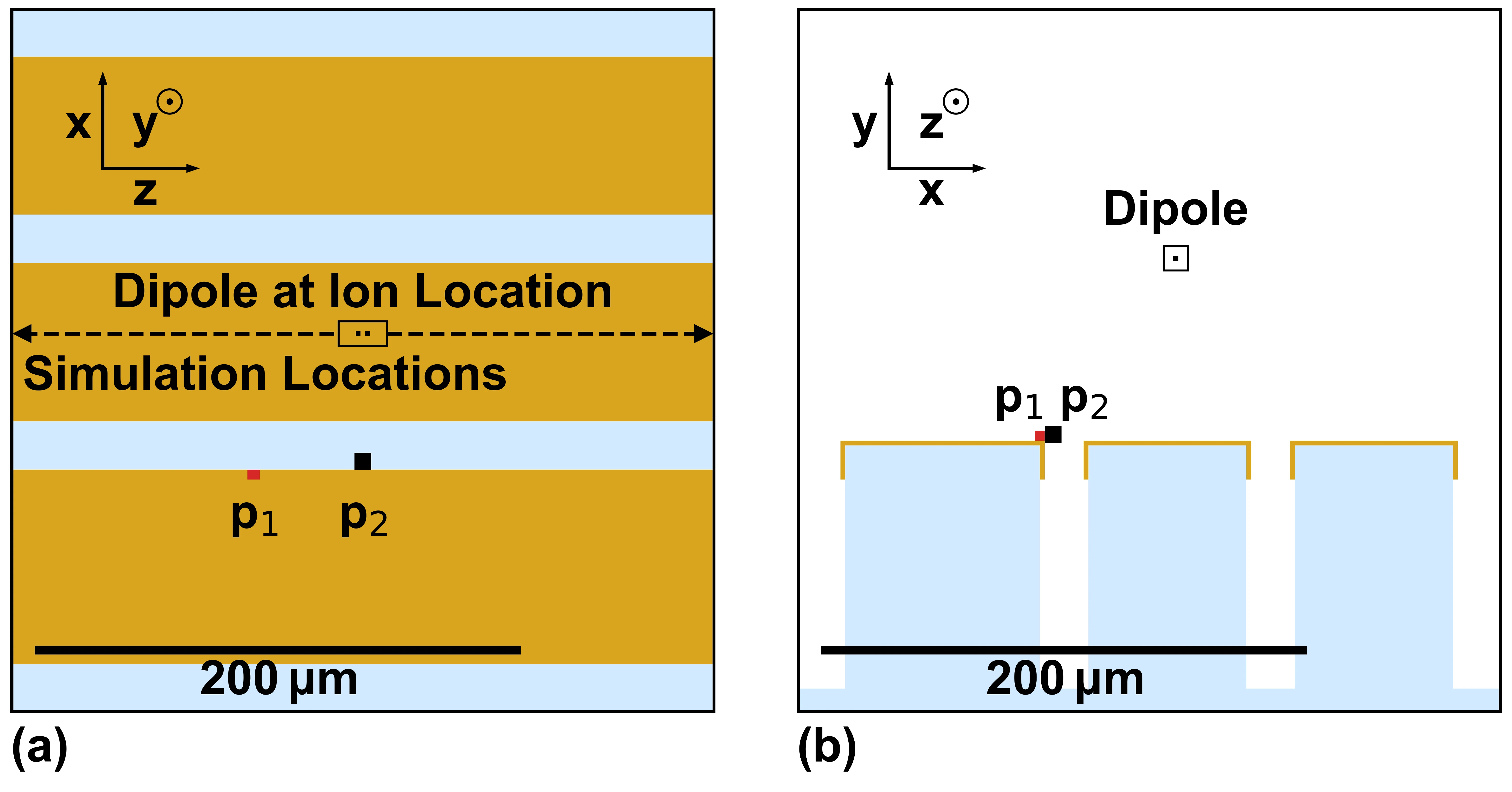
The authors of the new study looked right into the source of this noise. They took a linear surface Paul trap, a device where ions hover above a plane of electrodes, and measured the noise along its axis. It turned out that over a distance of 600 micrometers (just under the thickness of a credit card), the noise level changes by a factor of a thousand. Images from optical and electron microscopes showed that at the noisiest spots, particles a few microns in size sat on the electrodes, like dust motes in the air, but settled on metal.
To understand how dust grains create noise, the scientists modeled them as a "leaky" dielectric — a material that isn't a perfect insulator and slightly conducts alternating current. Such a dielectric is characterized by the loss tangent (a measure of how much electric field energy is converted into heat). By setting this parameter to 0.33, the model accurately described both the magnitude of the noise and how it depends on position and frequency. In other words, dust grains act as tiny antennas that pick up external fields and re-radiate them right into the ion trap.
Now it's clear why there is such a scatter in noise data in the literature: it all comes down to surface cleanliness. A single unnoticed dust grain can ruin the performance of an entire quantum processor. But the good news is that this problem can be tackled, just clean the electrodes more thoroughly before assembly. Then the ion orchestra will play more clearly.
The loss tangent of 0.33 found in this work is close to values for some glasses and ceramics — materials often found in ordinary dust.