An impurity is a foreign atom or defect deliberately or accidentally introduced into a material's crystal lattice. Even at concentrations of parts per million, impurities can dramatically alter a material's electrical, optical, magnetic, and mechanical properties. In semiconductors, impurities are the foundation of modern electronics: adding phosphorus to silicon creates n-type material with extra free electrons, while boron creates p-type material with electron 'holes' that act as positive charge carriers. The controlled placement of impurities is what allows transistors, diodes, and integrated circuits to function.
History
The systematic study of impurities in solids began in the early 20th century, with the development of quantum mechanics. Alan Wilson's 1931 band theory of solids explicitly incorporated impurity levels, explaining why doped semiconductors behave differently from pure crystals. The practical exploitation of impurities took off in 1947 with the invention of the transistor at Bell Labs.
How it works
Impurities disrupt the perfect periodicity of a crystal lattice. This disruption creates localized energy states within the material's band gap — the energy range where electrons cannot normally exist. These states can donate or accept electrons, changing the material's conductivity. In superconductors, impurities can act as pinning centers that hold magnetic flux lines in place, allowing higher currents without resistance. In quantum systems, an impurity in a 'quantum sea' of electrons can become a polaron — a quasiparticle where the impurity drags a cloud of lattice distortion as it moves, effectively gaining mass and changing its mobility.
In practice
Impurity doping is the core technology of all semiconductor devices, from computer chips to solar cells. In astrophysics, impurities in stellar plasma affect crystallization processes in white dwarfs, influencing their cooling rates and observable properties.
Fun fact
In a silicon crystal, adding just one atom of phosphorus per billion silicon atoms increases electrical conductivity by a factor of about a thousand.
A light switch clicks, and the light comes on. But imagine a switch that, with the same press, can either turn on the lamp or leave the room dark. It also remembers what it did last time, and sometimes it seems to flip a coin to decide whether to light up.
This kind of behavior was found in a crystal of black phosphorus — a semiconductor just a few atomic layers thick.
Organic light-emitting materials are like a busy intersection without traffic lights. Molecules receive energy but, instead of honestly giving it back as light, they often turn into dead ends: they form dark pairs (exciplexes — short-lived complexes that do not emit) or collide with each other, losing charge.
Quantum matter rarely treats us to the spectacle of self-motion. Where the classical world teems with starling murmurations, fish schools, and bustling bacteria, quantum thermodynamics long remained serene.
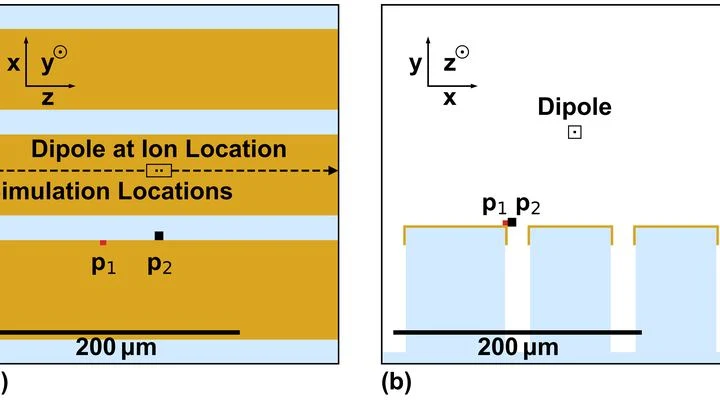
A quantum computer is like an orchestra where each ion is a musician and laser pulses are the conductor's baton. But if someone in the audience rustles, the delicate melody of quantum states goes off key.
A superconductor is like a perfect electron dance: electrons move in pairs without losing energy, like dancers who never miss a beat. But add a few magnetic impurities, and strangers crash into the dance, disrupting the synchronized motion. The temperature at which this dance begins drops.
A big sticky ball thrown onto a dusty shelf bounces off and kicks up a cloud of dust, but if you roll it slowly, it picks up every bit. Rydberg excitons behave just like that — they're giant 'atoms' inside a crystal, named after Johannes Rydberg.
A sheet of graphene is a mesh of carbon atoms one atom thick. Even the slightest contamination shows up on it, like dust specks on eyeglass lenses. Ten years ago, researchers learned to hide graphene between layers of boron nitride, like placing a fragile sheet between two pieces of plastic wrap.
A crystal of calcium ions in a trap, illuminated by a laser, is a tiny model of the matter inside a white dwarf. There, in the depths of a dying star, atomic nuclei arrange into a rigid lattice as the temperature drops.
A semiconductor film one atom thick is like a tightly stretched membrane. Light makes it flash: luminous points (excitons) are born, which quickly fade. Where the membrane is torn or crumpled, the glow flickers and stutters, like a string with a knot sounding off-key.
A semiconductor diode normally conducts current in only one direction, like a spring-loaded door: it opens easily one way but pushes back the other. But if you dope the crystal heavily, the door starts behaving strangely: under reverse bias, the current doesn't just flow: it shoots up.
In the macroscopic world we know, any motion inevitably decays: friction, a dissipative process that scatters energy, intervenes. But quantum reality has surprises in store.