How to See Magnetic Fields in the Hottest Depths of Earth express
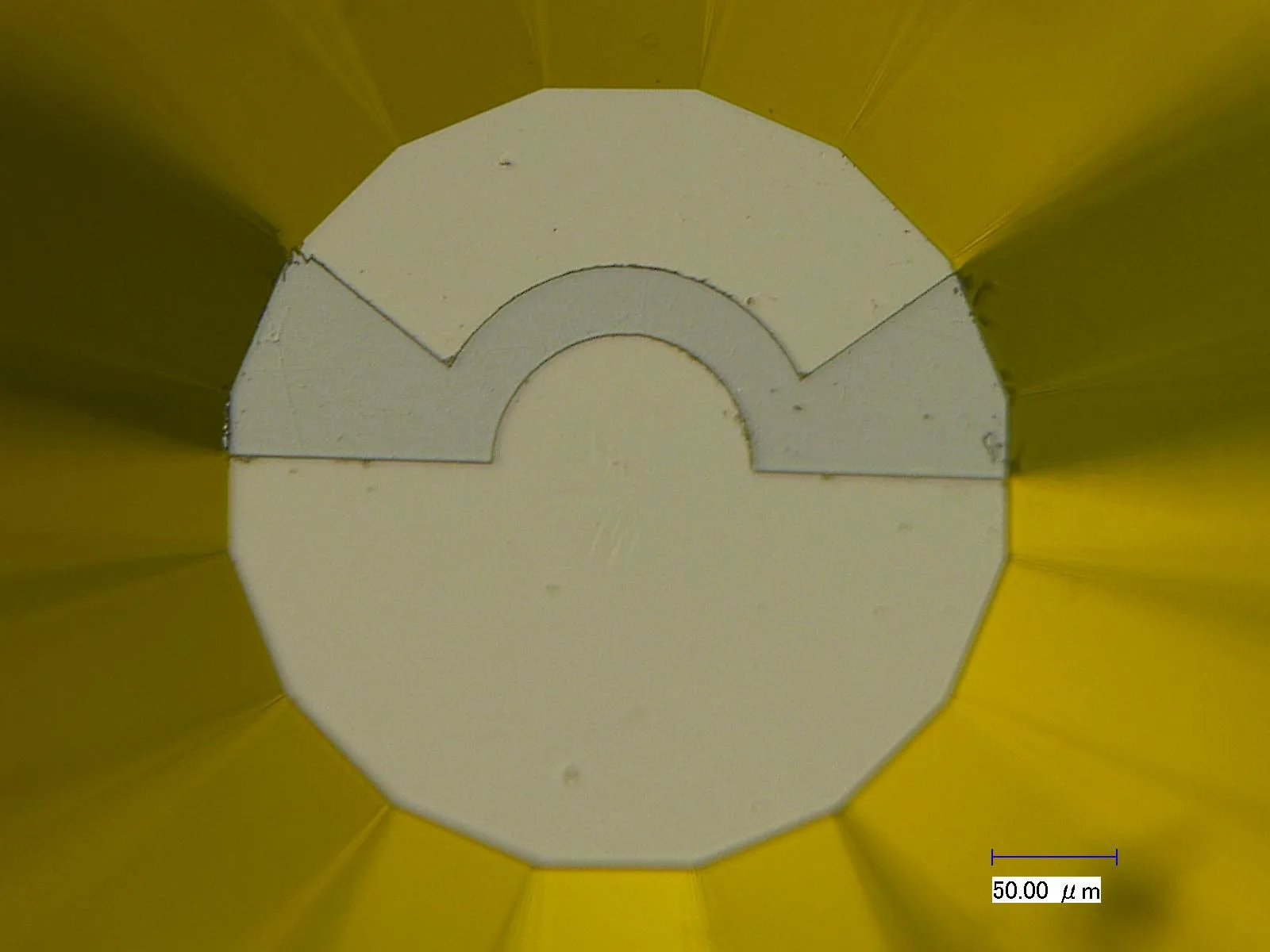
Deep underground, iron glows white-hot, and the pressure is so intense that an ordinary instrument would be crushed flat. To peer into this world, physicists built a special microscope based on tiny diamond defects (so-called NV centers). These defects glow differently depending on the surrounding magnetic field, and they can operate where conventional electronics fail.
In the new study, the researchers placed such a diamond sensor in a chamber that simultaneously squeezed the sample to 70,000 atmospheres and heated it to 500 degrees. Through the chamber walls, they tracked the glow of the defects and, for the first time, saw the magnetic "portrait" of a piece of iron at 7 gigapascals and the same temperature. The iron became magnetized, and its field distorted the signal from the diamond — in the image, this appeared as shadows cast by invisible field lines.
This method, optical microscopy through diamond windows, allows not just measuring the average field but also seeing its spatial distribution. This is important for studying magnetic phase transitions (for example, when a material loses its magnetism upon heating) and the behavior of materials under conditions close to planetary cores. So, white-hot iron is no longer invisible: its magnetic pattern can now be examined in detail.
Original abstract
as written by the authors arXiv:2606.25378
We demonstrate wide-field optically detected magnetic resonance (ODMR) under simultaneous high-pressure and high-temperature conditions using nitrogen-vacancy (NV) centers. Although NV-center magnetometry has been widely used for spatially resolved magnetic-field imaging, its application to extreme environments combining pressure and temperature remains challenging. In this work, we show that ODMR can be observed at 5 GPa and 500 K, demonstrating the feasibility of NV spin readout under such combined extreme conditions. We further perform wide-field ODMR of iron at 7 GPa and 500 K, where the stray magnetic field from the sample is spatially visualized through the pressure cell. These results establish NV-center magnetometry as a promising platform for imaging magnetic phenomena in materials under high-pressure and high-temperature environments.
Diamond NV centers are so sensitive that they can detect the magnetic field of a single electron in a neighboring molecule.