Infrared imaging is the technique of capturing and visualizing infrared radiation—light with wavelengths longer than visible light but shorter than microwaves—to create images based on heat or thermal emission. It allows us to 'see' in the dark, detect temperature differences, and observe objects that are invisible to the naked eye. This technology is crucial in fields ranging from astronomy to medicine, where it reveals thermal patterns and hidden structures.
History
The first infrared detectors were developed in the early 19th century, but practical infrared imaging emerged in the 20th century with military applications during World War II. Modern uncooled microbolometer arrays became widely available in the 1990s.
How it works
Infrared cameras use sensors made of materials like indium gallium arsenide (InGaAs) or microbolometers that respond to infrared photons. These sensors convert the incoming radiation into electrical signals, which are then processed to form a thermal image. Some systems use quantum well infrared photodetectors (QWIPs) or uncooled microbolometers that change resistance with temperature. The image displays temperature variations as different colors or shades of gray.
In practice
Infrared imaging is used in night vision, thermal inspection of buildings, medical thermography, firefighting, and astronomical observations of cool objects.
Fun fact
Infrared cameras can detect a single photon in some advanced quantum imaging setups, enabling imaging with extremely low light levels.
Spectroscopy has always been a way to hear the unheard. Back in the 19th century, Johann Balmer deciphered the elegant lines of hydrogen — a simple numerical harmony that foreshadowed quantum theory.
Deep underground, iron glows white-hot, and the pressure is so intense that an ordinary instrument would be crushed flat. To peer into this world, physicists built a special microscope based on tiny diamond defects (so-called NV centers).
An ultra-sensitive microphone listens not to sound, but to the trembling of space itself. That's how gravitational wave detectors work — LIGO, Virgo, KAGRA.
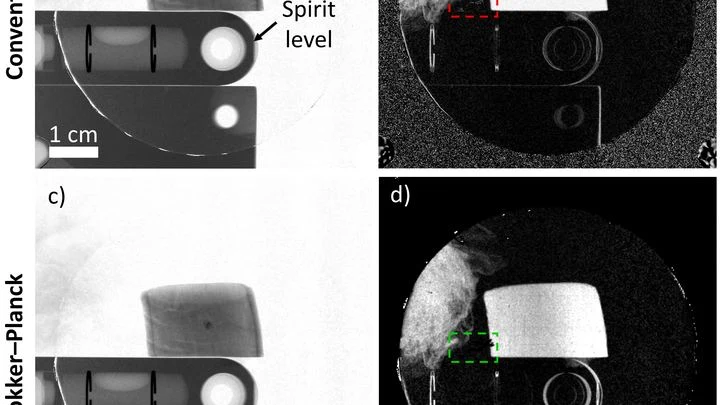
An X-ray machine with gratings takes not one but three pictures at once: a regular image, a map of beam deflections invisible to the eye, and an image of tiny structures that scatter light. Together, they help spot, for example, emphysema or pulmonary fibrosis. But there's a catch: to separate these three layers, you need a clever mathematical trick.
A galaxy is like a glowing pancake studded with stars. If you look at it face-on, you see everything at once — both the bright spiral arms and the dark dust lanes. But tilt the pancake, and the picture changes: layers overlap, light blends together. This very effect, it turns out, creates the illusion of a tight link between radio and gamma-ray emission in distant star systems.
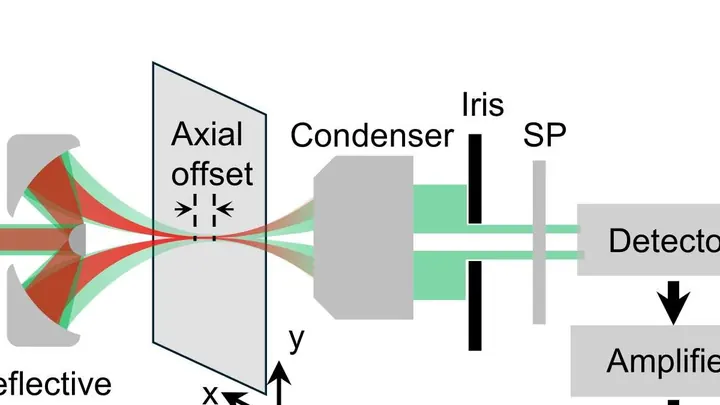
A conventional lidar is like an artist who paints a landscape but sees only gray shadows. It measures distances to each point accurately, but can't tell whether it's looking at rock, wood, or plastic. To learn the composition, you need a spectrometer — a separate device that works slowly and can't keep up with a fast scanner.
The new system takes a different approach.
Light we can't see but feel as heat turns out to be the key to cellular life. A new type of microscope uses waves 2000–2500 nanometers long, three times longer than red light, and such waves barely scatter in tissue. Thanks to this, the device peers into a tumor spheroid like a flashlight through frosted glass, illuminating individual molecules.
Earth's magnetic field is like an invisible river that meanders beneath our feet. Navigators and geologists rely on maps of this river, but instruments only take readings at scattered points, leaving blank spots in between. Filling those gaps is like trying to sketch the river's course from a few pebbles found on the bank.
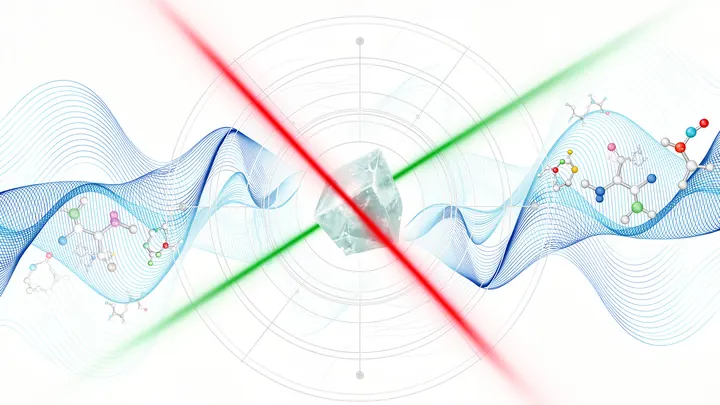
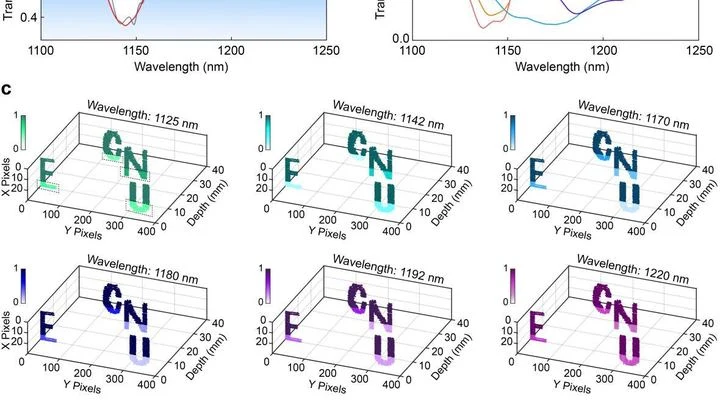
A warm cup or a human hand emits invisible light — mid-infrared radiation. Every substance absorbs this light in its own way, leaving a unique 'fingerprint'. From this fingerprint, you can tell what an object is made of without touching it.
Previously, seeing this fingerprint required huge lasers that fired very short pulses. They were expensive and complex.