How Nuclear Isomers Give Themselves Away with Gamma Flashes express
A collision of two neutron stars is a cosmic forge where the heaviest elements of the periodic table are hammered out in seconds. In 2017, detectors picked up gravitational waves from such a merger, and telescopes saw a flash — a kilonova. Its glow is powered by the decay of unstable nuclei born in the rapid neutron capture process (r-process). But this forge has quiet helpers that had previously gone unnoticed.
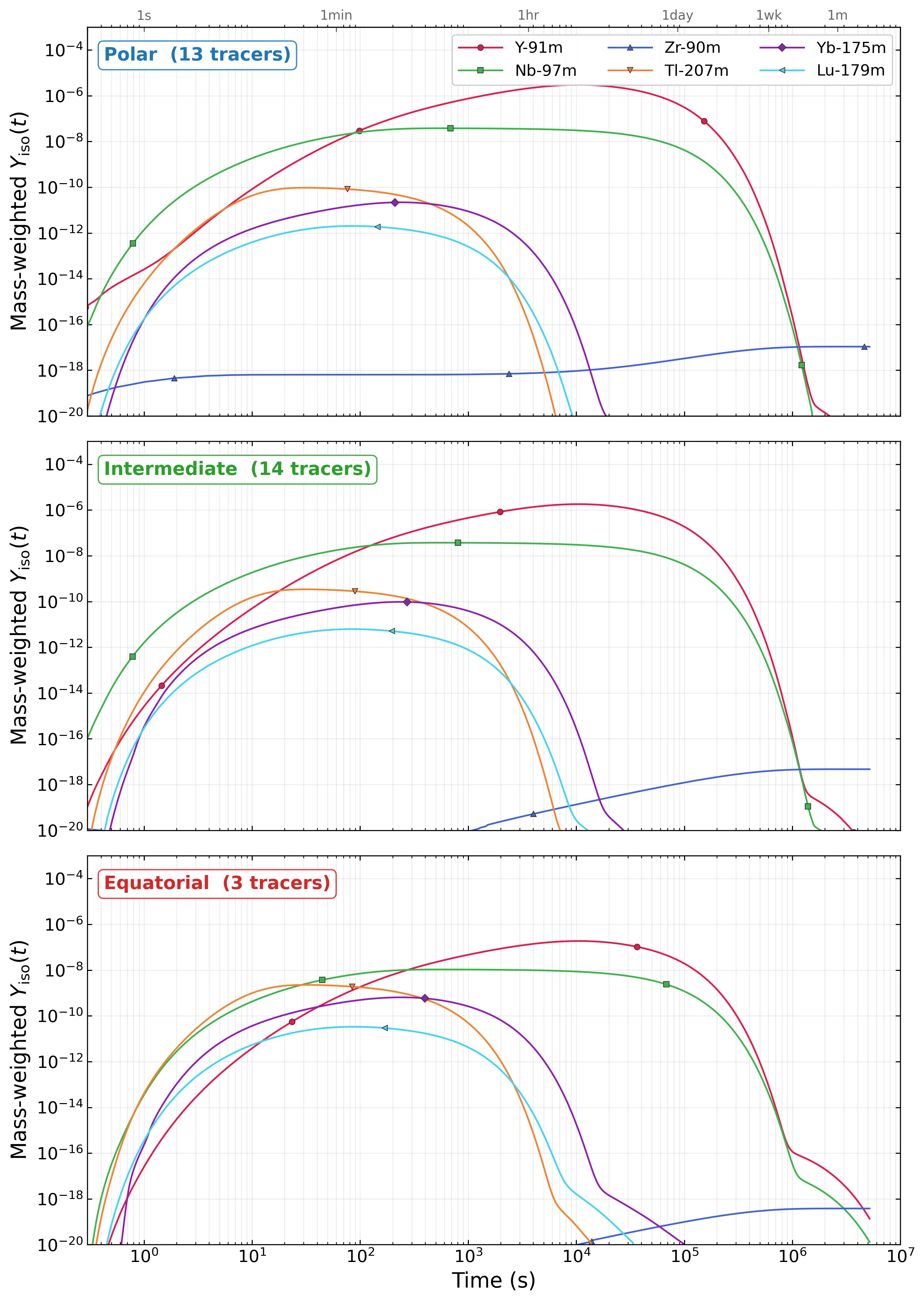
These are nuclear isomers — states in which a nucleus lingers for anywhere from fractions of a second to hours before shedding energy and settling into its ground state. Standard calculations have ignored them, assuming that after beta decay the daughter nucleus instantly calms down. The authors of this study, for the first time, tracked several isomers as independent players in the reaction. They calculated how temperature affects transitions between isomeric and ground states, and how beta decay populates different nuclear levels.
It turns out that two lines could be bright enough to be spotted by gamma-ray observatories like COSI, AMEGO, or LOX — if the explosion happened in our Galaxy. These are the 743.3 keV line from the isomer niobium-97 and the 555.6 keV line from yttrium-91. So far, the calculation covers only a small fraction of known isomers, but it is already clear: without them, the picture of the gamma-ray sky after a merger would be incomplete. The cosmic forge works more subtly than we thought, and now we have a chance to hear its quiet signals.
Some nuclear isomers live so long that they can be stored in a lab for years — for example, the hafnium-178 isomer has a half-life of 31 years.
In Peter Watts's novel Blindsight, alien probes use gamma-ray bursts to communicate — maybe isomer lines will one day help us decode cosmic messages.