Gamma-ray spectroscopy is the study of the highest-energy photons in the universe, typically above 100 keV. These photons arise from the most violent processes known: supernova explosions, matter falling into black holes, and the decay of radioactive nuclei. By measuring the energies and intensities of gamma rays, scientists can identify which isotopes are present in a distant object or a nuclear sample, and infer the physical conditions that produced them.
History
The field emerged in the 1950s with the development of scintillation detectors and, later, high-resolution germanium detectors in the 1960s. The first gamma-ray spectra from space were obtained by balloon-borne instruments in the 1960s.
How it works
Gamma rays interact with matter primarily through photoelectric absorption, Compton scattering, and pair production. Detectors such as germanium crystals or scintillators convert each incoming photon into a tiny electrical pulse whose height is proportional to the photon's energy. By sorting thousands of pulses into a histogram, a spectrum is built up showing characteristic peaks at specific energies — the 'fingerprints' of particular nuclear transitions.
In practice
Used in nuclear security to identify radioactive materials, in medical imaging (SPECT and PET scans), and in astrophysics to map gamma-ray sources like pulsars and gamma-ray bursts.
Fun fact
Gamma-ray spectroscopy can detect a single radioactive isotope in a sample weighing less than a microgram, even when it is mixed with tons of other material.
The gamma sky, captured by the Fermi telescope, is a grand symphony of thousands of sources. Here, the rhythmic pulsations of pulsars, the powerful chords of active galactic nuclei, but most of all — unidentified objects, whose part remains a mystery.
A collision of two neutron stars is a cosmic forge where the heaviest elements of the periodic table are hammered out in seconds. In 2017, detectors picked up gravitational waves from such a merger, and telescopes saw a flash — a kilonova.
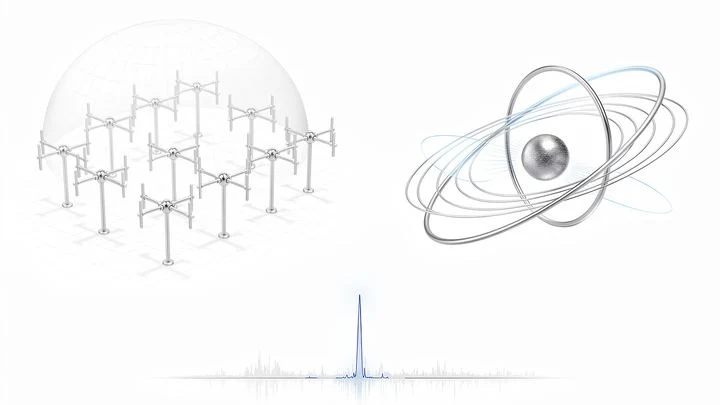
Listening to the cosmos requires patience and a finely tuned ear. Astronomers chose the most sensitive low-frequency instrument for this: the OVRO–LWA antenna array — 352 dipole antennas scattered across two and a half kilometers of California desert.
Deep in the Mediterranean Sea, where water presses down with the force of hundreds of atmospheres, a network of light-sensitive spheres waited for a rare guest. And it came — a neutrino that carried through the bulk of the Earth an energy comparable to the impact of a flying brick.
A translator gets distracted by every rustle in the hall, and a one-hour meeting stretches into two. Gluons, the particles that carry the strong force inside protons, behave much the same way. Usually, they dart back and forth, holding quarks together.
When a heavy nucleus slams into interstellar gas at enormous speed, it shatters into pieces. Those pieces (lithium, beryllium, boron) then fly onward, and their abundance in the cosmic-ray flux depends on how the breakup unfolded. Conventionally, one expected the proportions to shift smoothly with energy, like the taste of soup when you keep adding water.
When a massive star explodes, it hurls giant clouds of gas into space. These clouds, known as supernova remnants, can stretch across hundreds of trillions of kilometers. Two such clouds — G107.7-5.1 and G150.3+4.5—were recently studied by astronomers using a telescope in Turkey.
A gamma-ray burst is like a shot from a cosmic cannon: a brief but dazzling flash that outshines an entire galaxy for a few seconds. But when observed in the hardest gamma-ray band (photons with energies above a gigaelectronvolt), the signal often gets lost in the noise, like a whisper in a noisy hall.
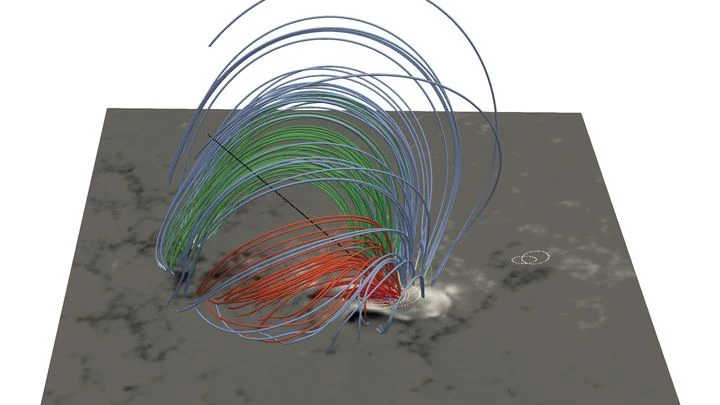
A solar flare is like thunder on a clear day: a short but powerful burst of energy. The MeerKAT radio telescope in South Africa caught one such M1.3-class flare and examined it with unprecedented clarity. Ordinary instruments see either bright details or faint ones, but not both at once.
Dark matter is like an invisible glue that holds galaxies together. It emits no light, but if its particles collide, gamma rays can flash. Scientists hunted for such flashes in dwarf galaxies — small stellar clusters with lots of dark matter and almost no ordinary matter.
A firefighter with a thermal imager can see the source of a fire through smoke. But how do you see a radiation source that has no smell, no glow, and no heat? Gamma cameras solve this problem: they capture gamma rays emitted by radioactive materials and overlay their 'trace' onto a regular photograph. The result is an image showing that the source is, say, behind the far door.
Sometimes you find a movie ticket from three years ago in the pocket of an old jacket. You can't reconstruct the time from it, but you can figure out where the owner went. The same goes for hot subdwarfs — tiny stars in the late stages of life that shine mostly in ultraviolet. Their light is like that ticket: it tells you about the past, but reading it is tricky.
A century ago, magnetic observatories recorded only the slow breathing of Earth's core. Today, their data have become hunting grounds for particle physics. At the Eskdalemuir Observatory in northern England, fluctuations of the magnetic field are recorded every hundredth of a second.