How Pressure Stops Black Holes from Being Born express
In the first moments after the Big Bang, the universe was filled with a hot, nearly uniform plasma. But in some places, the density could randomly be slightly higher. If such a clump gained critical mass, it collapsed into a black hole: this is how primordial black holes were born.
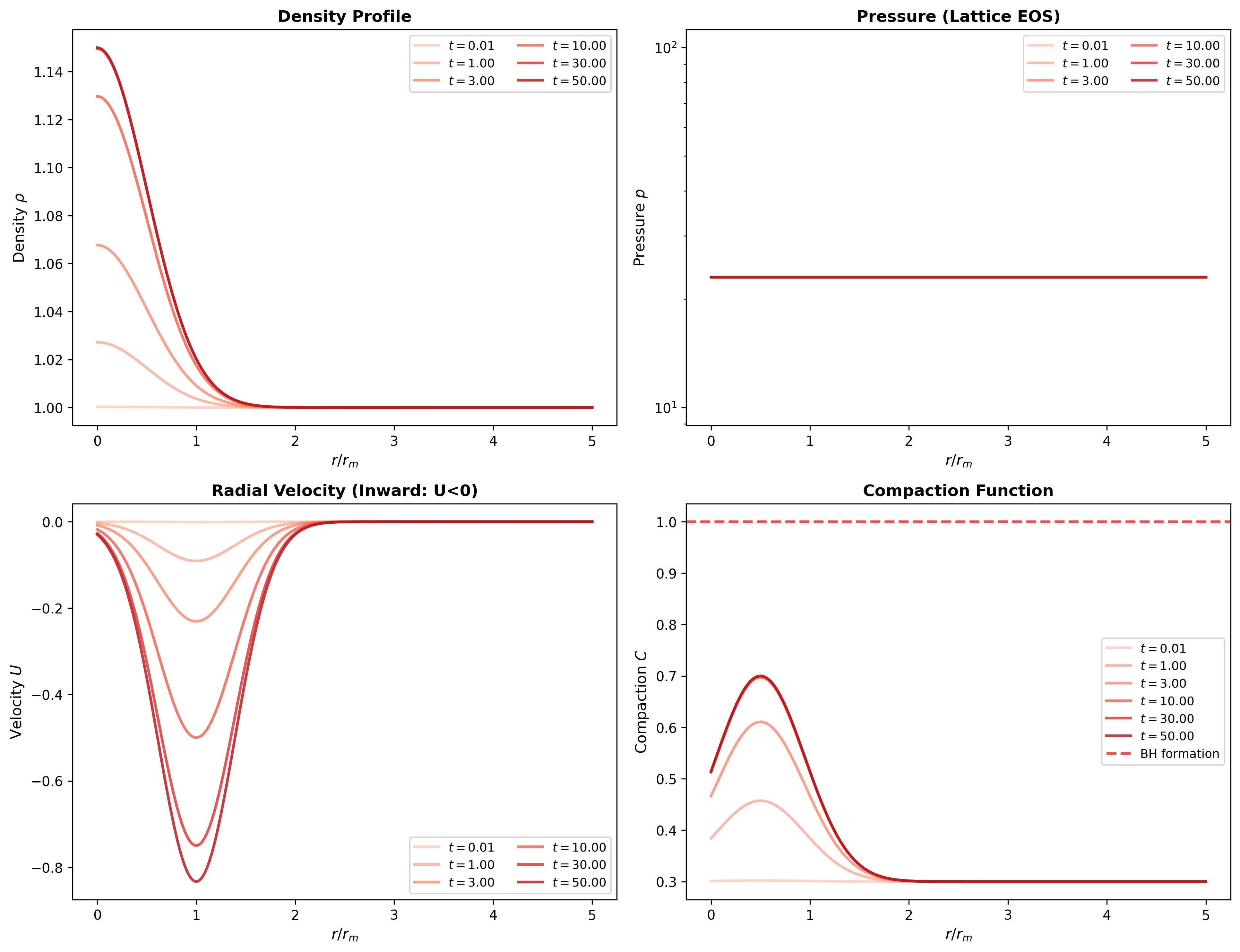
For a long time, theorists assumed that matter under those conditions behaved like radiation: pressure grew strictly proportional to density. But what if, under extreme compression, matter starts to 'stiffen'—its pressure skyrockets much faster? The authors of the study tested this idea using a simple model: they replaced radiation with a 'lattice gas'—a system where particles cannot occupy the same space. When density approaches the limit, sound in such a medium speeds up, and the matter desperately resists further compression.
The researchers ran a series of numerical simulations of spherically symmetric collapse within the framework of general relativity. They found that the threshold for black hole formation increased by 0.50±0.02% compared to the case of pure radiation. That's small, but enough to shift predictions about how many primordial black holes might have survived to the present day. Meanwhile, the critical mass exponent remained the same—0.357, within measurement uncertainty. This means the collapse mechanism near the threshold hasn't changed; it just takes a bit more initial density to trigger it.
In the densest part of a neutron star, sound can accelerate to nearly the speed of light — about 200,000 km/s.
In Bruce Sterling's novel 'Schismatrix', intelligent beings manipulate ultra-dense matter to build cities on neutron stars.