The 15 Solar Mass Threshold: How a Black Hole’s Mass Governs Its Spin ✛ ✎ ✦
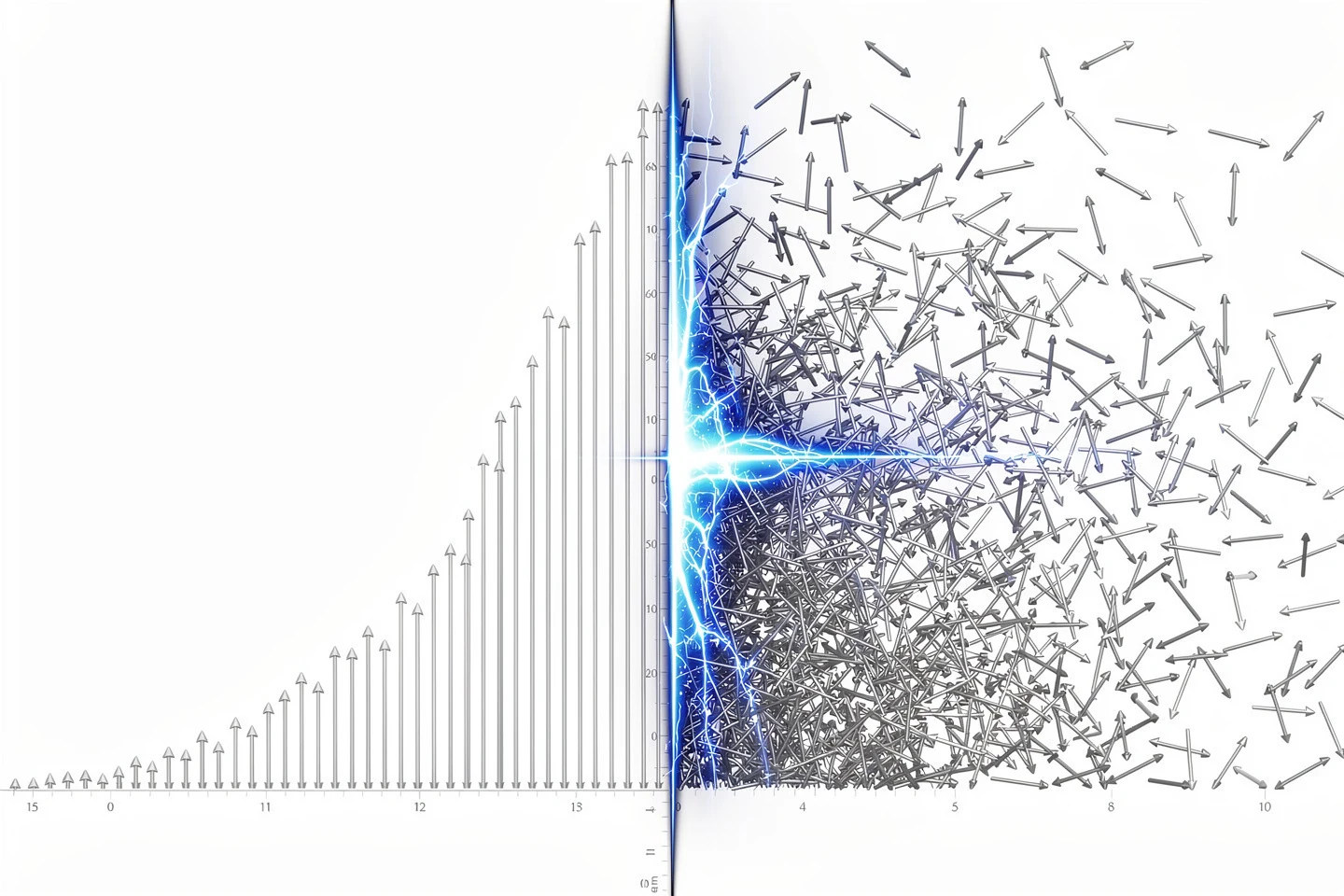
Objects predicted by Schwarzschild and now caught through gravitational waves (thanks to Weiss and LIGO) spin like tops when paired up. In some cases, their rotation is in sync: both spin in the same direction as the pair. In others, it's as if they were kicked out of alignment. An analysis of 259 mergers laid bare a sharp transition: if the heavier black hole is less than 15 Suns, its spin almost always 'points' along the orbit. Above that, the spins become chaotic, like tossed coins.
The 15-solar-mass boundary marks two evolutionary paths: the lightweights apparently get their main 'kick' during a supernova explosion (when the star's core, having exhausted its hydrogen and helium, fills up with carbon), while the heavyweights result from other processes. Interestingly, as it nears this limit, a black hole can spin up its rotation to near-light speeds, dragging the fabric of spacetime with it. Further observations will help piece together these dramatic histories in distant galaxies.
A 15-solar-mass black hole has an event horizon roughly the size of a small town — about 45 kilometers across.
In the film Interstellar, the rapid spin of the black hole Gargantua bends time. Real black holes, however, reveal their spin through gravitational waves.