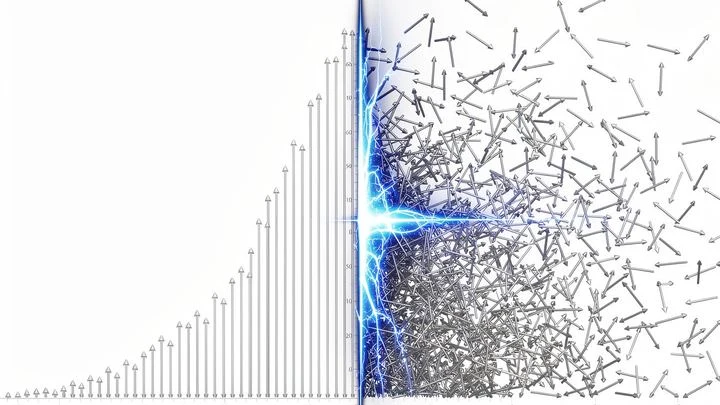
Gravitational wave echoes are hypothetical secondary signals that could follow the main gravitational wave burst from a compact binary merger, such as the collision of two black holes or neutron stars. While the primary signal is a strong, characteristic chirp produced by the inspiral and merger, echoes would appear as a series of weaker, repeating pulses shortly after. They are not part of standard general relativity predictions for black holes, which suggest that anything crossing the event horizon is lost and no further radiation escapes.
History
The concept gained prominence after the first LIGO detection in 2015, when a team led by Niayesh Afshordi and Vitor Cardoso proposed in 2016 that echoes could be a signature of quantum structure near black hole horizons. No confirmed detection has been made as of 2025.
How it works
The standard picture of a black hole merger ends with a single, distorted black hole that rings down, emitting gravitational waves at characteristic quasinormal frequencies that decay exponentially. Echoes would arise if the merged object is not a classical black hole but has some structure near the would-be horizon — for example, an exotic compact object with a reflective surface or a firewall. In that case, part of the gravitational wave energy would be reflected back and forth between the inner structure and the potential barrier outside, leaking out as a series of delayed pulses. The time delay between echoes would encode the size of the reflecting region, potentially revealing quantum gravity effects at the horizon scale.
In practice
Searching for echoes in LIGO and Virgo data is an active area of research that tests the classical black hole paradigm and probes quantum gravity, though no definitive detection has been reported.
Fun fact
If echoes exist, they would imply that black holes are not truly black but have a 'quantum hair' that reflects gravitational waves, potentially resolving the information paradox.
When two black holes merge far away, we receive a tremor of space — gravitational waves. Usually, they are described by Einstein's equations, but what if gravity works differently at the tiniest distances? The authors took one such hypothesis — Hořava–Lifshitz gravity.
The mergers of black holes, first predicted by Karl Schwarzschild, are the main source of gravitational waves picked up by LIGO detectors. Over the years, 259 events have accumulated, each one an encrypted birth story of a pair. But is there a hidden system in this data?
Two black holes spiraling toward each other resemble figure skaters in a pair spin: each rotates about its own axis, and together they weave a shared dance. This collective twist, the so-called effective spin, can be measured by astronomers from the gravitational waves rippling outward from the pair, like ripples on a pond.
LIGO, Virgo, and KAGRA detectors act like giant microphones, listening in on gravitational waves — vibrations of space itself. The new GWTC-5.0 catalog recorded 161 black hole mergers, bringing the total count to 390 events.
Two figure skaters glide on the ice. One is light and cautious, barely rotating. The other is massive and fast, spinning with all its might, and in different directions at that. That's roughly the picture painted by gravitational waves from black hole mergers.
When a neutron star and a black hole merge, they send out gravitational waves — ripples in spacetime that reach Earth. These ripples carry the imprint of their final dance: the orbit before the collision is often elongated, like an ellipse.
Two black holes spiral around each other not in a smooth dance, but like two stones thrown from opposite banks into a deep whirlpool. Their orbit resembles a highly flattened oval — the eccentricity is nearly one. When they finally collide, a powerful burst of gravitational waves is born — a shudder of space itself.
When two black holes spiral around each other and merge, they send ripples across the universe — gravitational waves. These waves carry the imprint of exactly how the objects moved before the collision. From the shape of this 'dance,' you can tell how closely the objects resemble perfect black holes.
Two black holes whirl faster and faster, draw closer, and merge into one. The space around them trembles — that tremor travels across the universe for billions of years and finally makes detector mirrors sway by a fraction of an atom. Scientists catch this signal and want to know exactly which holes produced it.