15 Solar Masses: The Spin Frontier of Black Holes ✛ ✎ ✦
The mergers of black holes, first predicted by Karl Schwarzschild, are the main source of gravitational waves picked up by LIGO detectors. Over the years, 259 events have accumulated, each one an encrypted birth story of a pair. But is there a hidden system in this data? Scientists suspected that across galactic expanses, an invisible sorter is at work, and the key to it is the mass of the primary black hole.
The central tool of investigation is the effective spin χeff, a clever blend of masses, individual spins, and tilt angles. Like a geological compass, it points to the formation conditions. If the spins are neatly aligned with the orbit, the ancestors probably evolved for a long time in a tight pair, where tides had time to “comb” their rotation. A wide scatter with balanced signs, on the other hand, is a trace of chaotic dynamics: the birth of a black hole with a gravitational kick.
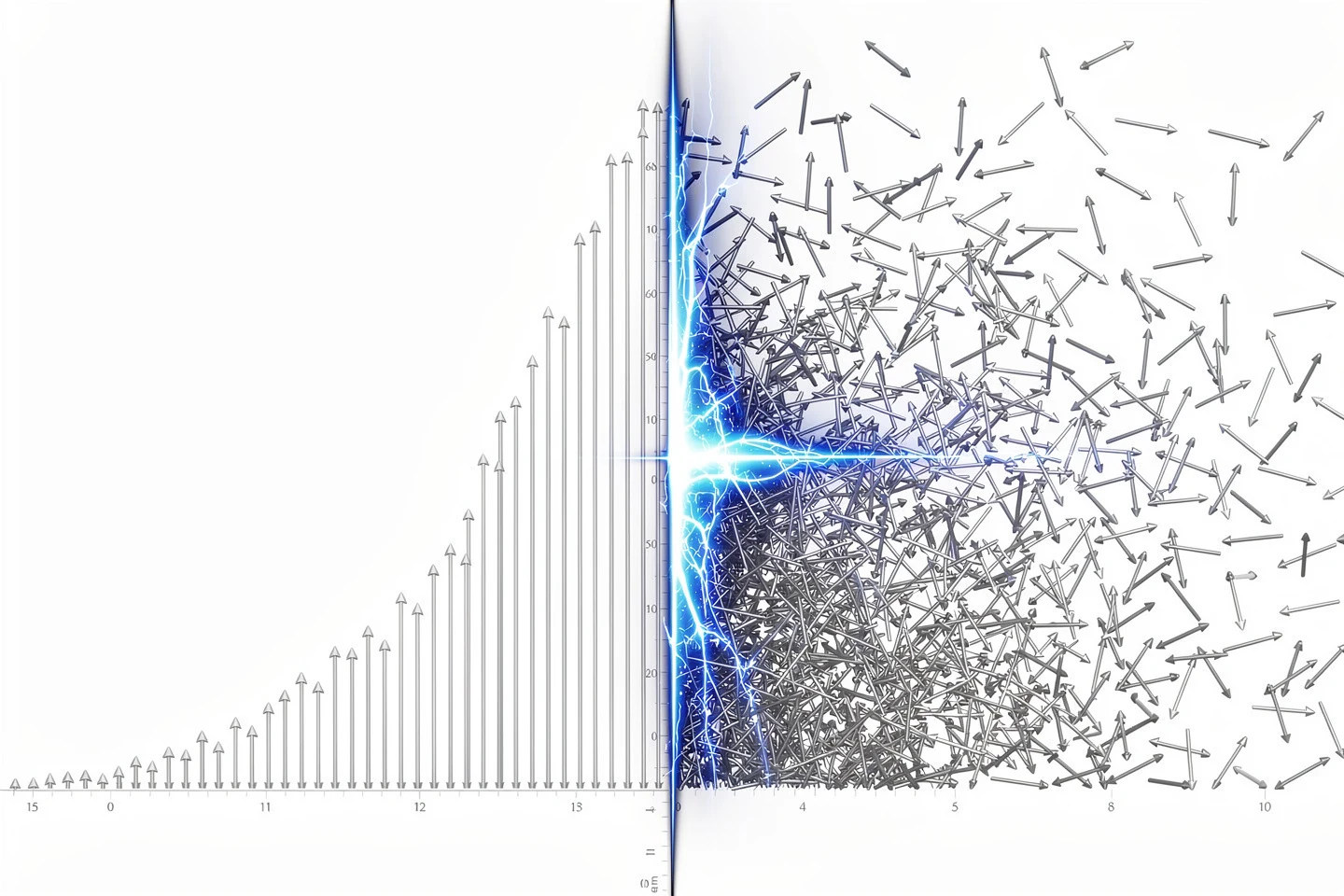
Analyzing the GWTC-5.0 catalog, researchers stumbled upon a clear boundary — a cosmic divide at around 15 solar masses. Below this mark, the χeff distribution is narrow, with a peak at +0.03 and a noticeable fraction of negative values, yet still skewed towards the positive. Above 15 M⊙, the picture changes sharply: the peak shifts to zero, and the spread doubles. It’s as if on one side of a ridge, calm rivers flow, while on the other, wild torrents churn everything in their path. The statistical significance of the difference exceeds 99%—this is no random fluctuation, but a genuine boundary between worlds.
This result challenges standard scenarios of isolated binary evolution. To explain the fraction of negative χeff in the low-mass population, we need either powerful natal kicks (≳100 km/s) during collapse into a black hole, often linked to exotic supernovae, or the intervention of a third body in a multiple system: gravitational maneuvers that can flip the spin. Thus, the chemical brew of the progenitor star (rich in hydrogen, helium, and synthesis of elements up to carbon) dictates the final impulse, and hence the fate of the newborn pair. Curiously, the 15 M⊙ threshold lies close to the boundary where massive stars shed their hydrogen envelope, exposing a helium core — perhaps this moment determines whether the hole receives a strong kick.
With next-generation detectors like Einstein Telescope and Cosmic Explorer, we will peer even further into the universe’s past and trace in detail how this spin boundary evolves with redshift. Improved simulations of collapse and triple-system dynamics will connect the microphysics of explosions to the large-scale picture of mergers. For now, 15 solar masses stands as a milestone on the map of the cosmos, reminding us that even in silent blackness, vivid stories of birth are hidden — stories we are only beginning to read.
The effective spin χeff is measured to hundredths, and its sign shows whether the black hole rotates in the same direction as the orbit or the opposite. For low-mass holes, positive values are more common, as if they prefer to “dance in the same direction.”
In Carl Sagan’s novel Contact, the alien signal from Vega contained encrypted gravitational-wave patterns. Today, we ourselves decipher “signals” from the depths of the universe to understand how black hole factories work.