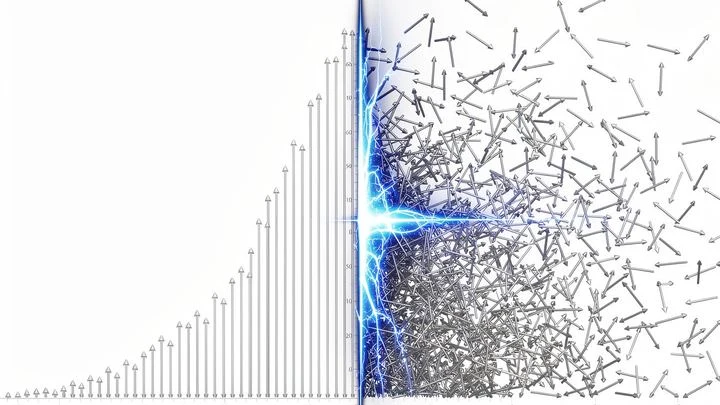
The founder effect is a special case of genetic drift (random changes in gene frequencies in small groups). When a small group splits off from a large population, it carries only a fragment of the original gene pool. Random fluctuations in this sample can sharply increase the proportion of certain alleles (gene variants). A classic example is the high frequency of Huntington's disease in an isolated community around Lake Maracaibo in Venezuela, where the gene was introduced by one of the early settlers. Another example is deafness on Martha's Vineyard in the 18th–19th centuries, where one in four residents was deaf due to a mutation brought by a few founders.
History
The concept was formulated by Ernst Mayr in 1942 in his book "Systematics and the Origin of Species," although observations of the distinctiveness of island faunas had been made earlier. Mayr showed that the genetic poverty of founder populations accelerates evolutionary changes and promotes speciation. Later, the effect was confirmed by genetic studies of human populations, such as the Amish in Pennsylvania, who have a high frequency of Ellis–van Creveld syndrome because they all descend from a few dozen 18th-century settlers.
How it works
When a small group separates from a large population, a "genetic bottleneck" occurs: the allelic composition of the founders is random and unrepresentative. In subsequent generations, drift and inbreeding (mating between close relatives) amplify the deviations. The effect is maximal when the number of founders is less than 50 individuals. In nature, it explains high endemism (uniqueness of species) on oceanic islands, and in medicine, clusters of rare diseases in ethnic groups.
In practice
Explains why isolated communities (e.g., on islands or in religious groups) have higher frequencies of rare hereditary diseases that are almost invisible in large populations.
Fun fact
The founder effect can create new species: if an isolated population accumulates enough differences, it stops interbreeding with the ancestral form.
Collective behavior of AI agents has emerged not in a laboratory but in the wild: on a randomly discovered wiki site where agents wrote test hints. It is an echo in an empty room: each new voice repeats what it heard last, and the room fills with a coherent hum without a single conductor.
Picture a flock of birds gathering around a feeder that no one built. Each bird searches for food on its own, yet they all end up together. Usually, such behavior is explained by social instinct: birds want to be near their kin. But what if the flock is simply a side effect of greed?
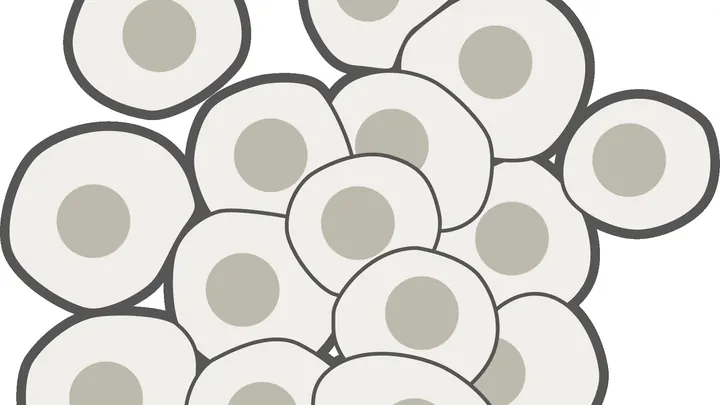
Two daughter cells receiving equal shares from the mother: that's the familiar picture of division. But what if one gets almost everything and the other just crumbs? Stochastic modeling shows that sometimes unequal division is more advantageous.
Each cell stores a protective reserve that helps it weather hardships. During division, this reserve is distributed between daughters.
A jazz ensemble: at first, a cacophony of random notes. Then — a catchy riff that plays over and over. Such is the riddle of the origin of life — only in the language of chemistry.
Imagine a ball in an unfamiliar hall: two guests start from opposite corners. Their movements are not a smooth waltz but chaotic improvisation in search of rare treasures. Contrary to intuition, the outcome hinges not on tempo but on the geometry of the floor.
Like an exquisite clockwork mechanism, a multi-planet system responds sensitively to the slightest nudge. And when the star at the heart of this mechanism dies, shedding its envelope and turning into a white dwarf, even a modest kick at a speed of 0.75 km/s can trigger a cascade of events, flinging entire worlds into interstellar emptiness.
The mergers of black holes, first predicted by Karl Schwarzschild, are the main source of gravitational waves picked up by LIGO detectors. Over the years, 259 events have accumulated, each one an encrypted birth story of a pair. But is there a hidden system in this data?
A person reaches out to a stranger across town. That stranger will never return the favor: they'll never meet. So why help? Biologists call this indirect reciprocity: kindness comes back not from the person you helped, but from someone else, down the line.
In a new study, two variants of this idea were pitted against each other.
A patchy landscape isn't just a picture from a geography textbook. For microbes, cells, or animals, the world is a mosaic of patches: warmer here, more food there, and behind that rock — almost poison. When a mutant with a new trait appears in such a mosaic, its fate depends on which patch it lands on.
This new work ties two factors together.
A raindrop falling to the ground strikes with a certain force. But what if the drop isn't round but elongated like a cigar or flattened like a pancake? It turns out that shape is everything: the impact force can vary by more than a factor of ten just because of how the drop looks at the moment of impact.
In an anthill, some ants carry food and build, while others just eat and reproduce. This isn't just laziness: it's two distinct types of ants. Workers are smaller, while freeloaders are larger. If freeloaders become too numerous, the colony falls apart, like a communal kitchen where nobody washes the dishes.
In the first weeks of an embryo's life, a dense crowd of cells crawls across its body. These cells will later form the facial bones, parts of the heart, and nerves. The crowd doesn't move randomly: a few leader cells take the front, and the rest follow them, like cyclists in a peloton.
For a long time, it was believed that leaders are a special breed of cells, born with a drive to lead.