Spin Secrets of Low-Mass Black Holes: a Transition at 15 Solar Masses ✛ ✎ ✦
Context
Mergers of binary black holes, first predicted by Karl Schwarzschild, are the main source of gravitational waves detected by observatories such as LIGO. The origin of these systems remains one of the central problems in astrophysics. The effective spin χeff is a key observable, carrying information about the masses, spins, and orientations of the components. Different formation channels predict distinct spin distributions, from aligned spins in isolated evolution to chaotic ones in dense clusters. Understanding these differences is essential for reconstructing the evolution of massive stars and stellar population dynamics in galaxies.
Methods
The study uses data from 259 confident events in the GWTC-5.0 catalog, detected by gravitational-wave observatories. Population analysis was performed using hierarchical Bayesian inference, modeling the χeff distribution as a mixture of two components separated by a transition mass ˜m, which was inferred directly from the data. The components were described non-parametrically with Gaussian processes, avoiding prior assumptions about their shape. A parametric model was also used for robustness checks. To exclude artifacts, 100 simulated catalogs with a smooth, mass-independent spin distribution were generated.
Results
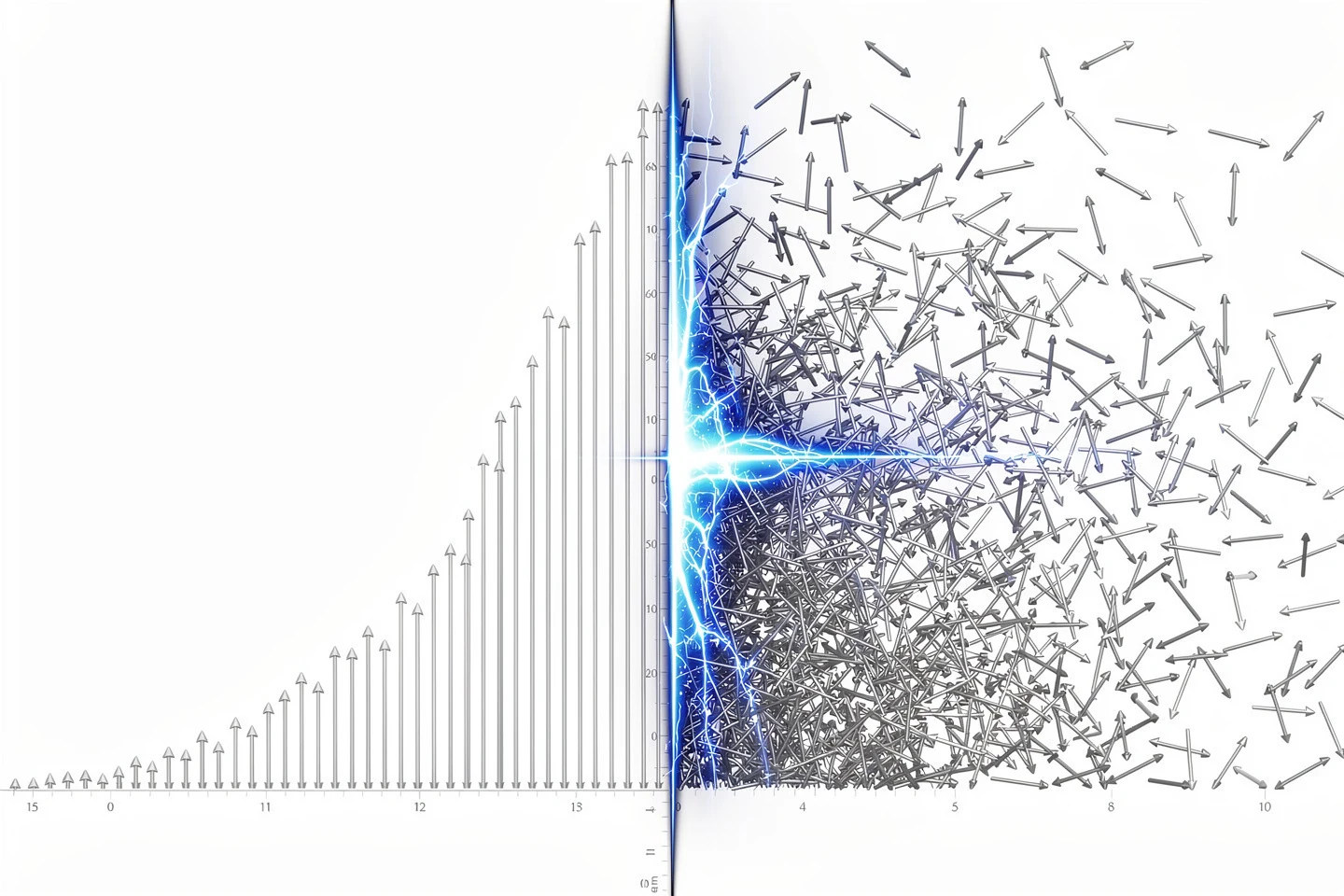
A pronounced transition is found at ˜m = 15.2+4.3–3.6 M⊙. Below this, the χeff distribution is narrow (width ~0.05), peaking around +0.03, but with a noticeable fraction of negative values. Above the transition, the distribution becomes significantly broader (~0.12), the peak shifts toward zero, and positive and negative spins occur almost equally often. The difference between the two populations is statistically significant at >99% level for the medians. Simulations show that such a transition cannot arise from random fluctuations with a mass-independent spin distribution. Importantly, the result is robust to the exclusion of individual unusual events like GW241011 and GW241110.
Implications
The results show that the dominant merger population with masses around 10 M⊙ is statistically distinct from the rest. This challenges the universality of isolated binary evolution scenarios, which in their standard form cannot reproduce the fraction of negative χeff. The explanation requires either large natal 'kicks' (recoils) during collapse into black holes (≳100 km/s), linked to supernova physics, or dynamical effects in triple systems. Thus, the origin of low-mass black holes turns out to be closely tied to the final stages of massive star evolution, where hydrogen and helium in the envelopes, as well as nucleosynthesis up to carbon, play important roles.
Future development
In the future, with accumulating data from current and planned detectors (LIGO, Virgo, KAGRA, and third-generation ones like Einstein Telescope and Cosmic Explorer), it will be possible to refine the detailed structure of the transition and study its dependence on redshift. Improved modeling of stellar collapse and supernova hydrodynamics will help clarify the mechanisms of black hole birth with large impulses. Progress is also expected in direct numerical simulations of triple and multiple systems, allowing predictions to be compared with data.
Impact
The work spans a wide range of fields: from gravitational wave physics and compact object astrophysics to the theory of massive star evolution and dynamical astronomy. It also stimulates research in nuclear astrophysics, where processes during core collapse are critically important.
Next steps
Further steps include detailed comparison of population synthesis predictions for triple systems with an expanded event sample, as well as searching for additional markers, such as the distribution of mass ratios and eccentricity. More thorough investigation of the dependence on metallicity and environment is planned.
Key open problems
The discovered spin boundary is directly connected to unresolved questions: what are the typical natal kick velocities of black holes? How often do massive stars form in triple and higher-order systems? How effectively does tidal interaction synchronize spins in tight binaries? Answering these questions will fill gaps in our understanding of the final stages of stellar evolution and the nature of the population of gravitational-wave sources.
The knowledge machine's view
This section is addressed to the author of the paper and their colleagues. Neighbouring works were found by meaning-based search across our archive, not by word overlap. We do not review: we show the field around the work.
What the work does
The study analyzes the distribution of effective spin χeff for 259 events from the GWTC-5.0 catalog using hierarchical Bayesian inference with nonparametric modeling of a two-component mixture. A statistically significant transition is found at a mass of ~15 M⊙: below this value, spins are narrowly distributed with a peak near +0.03; above it, the distribution is broader and nearly symmetric about zero.
Where its strength is
The strength of the work lies in directly inferring the transition mass from the data without prior assumptions about the shape of the distributions, which allowed a clear boundary between two black hole populations to be identified.
Where it could go next
- It might be interesting to compare the observed transition with the analysis of orbital eccentricity in mergers: if low-mass systems form dynamically, this could manifest in residual eccentricity.based on: Eccentricity: a magnifying glass for gravitational waves arXiv:2607.16136v2
- A nearby work on signatures of hierarchical mergers suggests that some events above the transition may be linked to black holes that have undergone a previous merger, which could explain their broader spin distribution.based on: The Smoking Gun of Hierarchy: Black Holes Betray Their Ancestors arXiv:2607.01121v1
- If the transition is related to different evolutionary pathways, it would be useful to compare with studies on the cosmological impact of primordial black holes: perhaps some low-mass objects have a non-stellar origin.based on: Cosmic Hot Tap: How Primordial Black Holes Rewrite the Speed of the Universe arXiv:2607.18528v1
Worth trying
- Check whether residual eccentricity correlates with mass and spin in the same sample, using methods from 2607.16136v2.
- Estimate the fraction of events above the transition that are consistent with the hierarchical merger model, following the analysis in 2607.01121v1.
- Combine constraints on primordial black holes from 2607.18528v1 with the obtained mass distribution to assess the possible contribution of non-luminous matter.
Why this may matter
The discovered transition could serve as a key test for models of binary black hole formation and may indicate the existence of a separate formation channel for low-mass systems, which is important for understanding massive star evolution and stellar cluster dynamics.
Nearby works in our archive
- Twin Black Holes: Why Light Ones Are Lazy and Heavy Ones Are Topssimilarity 0.69
- Black Holes Are Sorted by Weightsimilarity 0.66
- Eccentricity: a magnifying glass for gravitational wavessimilarity 0.66
- Cosmic Hot Tap: How Primordial Black Holes Rewrite the Speed of the Universesimilarity 0.65
- Black Holes Where You'd Least Expect Them: Solving the Mass Gap Mysterysimilarity 0.65
- The Hidden Spin of Black Holessimilarity 0.63
- The Smoking Gun of Hierarchy: Black Holes Betray Their Ancestorssimilarity 0.63
The closest work in the archive sits at 0.69 by meaning — the usual level for our corpus.
The Sun's mass is about 2×10³⁰ kg, and a typical 15 M⊙ black hole has an event horizon radius of only about 45 kilometers — less than the distance from San Francisco to San Jose.
In Carl Sagan's novel 'Contact' and the film of the same name, the signal from the Vega system contained encrypted gravitational-wave patterns. Today, we ourselves decode 'signals' from the depths of the universe to understand how black hole factories are built.
Key numbers
- transition mass: 15.2+4.3–3.6 M⊙
- number of mergers in catalog: 259
- spin distribution width below transition: 0.05
- spin distribution width above transition: 0.12