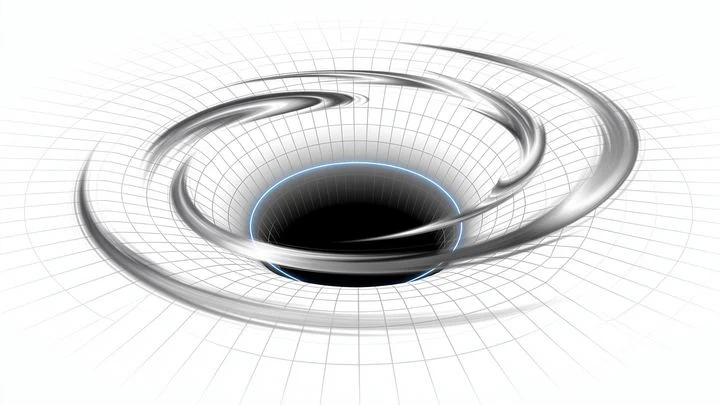
An analog black hole is a laboratory system that reproduces the essential physics of a gravitational black hole's event horizon using a different medium, such as flowing water, ultracold atomic clouds, or optical fibers. The idea is that the mathematical description of a horizon—where the flow speed exceeds the local wave speed—applies to any system with waves, not just gravity. These analogs allow researchers to study Hawking radiation and other horizon effects in a controlled setting, since real black holes are impossible to observe directly.
History
The concept was proposed by William Unruh in 1981, who noted the mathematical analogy between sound waves in moving fluids and scalar fields near a black hole.
How it works
In a typical setup, a fluid (or a Bose-Einstein condensate) is made to flow faster than the speed of sound in a localized region. Sound waves traveling against the flow are swept downstream, creating a sonic horizon. Quantum fluctuations near this horizon produce phonon pairs, one escaping and one trapped, mirroring Hawking radiation. In optical analogs, a pulse of light in a nonlinear medium creates a refractive index change that acts as a horizon for other light waves.
In practice
Used to test predictions of quantum field theory in curved spacetime, such as Hawking radiation and the thermodynamics of horizons, without needing a real black hole.
Fun fact
The first laboratory observation of a sonic analog of Hawking radiation was reported in 2016 using a Bose-Einstein condensate of rubidium atoms.
A network of radio telescopes scattered across the planet catches the whisper of a distant black hole. Each antenna records a signal, but how do you combine these recordings if the clocks at the stations tick at different rates and the atmosphere distorts incoming waves?
A black hole is a maze with no way out. But what happens to the information inside? To test this, physicists didn't fly to the nearest hole; instead, they built a tiny replica on a quantum processor. The maze was played by a chain of 32 superconducting qubits, where each step leads only forward, like a one-way corridor.
A black hole is not just a vacuum cleaner. It glows faintly, emitting particles — this idea was proposed by Jacob Bekenstein, who connected the hole's temperature to its degree of disorder. Detecting such radiation in space is incredibly difficult.
The universe as painted in Einstein’s textbooks is a smooth four-dimensional canvas. But string theory adds a frame of extra dimensions — invisible, yet tangible to gravity. Imagine our universe as a membrane that trembles under the pressure of hidden layers.
In 2019, the image of the M87* shadow was a sensation: for the first time, humanity saw the outlines of a black hole, predicted by Schwarzschild and shrouded in myth. But what if that glowing crescent isn't a portrait of an absolute abyss, but of a cosmic portal?
Stephen Hawking showed that black holes, regions with gravity so strong that even light cannot escape, emit particles and eventually evaporate. This process is called Hawking radiation. But a question arises: where does the information about what fell into the hole go?
An ordinary kettle: you heat it up — temperature rises, molecular chaos grows, and steam shoots out. But in the lab, they've created a peculiar "kettle"—an analog black hole made from superconducting circuits cooled to the extreme.
At the heart of an active galaxy, where interstellar gas spirals into a dazzling accretion disk around a supermassive black hole, a boundary is born through which even sound cannot break. This acoustic horizon was long considered frozen ripples on water.
When light swings past a massive body like a black hole, its path warps — an effect predicted by Einstein. New research has taken into account that near such objects, clouds of hadrons often swirl — the very particles we know from protons and neutrons in atomic nuclei.
Water flowing through a pipe can become a trap for sound. If the flow speed exceeds the speed of sound in water, then sound waves trying to go against the current can no longer escape: they are swept away, like light beyond a black hole's horizon.
In the quantum world, electrons can behave like waves. If you create the right conditions for them, these waves start to feel something akin to gravity. In crystals known as Weyl semimetals, electrons move as if they were massless, and their energy depends on direction, like a tilted cone.
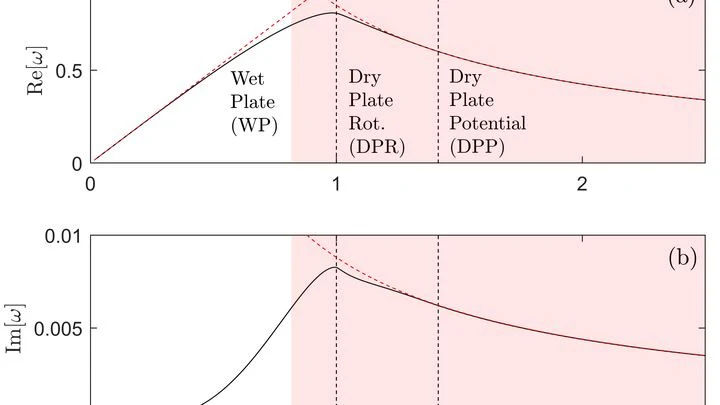
When liquid is swirled in a cup, a vortex with an empty center forms. In this empty core, waves find a trap: bouncing off the walls, they siphon energy from the vortex and grow like a flame along a fuse — each wave stronger than the last, until a surge breaks loose.
Astrophysicists have described the same chain reaction around black holes.