Simple

How to Spot the Invisible Backbone of Galaxies

Original: "Polar coordinate transformations for machine learning based dark matter subhalo detection in strong gravitational lenses"
arXiv:2607.02663v1 · 2026-07-02 · CC BY · ⏱ 1 min · Galaxies Cosmology
A simple twist on space images improves the hunt for dark matter clumps.
Abstract

Gravitational lensing acts like a giant cosmic magnifying glass, smearing the light of far-off galaxies into long arcs. Scientists have figured out a way to better pick out traces of tiny dark matter clumps in those arcs — just by 'rotating' the image in a clever way. Could a simple geometric trick like this bring us closer to cracking the dark matter puzzle?

Links in the knowledge graph 1

Modern science describes the Universe with the standard model, where it all started with the Big Bang and continues to expand thanks to dark energy. But the most mysterious part of this story is dark matter – an invisible scaffold that keeps galaxies from flying apart. You can't touch it, but its gravity bends light like a lens – that's gravitational lensing. Sometimes, this distortion turns a distant galaxy into a bright ring, with tiny clumps of dark matter hidden inside.

Back in the 1930s, Fritz Zwicky noticed galaxies moving too fast and suggested invisible mass. Later, Vera Rubin proved it by studying star rotation.

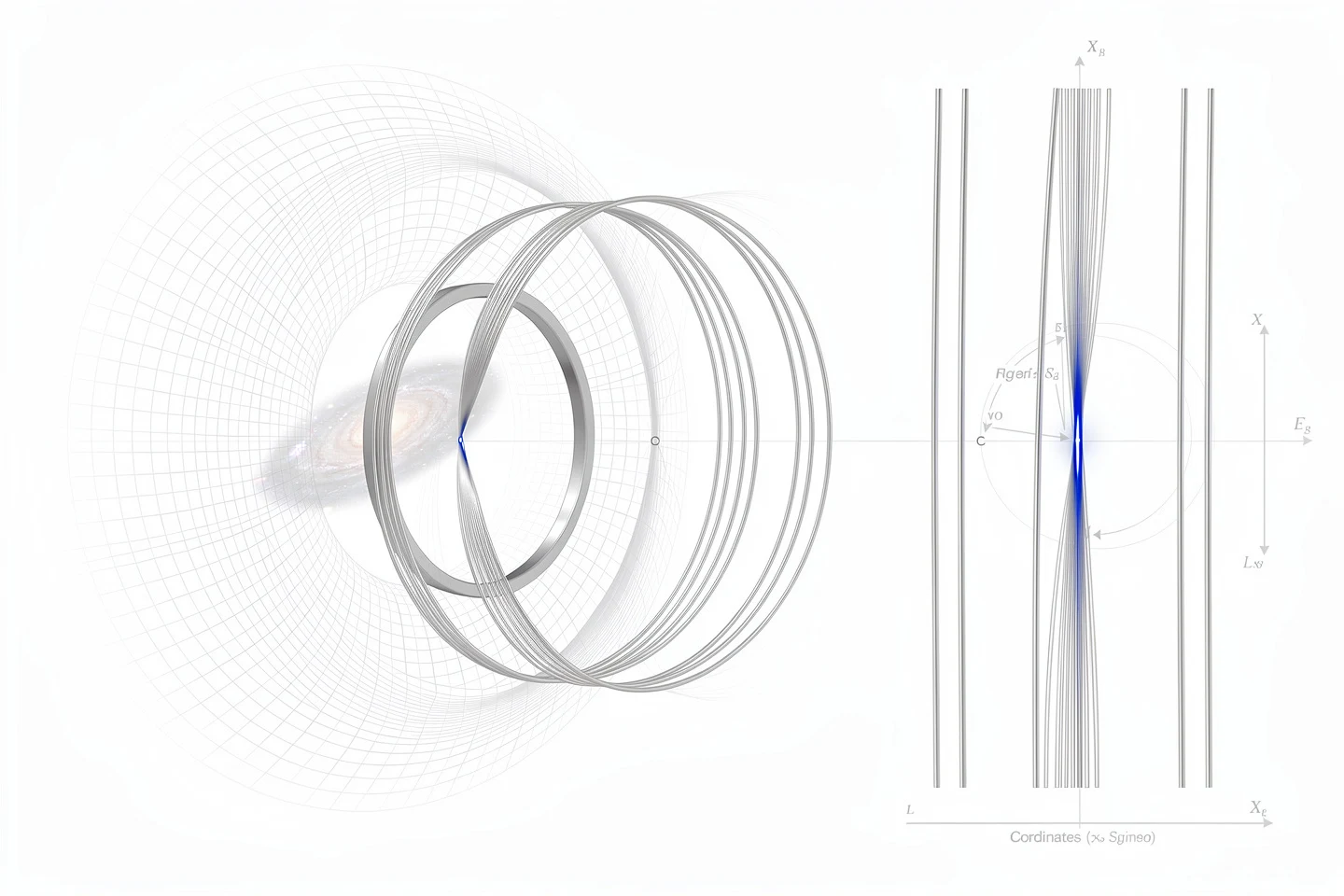
Researchers trained a program to find these clumps in images from the Hubble telescope. Usually, a computer sees an image like a sheet of graph paper. But a lens ring is round. So the scientists simply cut it and straightened it into a line, like a carousel ribbon. On a straight path, any bumps are immediately noticeable. This twist of the data let the program spot even the tiniest clumps more often.

The Hubble telescope, named after Edwin Hubble, has been operating in orbit for over 30 years and has captured numerous images of gravitational lenses.

Confidently detecting these tiny dark matter clumps will help us understand what it's made of – like guessing a soup recipe from its crumbs. The number of clumps depends on the properties of its particles. This new method will speed up solving the biggest cosmic mystery.

🎯 By some estimates, billions of dark matter particles zip through an ordinary room every second — you just don't notice them.

🎬 In Liu Cixin's sci-fi novel 'The Dark Forest,' gravitational lenses are used as colossal antennas for interstellar communication — almost like in real cosmology.

\rho(r) = \frac{M_0}{4\pi r (r + r_s)^2} \left( \frac{r_t^2}{r^2 + r_t^2} \right)
\rho — dark matter density at radius r, r_s — scale radius, r_t — truncation radius, M_0 — mass scale.
L = \frac{1}{N} \sum_{i=1}^{N} \left[ \frac{(\hat{y}_i - \mu_i)^2}{2\sigma_i^2} + \log \sigma_i \right]
L — loss value for N images, \hat{y}_i — true logarithmic mass, \mu_i and \sigma_i^2 — predicted mean and variance.
Scientists
Alan GuthAndrei LindeGeorges LemaîtreJames PeeblesAdam RiessBrian Schmidt
Tags
dark matter gravitational lensing Hubble Space Telescope galaxy Standard Model big bang dark energy
Laws
Friedmann equationsHubble's lawgravitational lensingNoether's theoremEinstein field equationsPlanck's law
Original: arXiv:2607.02663v1 · CC BY · bridge42worlds