Polar Coordinates Improve Detection of Dark Subhalos in Strong Lenses ✛ ✎
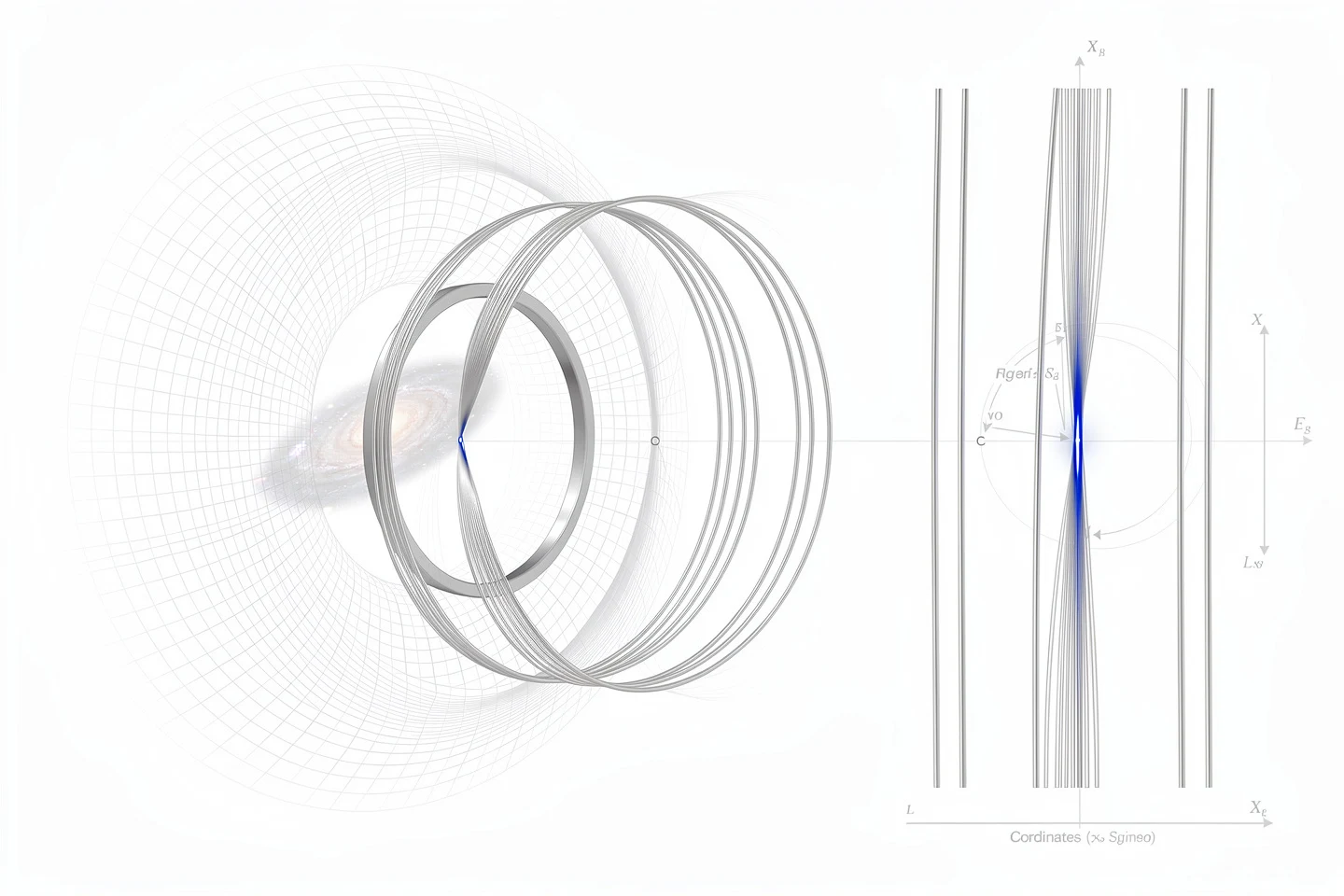
Context
Within the standard model that describes the evolution of the Universe from the Big Bang and includes dark energy, the nature of dark matter remains one of the biggest unsolved mysteries. On galactic scales, dark matter forms hierarchical structures, including galactic halos and populations of subhalos whose mass is sensitive to the specific dark matter model. Detecting these subhalos, especially completely dark ones, is only possible through their gravitational influence—for example, via perturbations in the arcs of strong gravitational lensing. Early pioneers of dark matter research such as Fritz Zwicky and Vera Rubin demonstrated the need for hidden mass, and observations with Hubble, named after Edwin Hubble, made it possible to study gravitational lenses in distant galaxies.
Methods
The study used simulated observations of the Hubble Space Telescope (WFC3 IR camera, F160W filter) at different signal-to-noise ratios (50 orbits and 1 orbit). The images contained a single subhalo modeled with a truncated NFW profile, set against a smooth lensing potential with multipole distortions. The data were transformed from Cartesian to polar coordinates: for each grid point (64×64 in radius and angle), pixel values were bilinearly interpolated. The neural network architecture is based on ConvNeXt-Tiny with ImageNet pretraining and a special regression head that predicts the mean and log variance of the mass. The loss function is the negative log-likelihood, incorporating aleatoric uncertainty. Four variants were compared: Cartesian/polar inputs, with random initialization and with pretraining.
Results
In all tested regimes (high and low signal-to-noise ratio, subhalo concentrations c=60 and c=30), networks trained on polar data achieved a better detection fraction. For subhalos with masses from $10^9$ to $10^{9.5}$ M⊙, the improvement was about 15% compared to the Cartesian representation. Pretraining also significantly improved the results, and the relative advantage of the polar transform increased with decreasing subhalo mass and when moving to less concentrated profiles (c=30). In the low signal-to-noise case, the gain narrowed to 1–5% but persisted for sources with faint magnitudes. The networks successfully separated confident from unconfident predictions using an uncertainty threshold, allowing unreliable estimates to be filtered out.
Implications
The study shows that a simple polar transform is an effective way to improve feature extraction from strong lensing images without modifying the neural network architecture. This is especially important for future large surveys (for example, with Hubble and its successors), where rapid processing of large data volumes is required. Improved detectability of low-mass subhalos will help place tighter constraints on the subhalo mass function, which in turn will narrow down the viable dark matter models and shed light on the "core-cusp problem".
Future development
Further development of the method will involve testing on realistic simulations with multiple subhalos, as well as on real observational data, where precise centering of the polar grid will be required. In addition, it is promising to explore combining the polar transform with other architectures, such as U-Net for segmentation or transformers, and to compare it with group equivariant convolutions that inherently account for rotational symmetry.
Impact
The results will impact observational cosmology and particle astrophysics, providing a more reliable tool for indirect detection of dark matter through gravitational lensing. This also advances the methodology of applying deep learning in astronomy, where accounting for data symmetries can significantly boost performance.
Next steps
The next steps include adapting the method to real telescope data, including images from Hubble, and testing the robustness of the polar transform advantage in the presence of multiple subhalos or complex lens configurations.
Key open problems
This work is directly connected to the fundamental problem of the nature of dark matter and the small-scale issues of the standard cosmological model, in particular to determining the subhalo mass function, which critically depends on the properties of dark matter particles. Improved detection of subhalos via strong lensing brings us closer to distinguishing between cold, warm, and self-interacting dark matter, one of the key challenges in modern physics.
The knowledge machine's view
This section is addressed to the author of the paper and their colleagues. Neighbouring works were found by meaning-based search across our archive, not by word overlap. We do not review: we show the field around the work.
What the work does
This study explores how converting strong gravitational lens images into polar coordinates affects a neural network's ability to detect dark subhalos. Using simulated Hubble data, the authors compared four training setups (Cartesian vs. polar inputs, with random initialization vs. pretraining) and showed that the polar representation boosts detection rates by up to 15% for subhalos with masses of 10^9–10^9.5 M⊙, especially at lower masses and less concentrated profiles.
Where its strength is
The key strength of this work is demonstrating that a simple coordinate transformation, without changing the network architecture, noticeably improves feature extraction from ring-like lens structures. This is a practical, computationally cheap trick that easily transfers to other image analysis tasks with axial symmetry.
Where it could go next
- One could examine how the polar transformation pairs with uncertainty-aware methods already used for subhalo detection in strong lenses. For instance, the archive contains a review of a work where a neural network catches invisible dark matter clumps, possibly using a similar confidence estimation scheme—comparing approaches might yield new ideas for reducing false positives.based on: Polar Flip: How Neural Networks Catch Invisible Clumps of Dark Matter arXiv:2607.02663
- It would be interesting to test whether the polar representation helps in analyzing subhalo perturbations in more complex scenarios, such as lensing by triple systems or in the presence of vector dark matter, where subhalo structure may differ from the standard NFW profile. The archive has a review of a work on vector dark matter producing invisible stars, which could provide alternative models for testing.based on: Triple Thread: How Vector Dark Matter Gives Birth to Invisible Stars arXiv:2607.18025v1
Worth trying
- Test the polar transformation on data from other instruments (e.g., JWST) to see if the gain persists at higher resolution and with different noise properties.
- Use rotation augmentation in polar coordinates to enlarge the training set without additional simulations.
- Try combining polar and Cartesian representations in a two-stream network to extract features from both the radial structure and fine details.
Nearby works in our archive
- Polar Flip: How Neural Networks Catch Invisible Clumps of Dark Mattersimilarity 0.79
- Invisible Particles Leave Their Mark on Ancient Lightsimilarity 0.68
- Triple Thread: How Vector Dark Matter Gives Birth to Invisible Starssimilarity 0.67
- Dark Matter Leaves Traces in the Ripples of Spacesimilarity 0.66
- Dark Matter Ignites a Gamma Glow Around the Sunsimilarity 0.66
- How to See the Invisible Web of the Cosmossimilarity 0.66
The archive is crowded around this work: 9 reviews nearby, closest at 0.79. This ground is well walked — and there is plenty to compare against.
If you turn an Einstein ring into a straight line using polar coordinates, the neural network begins to 'see' it as an ordinary texture, reminiscent of the trick with cylindrical anamorphosis, where a distorted image makes sense when viewed from the right angle.
In Liu Cixin's novel 'The Dark Forest', gravitational lenses are mentioned as a tool for interstellar communication, and the idea of 'unfolding' an image around the center of mass echoes the concept of transforming space to extract hidden information — almost like a lie detector for dark matter.
Key numbers
- increase in detection fraction: ~15% for subhalos with masses 109–109.5} M⊙
- subhalo concentrations: c=60 and c=30
- HST orbits for SNR: 50 orbits (high) and 1 orbit (low)
- pixel scale: 0.08 arcseconds/pixel
- image size: 64×64 pixels