Polar Vision: How to Unfold a Gravitational Lens and Find Traces of Dark Matter ✛ ✎
Almost a century after Fritz Zwicky suspected something was amiss in the motion of galaxies in the Coma cluster, and Vera Rubin measured stellar velocities in spiral arms, the nature of dark matter remains one of the most vexing mysteries. Within the Standard Model, it is responsible for structure formation after the big bang and, together with dark energy, orchestrates the expansion of the Universe. But what is it made of? The answer may be hiding in the tiniest details — in the abundance and properties of subhalos, miniature clumps of dark matter that swarm inside larger галактических halos like a beehive around a hive.
These clumps cannot be seen directly. The only way is to detect their gravitational influence, and here gravitational lensing takes the stage. When a massive galaxy or cluster distorts the light of a distant source, arcs and Einstein rings appear — cosmic mirages captured by instruments such as Hubble Space Telescope, named after Edwin Hubble. Each subhalo embedded in the lens leaves a barely perceptible ripple on these light patterns. However, extracting the signal from the noise is like trying to hear a whisper at a rock concert.
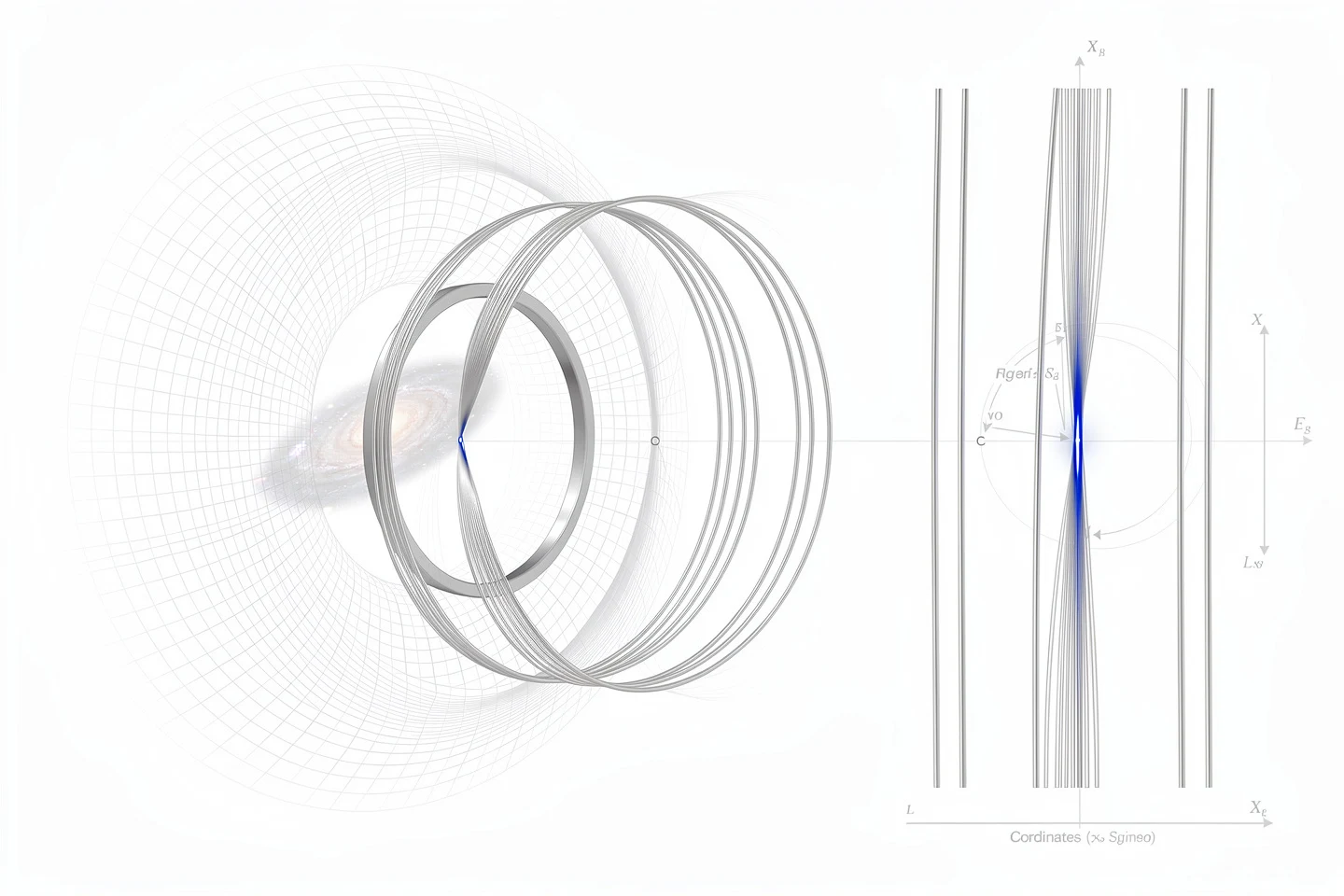
The idea is simple and elegant. Instead of feeding rectangular images with twisted arcs to the network, the scientists transformed the images into polar coordinates. A 64×64-pixel frame was unrolled like a scroll: along radius and angle. As a result, the ring turned into a striped fabric, where any irregularities from subhalos become visible texture distortions. The ConvNeXt-Tiny architecture, pre-trained on ImageNet, predicted the mass of the hidden clump with uncertainty estimation. Comparing performance on the same data in Cartesian and polar form, the researchers found: for subhalos with masses from $10^9$ to $10^{9.5}$ solar masses, the fraction of reliable detections increased by almost 15%. The advantage was especially pronounced for the lightest and most diffuse clumps — precisely those that carry key information about the physics of тёмной материи.
The anamorphosis metaphor works in reverse too: for many decades, we looked at gravitational lenses through the prism of Cartesian geometry and saw only a chaotic tangle of arcs. The polar transform is a turn of the cylinder that brings the image into clarity. Now, knowing this, we can tune telescopes and neural networks to look at the Universe from the right angle. In the future, the method will be tested on realistic simulations with many subhalos and on real data from Hubble's successors — Euclid and the Nancy Grace Roman Space Telescope. If it all works, we will obtain a map of dark clump distribution with unprecedented detail. And that is a direct path to answering whether dark matter is cold, warm, or self-interacting — a fork in the road that determines all of microphysics.
Turning an Einstein ring into a straight line using polar coordinates makes the neural network 'see' it as ordinary texture — it's reminiscent of cylindrical anamorphosis, where a distorted image gains meaning only from the right angle.
In Liu Cixin's novel 'The Dark Forest,' gravitational lenses serve as tools for interstellar communication, and the transformation of a ring into a line echoes the idea of unfolding space to extract hidden information — almost like a lie detector for dark matter.