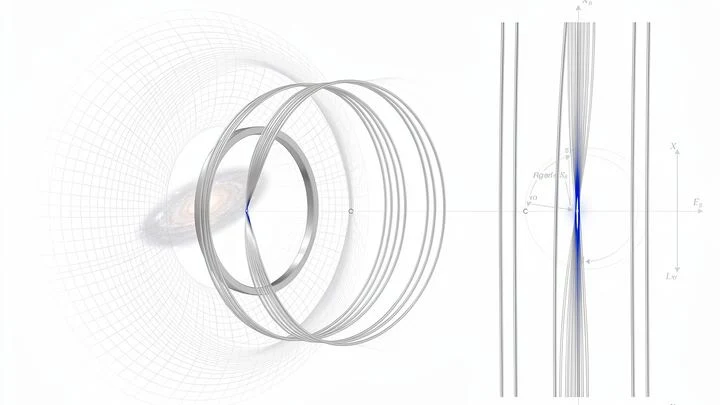
Gravitational lensing analysis uses the bending of light by massive objects to map the distribution of matter in the universe, including dark matter. When light from distant galaxies passes near a massive foreground object, its path is curved, creating distorted, magnified, or multiple images. By analyzing these distortions, astronomers can infer the mass distribution of the lensing object, even if that mass is invisible, such as dark matter.
History
The theory of gravitational lensing was first derived by Einstein in 1936, but the first complete gravitational lens was discovered in 1979. Weak lensing became a major cosmological tool in the 1990s and 2000s.
How it works
The gravitational field of a massive object acts like a lens, deflecting light rays according to general relativity. In strong lensing, this produces dramatic effects like Einstein rings and multiple images. In weak lensing, the distortion is subtle, but by statistically analyzing the shapes of many background galaxies, astronomers can map the dark matter distribution. The degree of distortion depends on the mass and distance of the lens, allowing precise measurements of cosmic structure.
In practice
Gravitational lensing is used to map dark matter in galaxy clusters, measure the expansion rate of the universe, and detect exoplanets via microlensing. It also helps test modified gravity theories.
Fun fact
A single galaxy cluster can act as a gravitational lens, producing multiple images of the same background galaxy, sometimes arranged in a near-perfect Einstein ring.
Dark matter is the invisible scaffolding of the universe. It's there, we know from the motion of stars and galaxies, but what this scaffolding is made of remains unknown. One guess is ultra-light particles similar to axions. They barely interact with ordinary matter, yet occasionally they do get involved.
In the galaxy NGC 1052 DF2, stars move at only 8 kilometers per second, as if there were no invisible mass around. For comparison: in our Milky Way, outlying stars accelerate to 200 kilometers per second, held by a massive dark matter halo.
A light ray passing by a massive body gets deflected: this is the effect of gravitational lensing, familiar from images of distant galaxies. The astrophysicists started with a rotating black hole (Kerr spacetime) and added a tiny correction to how light itself propagates.
When a distant planet passes in front of its star, it briefly blocks part of the light. Astronomers call this a transit and judge the planet's size by the depth of the dip. But light has a property: a massive body acts like a lens. Even a giant planet can slightly bend the star's rays, and the dip becomes a bit shallower than you might expect.
Ever since Fritz Zwicky noticed that galaxy clusters were moving too fast, and Vera Rubin measured the rotation of spiral arms, dark matter has remained cosmology's greatest mystery.
The standard model of cosmology, based on the field equations proposed by Einstein, describes the Universe as a cocktail of dark matter (discovered thanks to Vera Rubin) and dark energy in roughly a 1:3 ratio.
Almost a century after Фриц Цвикки suspected something was amiss in the motion of galaxies in the Coma cluster, and Вера Рубин measured stellar velocities in spiral arms, the nature of тёмной материи remains one of the most vexing mysteries.
Light from a distant galaxy travels across the universe, passing through vast clumps of dark and ordinary matter. Their gravity slightly bends the path of the rays, like a river's current flowing around invisible boulders. In images, this shows up as a barely noticeable elongation of galaxy shapes, as if they were stretched on an invisible frame.
In the 1930s, Fritz Zwicky first noticed that galaxies in clusters were moving too fast — something invisible was holding them. Later, Vera Rubin measured the rotation of spiral galaxies, confirming that space is permeated by dark matter.
Through the ripples on the water, pebbles at the bottom of a pool look shifted and warped. In a similar way, the gravity of invisible dark matter bends the light of distant galaxies — a phenomenon known as weak lensing.
Two black holes smash head-on at full speed — while a third one circles nearby. In ordinary life, such a crash would produce a burst of gravitational waves (ripples in space, like the ripples from a stone thrown into a pond). But here, part of the ripple passes by the massive neighbor, and changes, like light in a funhouse mirror.
Photographing the vicinity of a black hole is like shooting a fountain: a short exposure freezes the droplets, a long one blends everything into blurry streaks. Light from the superheated gas swirling around the hole reaches us along different paths. Some rays curve around it in an arc, others make multiple loops due to spacetime curvature.
When light swings past a massive body like a black hole, its path warps — an effect predicted by Einstein. New research has taken into account that near such objects, clouds of hadrons often swirl — the very particles we know from protons and neutrons in atomic nuclei.
A galaxy is like a giant merry-go-round: stars and gas whirl around the center, and their speeds reveal how much stuff is on the ride. If we only saw the luminous matter, the outer parts would spin slower than observations show. So there must be invisible mass, dark matter, that holds the galaxy together.
A distant galaxy, similar to our Milky Way, is blowing gas into space like a hair dryer blowing dust off a table. Seven beams of light from an even more distant object pierced this gas cloud, and astronomers saw that the gas flow is narrow, like a jet from a hose, not wide like a fan.
In the dark depths of space lurks invisible matter. It doesn't shine, but its pull holds galaxies together. Usually, we assume dark matter obeys the same laws of gravity as tables and chairs. A new study offers a different perspective: dark matter might subtly alter gravity itself.
Dark matter is like an invisible glue that holds galaxies together. It emits no light, but if its particles collide, gamma rays can flash. Scientists hunted for such flashes in dwarf galaxies — small stellar clusters with lots of dark matter and almost no ordinary matter.
Light from distant galaxies passes through clumps of matter, and the gravity of those clumps slightly bends its path, like a lens. By measuring how much the images of distant galaxies are distorted, we can infer the distribution of matter and how gravity affects light.
The night sky is full of stars, but they are only a small part of everything that exists in the universe. Astronomers have long noticed a strange thing: galaxies rotate so fast that they should fly apart, yet they don't. Something invisible holds them together, like invisible threads linking beads on a spinning wheel.
This "something" was named dark matter.
Three distant galaxies spin like giant carousels. Their stars and gas move along spiral arms, and from the speed of this motion you can calculate how much total matter the galaxy contains — visible and invisible.
Astronomers combined two views: radio telescopes revealed cold gas, while the James Webb Space Telescope showed the stars.
Supermassive bodies warp space, turning into a lens that bends light from distant objects. Such spacetime curvature allows astronomers to see the invisible. Recently, this method helped detect a hidden clump with the mass of a million Suns.
Dark matter is the invisible scaffold of the Universe, revealing itself only through gravity. Vera Rubin, studying the rotation of galaxies, found that stars at the periphery move too fast, as if held by an unseen mass. This became compelling evidence for the existence of dark matter, yet its particles still elude direct detection.
Astronomers have found an invisible object in the Universe weighing just a million Suns — for cosmic scales, that’s a mere trifle, a hundred times lighter than anything they’ve been able to “weigh” at such distances. The object itself doesn’t shine, but it gave itself away by bending the light from an even more distant galaxy.
A silicon sphere 166 nanometers in diameter floats in a beam of infrared laser light. The pressure is below 10⁻⁸ mbar, and the motional temperature is about 10 millikelvin. That is colder than the cosmic microwave background.