Two Quantum Sensors Peek Inside a Living Cell express
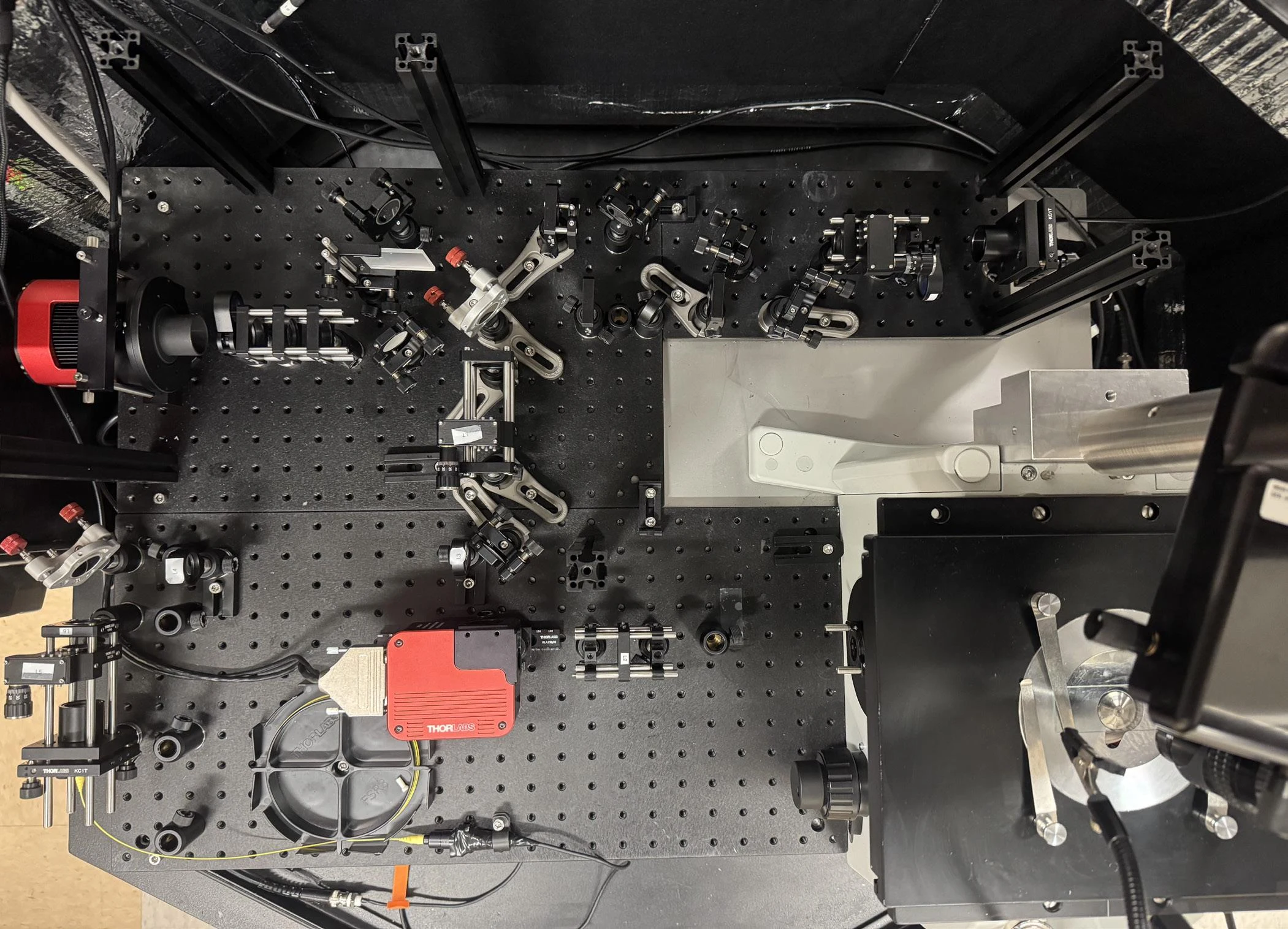
A living cell constantly emits faint magnetic signals, as if whispering. Scientists eavesdrop on this whisper with two microscopic 'microphones'—magnetic field sensors. One is crafted by nature (a protein), the other is a man-made diamond speck with a flaw (pure carbon) that turns it into an antenna.
The microscope interrogates both sensors in turn: it shines a blue beam on one, a green beam on the other (a technique of spectroscopy — working with color). The sensors respond with their own glow, which is measured with unprecedented precision: this is where photometry (the science of light pulses) comes in. Even the molecular chaos inside the cell (entropy, the measure of disorder) doesn't drown out these signals.
Two sensors in one cell create a stereo effect: just as two ears pinpoint sound more accurately, two sensors provide a three-dimensional picture. The technology, grown from experiments in quantum control by David Wineland, promises to monitor neurons and drugs. If quantum entanglement, the mysterious connection studied by John Stewart Bell, links the sensors in the future, precision will multiply.
Original abstract
as written by the authors arXiv:2607.03552
Two revolutions in quantum sensing are converging on the same microscope stage. Biological qubits have emerged as genetically encoded, optically addressable quantum systems inside live cells. Solid state spin based qubits have been entangled and used as nanoscale correlator magnetometers, delivering sensitivity and spatial-resolution gains that single-spin probes cannot reach. Here we report a pulsed quantum microscope that enables simultaneous quantum state manipulation of both qubit technologies in live cells. The platform combines nanosecond-gated optical excitation at 450 nm and 520 nm, three-dimensional diffraction-limited addressing by galvo beam scanning and piezo objective focus, rapidly switched static and radio-frequency magnetic fields, single-photon timing with picosecond resolution, and microwave control for frequencies from DC to 5 GHz, including the 2.87 GHz resonance of solid state spins, the 500 MHz to 800 MHz resonance of radical pairs in biological qubits, and any future qubit resonance in the GHz range. Live cell imaging with simultaneous biological and solid state nanoparticle qubits in the same cell demonstrates the power of this technique for multiplexed quantum sensing. We anticipate this approach will open new opportunities for researchers to explore quantum sensing in live cells, and, ultimately, entanglement between a solid-state qubit and a protein-hosted spin qubit.
Some proteins in the eyes of migratory birds can sense Earth's magnetic field, acting as natural quantum compasses.
Reminiscent of the medical tricorder from 'Star Trek': it peers into cells and deciphers their magnetic whispers.