Atoms Get Entangled in Space: A New Kind of Quantum Link express
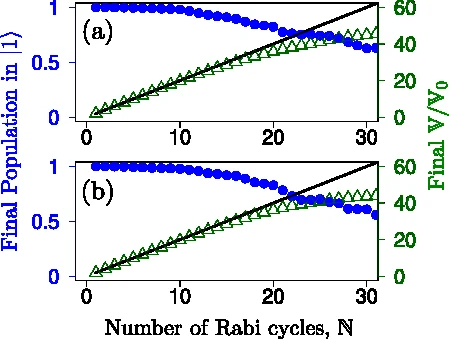
Usually, quantum entanglement links internal properties, but here, for the first time, the positions of two atoms are entangled. Like a pair of dancers, one can move only if the partner freezes — but which one moves is unknown beforehand due to quantum uncertainty.
The secret lies in giant atoms: with precise laser spectroscopy, an electron jumps to a distant orbit, and the atom swells thousands of times. These bloated atoms strongly repel each other and cannot be excited simultaneously. In the experiment, a laser pulse traveling at the speed of light nudged one atom. If it became a giant, the second froze — and vice versa. Thus, position entanglement was born: one shifted, the other not, but which one — undetermined.
The distance between possible positions is hundreds of microns. For atoms, it's like separating two people by kilometers. This spatial entanglement promises to be a bridge between stationary quantum elements and flying light particles in future networks.
Between Rydberg atoms, forces act that are comparable to the gravity of small bodies — and this despite their purely electric nature.