Cosmic Mirage: How the Solar Bubble Is Reshaping the Map of the Universe express
The cosmological debate is like two craftsmen measuring the same wall but getting different lengths. One uses a tape measure, applying it to nearby landmarks — Cepheids (pulsating beacon stars) and Type Ia supernovae (flashes of dying stars). He finds the wall is stretching at 73.5 arbitrary units. The other looks at an ancient pattern — the cosmic microwave background (light left over from the Big Bang)—and gets 67.4. The difference is nearly 9%, and this contradiction has been dubbed the "Hubble tension."
The new explanation suggests we should look not at the wall but at the tape measure itself. More precisely, at the medium in which it sits. Our solar system floats inside a huge bubble, the heliosphere, created by the solar wind. Beyond its boundary, in interstellar space, plasma is heated to tens of thousands of degrees. This hot cocoon is full of energetic particles that can affect light passing through it.
The authors calculated that if light from Cepheids and supernovae is slightly altered as it passes through this hot "lens," our detectors could systematically overestimate distances. The effect is small but insidious: it could account for up to 8% of the observed discrepancy. After accounting for corrections (inhomogeneity of the medium, partial compensation during calibration), the realistic contribution is estimated at 3–8%. This doesn't rule out other hypotheses, but it adds an important nuance: part of the puzzle may be hiding right under our noses.
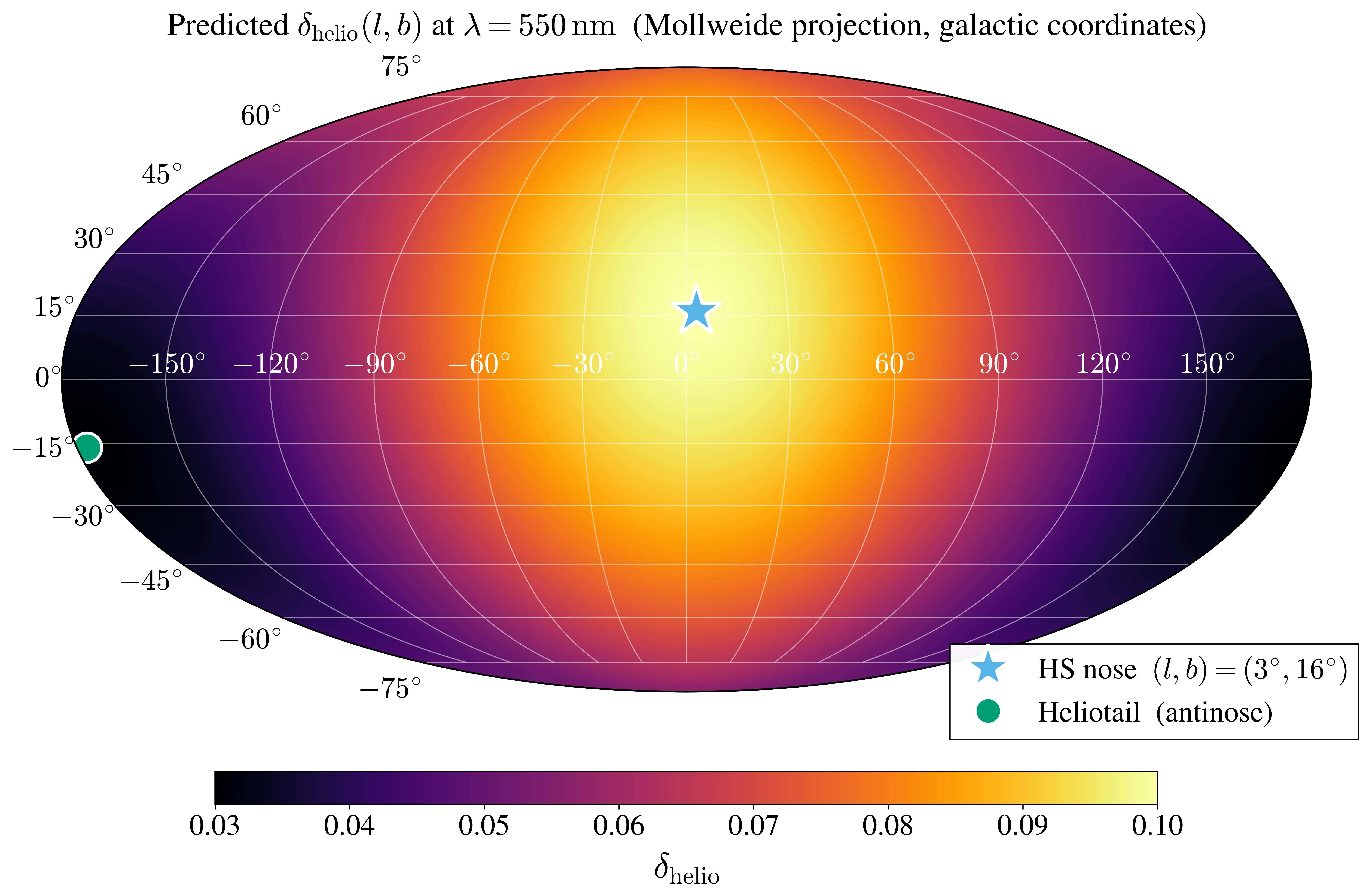
So the circle closes: the tape measure we trusted so much has itself been affected by heat and pressure. To test this idea, scientists propose looking for subtle differences in starlight depending on direction — where the heliosphere is thinner or denser, the distortions should be stronger. This turns an annoying interference into a new tool for studying our cosmic home.
Original abstract
as written by the authors arXiv:2607.07741
The Hubble tension (HT) represents one of the most significant discrepancies in modern cosmology, with local distance measurements yielding $$H_0 = 73.5 \pm 1.4$$ km/s/Mpc while cosmic microwave background (CMB) observations predict $$H_0 = 67.4 \pm 0.5$$ km/s/Mpc. We propose that this tension arises from systematic effects introduced by our Solar System's heliospheric (HS) environment on local distance measurements. The HS creates a complex medium of heated plasma and energetic neutral atoms (ENAs) beyond the heliopause (HP), where interstellar medium (ISM) temperatures rise significantly. This thermal gradient and particle environment may systematically affect observations of Cepheid variables and Type Ia supernovae (SNe~Ia) used in the local cosmic distance ladder (CDL), biasing distance measurements and artificially inflating the measured Hubble constant. We present theoretical calculations showing how HS effects could account for up to $$\sim 8\%$$ of the observed 8--9\% discrepancy, with the realistic contribution lying in the $$\sim 3$$--$$8\%$$ range once anisotropy, partial calibration cancellation, and chromatic suppression are included, and discuss observational tests to validate this hypothesis.
The temperature inside the heliospheric bubble can reach millions of degrees, but because the matter is so extremely rarefied, a spacecraft flying through it would not melt: there simply wouldn't be enough particles to transfer heat to it.